🚢
SHIP SURVEYS
SECTION 1 — INTRODUCTION TO SHIP SURVEYS
1.1 What is a Survey?
📖 Definition: A ship survey is an official inspection of a ship — its structure, machinery, equipment, and documents — carried out by a surveyor to confirm that the ship meets the required standards of safety, seaworthiness, and environmental protection.
Surveys are required by international conventions (SOLAS, MARPOL, Load Line), national maritime administrations (Flag States), and Classification Societies. Without valid survey certificates, a ship cannot legally trade internationally.
⚓ Key Point: Think of a ship survey like the annual vehicle inspection (Pollution Under Control / Fitness Certificate) for a car — except ships have many different types of surveys, each checking different aspects of the ship.
1.2 Who Conducts Surveys?
Surveyor Type | Who They Are & What They Survey |
Flag State Surveyor | Government officials from the ship's flag state (e.g., Indian DGS surveyors for Indian-flagged ships). Conduct statutory surveys — issue SOLAS, MARPOL, Load Line certificates. |
Classification Society Surveyor | Surveyors from IACS member societies (Lloyd's Register, DNV, Bureau Veritas, ClassNK, ABS, etc.). Conduct class surveys — issue Class Certificates (Certificate of Class). |
Recognized Organization (RO) | Classification societies authorized by a flag state to conduct statutory surveys on their behalf. Most statutory surveys are actually done by ROs under flag state authorization. |
Port State Control Officer (PSCO) | Port state inspectors who verify ships meet international standards. They check certificates and may conduct operational tests. They do NOT issue certificates. |
Vetting Inspector (Private) | Oil company inspectors (SIRE, CDI) who assess tanker condition for commercial vetting — not statutory, but important for trading. |
1.3 Why are Surveys Important?
To ensure the ship is seaworthy — structurally sound and safe to go to sea
To ensure the ship complies with international conventions (SOLAS, MARPOL, STCW, Load Line)
To maintain the ship's Classification — without class, the ship cannot get P&I Club insurance, and cannot trade
To protect the crew — safe machinery, firefighting, lifesaving equipment
To protect the marine environment — oil pollution prevention, garbage management
To satisfy Port State Control — a ship with expired certificates will be detained
To satisfy charterers and cargo owners — ship must have valid certificates to load cargo
⚠ Important: Loss or suspension of class is a serious condition and may affect statutory certification, insurance and trading. However, statutory certificates do not automatically disappear in every case: the Flag Administration/RO must assess the consequences and take the appropriate statutory action. Class and statutory status should therefore be treated as related but legally distinct.
1.4 Key Organisations Involved
Organisation | Abbreviation | Role |
International Maritime Organization | IMO | Creates international conventions (SOLAS, MARPOL). Does not survey ships directly. |
International Association of Classification Societies | IACS | Umbrella body for major class societies. Sets unified requirements (URs) for structural standards. |
Lloyd's Register | LR | UK-based classification society — one of the oldest |
Det Norske Veritas | DNV | Norwegian class society — world's largest by tonnage |
Bureau Veritas | BV | French class society |
American Bureau of Shipping | ABS | US-based class society |
Nippon Kaiji Kyokai | ClassNK / NKK | Japanese class society |
Indian Register of Shipping | IRS | Indian classification society — surveys Indian-flagged ships |
Directorate General of Shipping | DGS | Indian Flag State administration — issues statutory certificates |
SECTION 2 — CLASSIFICATION OF SURVEYS
2.1 Two Main Categories
Category | Description |
STATUTORY SURVEYS | Required by law (international conventions and national regulations). Conducted by or on behalf of the Flag State Administration. Result in statutory certificates (e.g., Safety Construction, IOPP, Load Line). Mandatory — ship cannot operate without these. |
CLASS SURVEYS (Non-Statutory) | Required by the Classification Society to verify compliance with its rules for hull and machinery. They lead to maintenance/renewal of class. Classification is legally distinct from statutory certification, although it is normally essential for insurance, finance, chartering and commercial operation. |
📝 Note: In practice, most flag states authorize their recognized classification societies to conduct both statutory AND class surveys at the same time. So the same surveyor does both — saving time and cost.
2.2 Survey Classification by Frequency
Survey Type | Frequency | Category |
Annual Survey | Normally every 12 months; statutory annual survey window is ±3 months from the certificate anniversary date (where applicable) | Statutory + Class |
Intermediate Survey | Within ±3 months of either the 2nd or 3rd anniversary date of the relevant certificate; replaces one annual survey where required | Statutory + Class |
Special Survey / Class Renewal | Class renewal normally on a 5-year cycle; statutory renewal is certificate-specific | Class (Statutory renewal usually also 5 years) |
Docking Survey | Cargo ships: minimum 2 outside-bottom inspections in any 5-year period; maximum 36 months between inspections. Class requirements may be additional | Class |
Continuous Survey of Machinery (CSM) | Rolling — machinery items surveyed on a 5-year cycle | Class |
Close-Up Survey (CUS) | During Special Survey and some Intermediate Surveys | Class (ESP requirement) |
Sequential Survey | Class-specific phased renewal arrangement; some schemes use a window of about 15 months | Class option |
2.3 Survey Classification by Ship Type
Ship Type | Special Survey Requirements |
Bulk Carriers (ESP ships) | 2011 ESP Code survey regime applies to applicable bulk carriers; close-up survey and thickness-measurement extent increases with age, survey number, coating condition and findings |
Oil Tankers (ESP ships) | 2011 ESP Code survey regime applies to applicable oil tankers; extent increases with age, survey number and condition |
Single-hull Oil Tankers — CAS (legacy) | CAS applied to single-hull tankers of 15 years or older. It is now mainly a legacy/exam topic because MARPOL phase-out limits ended continued Category 2/3 operation by 2015 or 25 years of age, whichever was earlier |
Chemical Tankers | IBC Code surveys — cargo containment systems, pump rooms, vent systems |
Gas Carriers (LPG/LNG) | IGC Code surveys — pressure vessels, cargo containment, reliquefaction |
Passenger Ships | Annual statutory survey — more frequent and thorough than cargo ships |
Ro-Ro Passenger Ships | Enhanced stability surveys — ramp, watertight doors, car deck drainage |
SECTION 3 — STATUTORY SURVEYS
Statutory surveys are those required by international conventions. The main conventions requiring surveys are:
Convention | Survey / Certificate Issued | Validity |
SOLAS — Safety Construction | Passenger Ship Safety Cert / Cargo Ship Safety Construction Cert | 1 year (passenger) / 5 years (cargo) |
SOLAS — Safety Equipment | Cargo Ship Safety Equipment Certificate | Maximum 5 years; annual survey plus a periodical survey at the 2nd/3rd anniversary |
SOLAS — Safety Radio | Cargo Ship Safety Radio Certificate | Maximum 5 years; periodical radio survey at each anniversary |
MARPOL Annex I | International Oil Pollution Prevention (IOPP) Certificate | Maximum 5 years; annual surveys plus one intermediate survey at the 2nd/3rd anniversary |
MARPOL Annex II | International Pollution Prevention Cert for NLS (NLS Certificate) | Maximum 5 years; annual surveys plus one intermediate survey at the 2nd/3rd anniversary |
MARPOL Annex IV | International Sewage Pollution Prevention Certificate (ISPPC) | Maximum 5 years; survey scheme is primarily initial and renewal under MARPOL Annex IV |
MARPOL Annex VI | International Air Pollution Prevention (IAPP) Certificate | Maximum 5 years; annual surveys plus one intermediate survey at the 2nd/3rd anniversary |
Load Line Convention | International Load Line Certificate (ILLC) | Maximum 5 years; annual surveys |
Tonnage Convention 1969 | International Tonnage Certificate (ITC-69) | No fixed periodic expiry while particulars remain unchanged; a new certificate is required when specified tonnage-affecting changes occur |
ISPS Code | International Ship Security Certificate (ISSC) | Maximum 5 years; one intermediate verification between the 2nd and 3rd anniversary |
⚓ Key Point: Survey and certificate cycles are instrument-specific. Many cargo-ship SOLAS/MARPOL certificates have a maximum 5-year validity, but the Passenger Ship Safety Certificate has a maximum 12-month validity, the International Tonnage Certificate has no routine periodic expiry, and survey patterns (annual/intermediate/periodical) differ by certificate. Use HSSC 2025 (A.1207(34)) as the current harmonized survey reference.
SECTION 4 — CLASS SURVEYS: ANNUAL, INTERMEDIATE & SPECIAL
4.1 Annual Survey
ANNUAL — Annual Class Survey [Classification Society Rules]
Conducted every year within 3 months before or after the anniversary date of the Certificate of Class. General inspection — does NOT involve dry-docking. The ship can be afloat.
What is Checked in Annual Survey?
Hull exterior — as accessible; look for visible damage, corrosion, coating condition
Weathertight integrity — hatches, hatch covers, coamings, weathertight doors
Anchoring and mooring equipment — windlass, anchor chain, mooring winches
Fire detection and firefighting equipment — fixed systems, portable extinguishers
Lifesaving equipment — lifeboats, rescue boats, liferafts, immersion suits, EPIRBs
Navigation equipment — compass, radar, ECDIS — verified as operational
Bilge system — bilge pumps, bilge wells, non-return valves
Ballast tanks — external; internal only if due for inspection under ESP
Cargo holds/tanks — hatch cover sealing, structural condition as accessible
Machinery — general survey that all machinery is operational; not a detailed strip-down
📝 Note: Annual survey is a "general inspection" — the surveyor confirms the ship looks good overall. The detailed technical surveys happen at Intermediate and Special Surveys.
4.2 Intermediate Survey
INTERMEDIATE — Intermediate Class Survey [Classification Society Rules]
For statutory certificates requiring an intermediate survey, it is held within 3 months before or after either the 2nd or 3rd anniversary date and takes the place of one annual survey. Class intermediate survey timing follows the applicable class rules. It is more detailed than an annual survey.
Additional Checks at Intermediate Survey (vs Annual)
Internal examination of ballast tanks — at least the representative tanks under ESP
Thickness measurements of shell plating and structural members (for ships under ESP)
Cargo hold structural inspection — frames, transverse webs, inner bottom plating
Testing of anchor chain — ranging and measurement of chain cable diameter
Testing of emergency equipment — emergency generator, fire pumps, bilge pumps
Pressure testing of pipe systems where required
Steering gear — detailed inspection and operational test
Windlass and mooring equipment — operational test
📋 Exam Tip: "Annual vs Intermediate?" — Annual = general verification within the anniversary window. Intermediate = a more detailed survey held in the 2nd/3rd anniversary window for the relevant certificate, replacing one annual survey.
4.3 Special Survey / Class Renewal Survey
SPECIAL SURVEY (SS) — Special / Class Renewal Survey [Classification Society Rules — Every 5 Years]
The class renewal (Special Survey) is the most comprehensive class survey and is normally on a 5-year cycle. Structural and machinery items are examined to the extent required by class rules. The statutory outside-bottom inspection requirements must also be met; whether an inspection may be credited afloat depends on the Administration, ship type, age and class/ESP rules.
What is Covered in Special Survey?
Hull — Structural Survey
Internal examination of cargo holds, ballast tanks and void spaces to the extent required by class/ESP and ship age/type
Thickness measurements of structural members to the extent required by class/ESP and survey findings
Close-up survey of required structural areas under the applicable ESP/class survey programme
Hatch covers — operational test, sealing test (hose test or ultrasonic)
Anchoring equipment — windlass, chains, anchors — replacement if worn
Mooring equipment — winches, fairleads, bollards
Bottom Survey — Underwater
All underwater shell plating — thickness, corrosion, damage
Sea chests and sea valves — zinc anodes, condition
Rudder — pintle clearances, stock condition, blade damage
Propeller — blade condition, boss, nuts, keys — clearances
Stern tube seal — condition, oil leakage
Sacrificial anodes — renewal as required
Anti-fouling paint — condition assessed
Machinery Survey (if not on CSM)
Main engine — crankcase inspection, bearing clearances, scavenge space
Auxiliary engines — inspection and operational test
Boilers — internal/external inspection, safety-valve testing; hydraulic pressure testing only where required by class/Administration
Pressure vessels — inspection, thickness/safety-device checks and hydraulic testing where required by class/Administration
Steering gear — detailed inspection and operational testing; opening/dismantling as required by class, condition or survey scope
Bilge and ballast pumps — inspection and test
Fire pumps — capacity test
📝 Note: Special Survey is extensive and normally coordinated with statutory renewal work where practical, but a class Special Survey does not by itself renew every statutory certificate. Each statutory certificate must satisfy its own convention/HSSC survey and certification requirements.
SECTION 5 — DOCKING SURVEY & BOTTOM INSPECTION
DOCKING / BOTTOM SURVEY — Outside-Bottom Inspection [SOLAS/HSSC + Classification Society Rules]
A dry-dock inspection gives direct access to the underwater hull, appendages and sea connections. Under HSSC 2025, cargo ships require at least two inspections of the outside of the ship's bottom in any 5-year period, with no more than 36 months between inspections; one is normally carried out in conjunction with renewal. Inspections are normally in dry dock, although an alternate afloat inspection may be accepted when permitted.
5.1 Why is Dry Docking Needed?
The underwater hull cannot be properly inspected while the ship is afloat
Propeller and rudder work requires the ship out of the water
Anti-fouling paint must be applied to the dry hull
Sea chests and underwater valves must be overhauled
Hull thickness measurements are most accurate on a clean, dry surface
5.2 What is Inspected During Docking Survey?
Item | What is Checked / Done |
Shell Plating (bottom) | Thickness measurements using ultrasonic testing; corrosion assessment; any dents or buckling |
Keel | Condition, straightness; any grounding damage |
Rudder | Pintle and gudgeon clearances (maximum allowed varies by class); stock condition; blade for cracks |
Propeller | Blade condition — erosion, cracks, bent tips; boss and nut; keyway; tip clearance; cavitation erosion |
Stern Tube | Oil seal condition; any leakage marks; bearing wear measurements |
Sea Chests | Grating condition; sea valves opened and inspected; seating condition |
Sea Valves (Kingston valves) | Opened, cleaned, seats and discs inspected; reground if leaking |
Sacrificial Anodes (zinc) | Remaining anode condition and consumption assessed; renew according to the cathodic-protection design, maker and class criteria so protection remains adequate to the next scheduled inspection |
Anti-fouling Paint | Old paint removed by hydroblasting or grit blasting; hull cleaned; new anti-fouling applied |
Anchor / Chain | Ranging of chain on dock floor; link diameter measured; replaced if worn below class minimum |
5.3 Propeller, Stern-Tube and Rudder Clearances — Class / Design Requirements
At docking the surveyor checks propeller/hull clearances and wear-down/clearances in stern-tube and rudder bearings as applicable. Acceptance limits are vessel-design and class specific.
Tip clearance: Minimum blade-tip-to-hull clearance is checked against the approved design/class requirement; there is no single universal percentage of propeller diameter for all ships.
Stern tube bearing clearance: The wear-down of the bearing supporting the propeller shaft.
Rudder pintle clearance: Wear in the rudder bearing; excessive clearance causes steering vibration.
📋 Exam Tip: Exam question: "Name the items inspected during a docking survey." List: shell plating thickness, keel, rudder (pintles), propeller (blades, boss), stern tube, sea chests, sea valves, anodes, anti-fouling paint, anchor chain.
SECTION 6 — IN-WATER SURVEY (IWS)
IWS — In-Water Survey / Afloat Bottom Inspection [Subject to Administration and Class Acceptance]
An In-Water Survey is an afloat inspection of the underwater hull by approved divers and/or ROV with suitable recording and supervision. It may be accepted as an alternate outside-bottom inspection when the statutory and class conditions are satisfied; it is not an automatic substitute on every ship.
6.1 When is IWS Allowed?
A typical cargo-ship 5-year cycle has two outside-bottom inspections. An alternate inspection afloat may be accepted for one of them when permitted by the Administration/class. For bulk carriers and oil tankers 15 years of age and over, the outside-bottom inspection is to be carried out in dry dock under the HSSC/ESP framework.
Administration/Flag State acceptance and classification-society acceptance are required where the survey is being credited for statutory and class purposes
The ship must have a clean record — no recent groundings, no propeller damage, no structural concerns
Water visibility must be sufficient for the diver/ROV to inspect properly
Port or anchorage must be suitable — calm water, no strong currents
6.2 How is IWS Conducted?
Approved diving company (accredited by the class society) carries out the inspection
Divers inspect all underwater surfaces using video cameras — footage reviewed by class surveyor
Alternatively, ROV (unmanned underwater vehicle with cameras) is used
Ultrasonic thickness measurement gauges can be used underwater by divers (limited accuracy)
Surveyor may attend in person or review video evidence remotely
A detailed report with video recordings must be submitted to the class society
6.3 Limitations of IWS vs Dry Docking
Aspect | IWS Limitation |
Thickness measurements | Less accurate than dry hull measurements; limited by marine growth, visibility, and diver access |
Propeller inspection | Detailed visual examination is possible; some measurements/repairs may be limited and depend on approved underwater procedures and equipment |
Sea valves | Internal opening/overhaul is generally not possible afloat; satisfactory external condition can be examined and further action required if defects are suspected |
Anti-fouling paint | Cannot be applied in water — hull remains with old paint between dockings |
Structural repairs | Repair capability is limited; significant steel renewal or work requiring access to sea connections normally requires docking |
Rudder pintles | Certain rudder clearances may be difficult or not required at afloat inspections; class/Administration procedures govern the accepted method |
📝 Note: IWS can reduce off-hire and dry-docking cost, but acceptance is conditional. If visibility, underwater access, ship condition, casualty history or survey findings are unsatisfactory, the Administration/class may require dry-docking.
SECTION 7 — CONTINUOUS SURVEY OF MACHINERY (CSM)
CSM — Continuous Survey of Machinery [Classification Society Option — Rolling 5-Year Cycle]
CSM is a classification-society option that spreads survey credit for selected machinery items across the class cycle instead of concentrating all machinery work at class renewal. A five-year rolling cycle is common, but the exact item list, intervals and yearly distribution are class-specific; “about 20% per year” is only a rough planning concept, not a universal rule.
7.1 Why CSM?
Without an approved continuous/alternative machinery survey arrangement, machinery survey items are dealt with according to the class renewal scheme. CSM distributes eligible survey work through the cycle:
Less disruption to ship operations — machinery overhauls spread over 5 years
Cost is spread over 5 years rather than one large bill
Items are inspected closer to their actual maintenance intervals
The ship avoids a massive refit all at once
7.2 How CSM Works
The class society issues a CSM schedule listing which machinery items are due each year
At each annual survey, the surveyor checks the items due that year
Each item is given a "Due Date" — the date by which it must be surveyed
Items are marked as "Completed" in the CSM register when surveyed
If an item is overdue, the class society issues a condition of class or recommendation
7.3 Typical CSM Items and Intervals
Machinery Item | Typical / Class-Specific Interval | What is Surveyed |
Main Engine (Cylinder units) | 5 years (can be done in sections) | Cylinder liners, pistons, connecting rods, crossheads, bearings — clearances measured |
Main Engine (Crankcase) | 5 years | Crankshaft journals, main bearings, crankpin bearings — clearances; crankweb deflections |
Turbochargers | 5 years or per PMS | Bearing clearances, rotor inspection, nozzle ring, diffuser |
Auxiliary Engines | 5 years (staggered) | Similar to main engine — each alternator engine inspected in turn |
Boilers (Fire tube/Water tube) | As required by class/flag boiler survey scheme | Internal/external examination and safety-device tests as required; hydraulic testing only when specified by class/Administration or condition/repair requires it |
Pressure Vessels (Air receivers, etc.) | As required by class rules / survey scheme | Internal/external examination, thickness/condition assessment and safety-valve testing; hydraulic test when required |
Steering Gear | As required by class survey programme | Detailed inspection and operational tests; opening/dismantling where required by class/condition |
Windlass / Mooring Winches | As required by class survey programme | Condition and operational/brake tests; load testing where required by the applicable class survey scope |
Fire Pumps | Operational testing at relevant surveys / PMS | Capacity test; impeller condition |
Bilge Pumps | Operational testing at relevant surveys / PMS | Capacity test; non-return valves |
⚓ Key Point: CSM is a common class option that spreads machinery survey credits across the class cycle and can align survey attendance with planned maintenance. The exact item list, due dates, crediting rules and any Chief Engineer survey privileges are class-society specific.
SECTION 8 — CLOSE-UP SURVEY (CUS)
CUS — Close-Up Survey [IACS UR S6, S17, S18 / ESP Requirements]
A Close-Up Survey is an examination in which the details of structural components are within close visual inspection range of the surveyor—commonly described as within arm’s reach. Suitable means of access such as staging, rafting or other approved arrangements may be used; it is not defined simply as “the surveyor must physically enter every space.”
8.1 Why Close-Up Survey is Required
General surveys from a distance can miss:
Cracks in structural members (frames, webs, longitudinals)
Corrosion in corners and underside of plating where coating has failed
Wastage (metal loss) in areas not visible from a distance
Fatigue cracks near welded connections
Deformed or buckled frames that appear straight from a distance
Close-Up Surveys form part of the Enhanced Survey Programme (ESP) for applicable bulk carriers and oil tankers. The required locations and extent are prescribed by the ESP Code tables and increase with ship age, survey number, coating condition, suspect areas and substantial corrosion.
8.2 Close-Up Survey Requirements — Bulk Carriers (ESP)
Survey Age | Simplified ESP Guidance — Exact Extent per 2011 ESP Code Tables |
1st Special Survey (SS1) ~5 years | First renewal: specified close-up examination of representative cargo-hold and ballast-tank structural members; exact locations depend on single-/double-side-skin design |
2nd Special Survey (SS2) ~10 years | Second renewal: expanded close-up examination and thickness measurements; more holds/tanks and structural members become subject to close-up survey |
3rd Special Survey (SS3) ~15 years | Third renewal and older: extensive close-up survey and thickness measurement programme in accordance with the applicable ESP tables; suspect areas/substantial corrosion trigger additional measurements |
4th Special Survey (SS4) ~20 years | Fourth renewal and older: extensive survey continues; scope is driven by the ESP tables, previous findings, suspect areas, coating condition and substantial corrosion — not a universal '25% wastage' rule |
Annual Survey (after 10 years) | Annual scope increases with age and findings. Tanks/areas identified by ESP provisions (including coating breakdown criteria) are examined at the required annual surveys |
8.3 Close-Up Survey Requirements — Oil Tankers (ESP)
Survey Age | Simplified ESP Guidance — Exact Extent per 2011 ESP Code Tables |
SS1 (~5 years) | First renewal: specified close-up survey of representative cargo/ballast tank structural members and required thickness measurements |
SS2 (~10 years) | Second renewal: expanded close-up survey and thickness measurements across additional cargo and ballast tank structure |
SS3 (~15 years) | Third renewal and older: extensive close-up survey and thickness measurements as prescribed by the applicable ESP tables |
SS4 (~20 years) | Fourth renewal and older: extensive survey continues; previous repairs, suspect areas, coating condition and corrosion findings govern additional extent |
Annual Surveys (after 10 years) | Annual examination requirements are condition- and age-dependent; ballast tanks with coating less than GOOD are subject to annual examination where the amended ESP Code requires it |
8.4 Thickness Measurement (TM)
Close-Up Survey almost always includes Ultrasonic Thickness Measurement (UTM) to quantify the amount of metal loss (corrosion):
UTM is done using a handheld ultrasonic gauge placed directly on the steel surface
The gauge measures the remaining plate thickness without drilling or cutting
Results are compared against the original (as-built) thickness in the ship's drawings
If corrosion exceeds class-allowed limits, the plate must be renewed (cropped and reinserted)
Allowable diminution / renewal thickness: determined from approved scantlings, corrosion margins and the applicable class rules. There is no universal 20–25% original-thickness renewal limit for all structural members.
📋 Exam Tip: “What is a Close-Up Survey?” — An examination where structural details are within close visual inspection range (about arm’s reach). Under ESP, the exact members/locations and extent are taken from the applicable Code tables and expand with age and findings; do not answer that every hold/tank is always close-up surveyed at every Special Survey.
SECTION 9 — SEQUENTIAL SURVEY
SEQUENTIAL SURVEY — Sequential / Phased Special Survey [Classification Society Option]
Sequential/phased survey is a class option to complete approved renewal items over multiple attendances. The time window and crediting rules are class-specific; some schemes use about 15 months.
9.1 How Sequential Survey Works
The ship owner applies to the class society to complete the Special Survey sequentially
The class society approves a plan showing which parts of the survey will be done where and when
Follow the class-approved plan and completion window; if the applicable scheme uses 15 months, all credited items must be finished within that period.
Surveys are credited as completed on the date each part is done
After all required items and outstanding conditions are satisfactorily completed within the approved window, class renewal is closed in accordance with class rules.
9.2 Advantages of Sequential Survey
Ship stays in service — revenue continues during the survey period
Dry-docking period is shorter (only the bottom/underwater work requires dry-dock)
Survey work can be done at the most convenient port or anchorage
Machinery items can be opened up between voyages without a full shipyard stay
Reduces the "all at once" cost spike of a traditional Special Survey
9.3 Limitations / Conditions
Complete all items within the class-approved sequential-survey window.
The ship must be in a satisfactory overall condition — class will not approve if there are outstanding conditions
Some items (e.g., underwater survey, pressure vessel hydrostatic testing) may still require specific facilities
Class surveyors must be available at each port where survey work is done
More administrative work — the class society must track what is done where and when
📝 Note: Sequential survey can spread renewal work over several attendances and help coordinate class work with trading and planned maintenance.
SECTION 10 — ENHANCED SURVEY PROGRAMME (ESP)
ESP — Enhanced Survey Programme [IACS UR Z10 / SOLAS Reg XI-1/2]
ESP is the mandatory enhanced survey regime under SOLAS XI-1/2 and the 2011 ESP Code for applicable bulk carriers and oil tankers. It prescribes survey planning, overall/close-up surveys, thickness measurements and records; the survey extent generally increases with age, renewal number and findings.
10.1 Which Ships are Subject to ESP?
Applicable bulk carriers within the 2011 ESP Code/SOLAS survey regime — enhanced survey requirements apply according to the Code; scope increases with age and findings
Applicable oil tankers of 500 GT and above within the ESP Code definitions/survey regime — scope increases with age and findings
Chemical tankers — similar requirements under IBC Code surveys
Ore carriers, combination carriers — treated as bulk carriers
⚠ Important: ESP is not an optional commercial programme. Where the ship falls within the SOLAS/ESP Code scope, the prescribed ESP surveys, planning and records form part of the mandatory survey regime.
10.2 What Does ESP Require?
1. Expanded Survey Programme — increasing with age
Annual: Hull condition survey with focus on critical structural areas
Intermediate: Internal tank/hold surveys with thickness measurements
Special/Renewal Survey: close-up surveys and thickness measurements are carried out to the extent specified by the applicable ESP Code tables; scope increases with age, renewal number and findings
2. Enhanced Preparation and Documentation
Ship owners must prepare a Survey Planning Document before each SS
The document lists: areas of high stress, previous thickness measurement results, coating condition reports, previous repair history
Class surveyor reviews this document before going on board
3. Overall and Close-Up Surveys
Type | Description |
Overall Survey | Surveyor surveys the space from a position giving a general view — from deck, manhole, or using a raft/boat. Identifies areas for close-up. |
Close-Up Survey | Structural details are examined within close visual inspection range (about arm's reach), using approved access arrangements as necessary. Exact locations/extent are prescribed by the applicable ESP Code tables and survey findings. |
4. Thickness Measurement Programme
Measurements taken at each Special Survey — results recorded and compared with previous surveys
Wastage (metal loss) tracked over time — a pattern of increasing wastage triggers more frequent surveys
Thickness results are assessed against class minimum acceptable thickness/corrosion margins. Steel renewal is required where the applicable acceptance criteria are not met; suspect areas and substantial corrosion require expanded measurement/monitoring.
5. Coating Condition Assessment
ESP requires the coating condition in tanks and holds to be reported:
GOOD — coating intact, only minor spot rusting
FAIR — coating broken down in some areas, moderate rusting
POOR — general breakdown of coating, heavy corrosion, pitting
For ballast tanks, the amended ESP Code uses 'less than GOOD' (FAIR or POOR) as the trigger for annual examination in the applicable cases if the coating is not restored. For certain double-side-skin void spaces on older bulk carriers, POOR coating also triggers annual examination.
10.3 ESP Survey File
Every ESP ship must maintain an ESP Survey File on board containing:
Ship's basic information and structural drawings
Record of all previous surveys — type, date, findings
Thickness measurement records — all surveys
Coating condition reports
Repair history — all structural repairs done
Photographs of damaged or repaired areas
Survey Planning Documents for upcoming surveys
📝 Note: The ESP Survey File must be available on board at all times and presented to the surveyor at every survey. Port State Control officers can also request to see it.
SECTION 11 — CONDITION ASSESSMENT PROGRAMME (CAP)
CAP — Condition Assessment Programme [Classification-Society / Commercial Programme]
CAP (Condition Assessment Programme) is a voluntary commercial/class-society condition assessment beyond ordinary class compliance. The scope, terminology and rating scale are programme-specific and may differ between classification societies.
11.1 What is CAP?
CAP is commonly requested for older vessels by charterers, owners, buyers, financiers or insurers to obtain a more detailed picture of condition than a simple 'class maintained' status. There is no universal IMO age trigger.
⚓ Key Point: Think of CAP like a detailed car inspection report for a used car. It tells you not just that the car "passes inspection" but gives you specific ratings for bodywork, engine, gearbox, etc. CAP does the same for ships.
11.2 CAP Ratings — The Rating Scale
Example CAP Rating* | Description | General Interpretation* |
CAP 1 | Highest / very good condition | Illustrative only — exact definitions are set by the class society's CAP programme |
CAP 2 | Good condition | Illustrative only — verify the programme used |
CAP 3 | Satisfactory condition | Illustrative only — does not itself define class status |
CAP 4 | Poor / below target condition | Illustrative only — required action depends on the CAP programme and class findings |
📝 Note: CAP ratings are class-society specific. Many programmes use numerical grades, but the exact meaning of each grade must be stated with reference to the society/programme. Do not present a 1–4 scale as an IMO/IACS universal standard.
11.3 Areas Assessed in CAP
Area | What CAP Assesses |
Hull Structure | Plating condition, coating in tanks, thickness measurements vs original — corrosion wastage rated |
Main Engine | Cylinder liner wear, piston condition, bearing clearances, turbocharger condition |
Auxiliary Engines | Condition, age, recent overhauls, fuel consumption records |
Boiler / Steam Plant | Tube condition, operating pressure history, scaling, water treatment records |
Deck Machinery | Cargo cranes/derricks, winches, windlass — operational test and condition |
Cargo Handling | Cargo pumps (tankers), conveyor systems (bulk), hatch covers — sealing test |
Accommodation | Living quarters, galley, sanitary facilities — MLC compliance |
Navigation Equipment | Age, type, calibration records, operational test |
11.4 Who Requests CAP?
Ship buyers — want to know actual condition before purchase
Charterers — major oil companies and mining companies require CAP for older ships
P&I Clubs (insurers) — may require CAP before insuring a very old ship
Ship owners — to independently assess their own fleet and plan maintenance
Banks / financiers — financing a secondhand ship purchase may require CAP
📋 Exam Tip: "CAP vs standard class survey?" — Class survey verifies compliance with class rules. CAP is an additional voluntary condition-assessment service used for commercial/asset decisions; its scope and rating system are class-society specific.
SECTION 12 — CONDITION ASSESSMENT SCHEME (CAS)
CAS — Condition Assessment Scheme [MARPOL Annex I — Reg 20 / Reg 21]
CAS (Condition Assessment Scheme) was a mandatory MARPOL structural assessment for single-hull oil tankers of 15 years or older, additional to normal statutory/class surveys. It is now mainly a legacy and examination topic because the single-hull phase-out timetable has ended.
12.1 What Triggered CAS?
Two major oil tanker disasters caused a major rethink of tanker safety:
MV Erika (1999): 15-year-old French single-hull tanker broke in two off Brittany, France — 20,000 tonnes of heavy fuel oil spilled, devastating the French coast
MV Prestige (2002): 26-year-old single-hull tanker broke in two off Spain — 77,000 tonnes of oil spilled, affecting 2,900 km of coastline
Both disasters involved structural failure of old single-hull tankers. CAS was introduced to prevent further incidents by verifying the actual structural condition of these ships.
12.2 Which Ships Needed CAS? (Legacy MARPOL Context)
Category 1 single-hull tankers: MARPOL Annex I, Reg 20 — pre-MARPOL tankers with cargo in wing tanks
Category 2 & 3 single-hull tankers: Reg 21 — double bottom or double side only (not full double hull)
CAS applied to single-hull oil tankers of 15 years or older under the MARPOL phase-out provisions.
For Category 2 and 3 tankers permitted to continue beyond 2010, satisfactory CAS was required, but operation could not continue beyond the ship's anniversary in 2015 or 25 years of age, whichever occurred earlier.
⚠ Important: In 2026, CAS should be answered as a historical/legacy MARPOL scheme. The important oral point is why it existed, which ships it covered, how it differed from CAP, and how it supported the phase-out of older single-hull tankers.
12.3 What Does CAS Involve?
CAS is an additional, detailed structural survey — on top of the regular class Special Survey
The flag state and classification society both participate in CAS
Extensive thickness measurements throughout the cargo tanks, ballast tanks, void spaces
Close-up survey of all structural members in all cargo and ballast tanks
Coating condition assessed in all spaces
Results verified by the flag state administration (not just the class society)
If the ship passes CAS, a Statement of Compliance is issued by the flag state
12.4 CAS vs CAP — Key Differences
Feature | CAS / CAP Comparison |
CAS — Mandatory or Voluntary? | MANDATORY historically for applicable single-hull tankers of 15 years or older under MARPOL/CAS provisions; now essentially a legacy topic because the phase-out period has ended |
CAP — Mandatory or Voluntary? | VOLUNTARY (additional) — requested by owners/charterers/buyers for any ship. No legal requirement. |
CAS — Who Issues Certificate? | Flag State issues Statement of Compliance with CAS. |
CAP — Who Issues Certificate? | Classification Society issues CAP rating certificate. |
CAS — Ship Types | Only single-hull oil tankers (MARPOL categories 1, 2, 3). |
CAP — Ship Types | Any ship type — tankers, bulk carriers, container ships, etc. |
CAS — Rating System | Pass / Fail — not a numeric rating. |
CAP — Rating System | Programme-specific rating/condition result issued by the classification society; exact scale varies |
SECTION 13 — IOPP SURVEY
IOPP — International Oil Pollution Prevention Survey [MARPOL 73/78 Annex I]
The IOPP Survey verifies compliance with MARPOL Annex I pollution-prevention requirements. An IOPP Certificate is required for oil tankers of 150 GT and above and other ships of 400 GT and above engaged on relevant international voyages.
13.1 What is MARPOL Annex I?
MARPOL Annex I governs the prevention of pollution by oil from ships. Key requirements:
Discharge of oil or oily mixtures is prohibited except where the applicable MARPOL Annex I discharge conditions or specific exceptions are satisfied.
Machinery-space oily bilge discharge (where permitted): ship proceeding en route, oily mixture processed through approved oil-filtering equipment, and effluent oil content without dilution not exceeding 15 ppm; additional restrictions apply to tankers and special areas.
Oil tanker cargo-area discharge outside special areas (where permitted): tanker proceeding en route, more than 50 nautical miles from nearest land, instantaneous rate not exceeding 30 litres per nautical mile, total oil discharged not exceeding 1/30,000 of the cargo quantity, and approved ODME/control arrangements in operation.
Oil Record Book (ORB) must be maintained — all oil operations recorded
13.2 Initial IOPP Survey
Conducted before the ship enters service or before the IOPP Certificate is issued for the first time
Ensures all required equipment is fitted and operational
Includes inspection of: OWS, 15 ppm bilge alarm, Oil Record Book Part I (machinery spaces)
For tankers: additionally inspects ODME, slop tanks, crude oil washing system (COW) if fitted, clean ballast tanks (CBT) if fitted, ORB Part II (cargo/ballast)
13.3 Periodic IOPP Survey
IOPP survey cycle: initial survey; annual survey within ±3 months of each anniversary; one intermediate survey within ±3 months of the 2nd or 3rd anniversary (replacing one annual); and renewal survey at intervals not exceeding 5 years.
Survey Type | Timing | What is Checked |
Initial Survey | Before first certificate issuance | Full survey — all equipment fitted and operational as per MARPOL Annex I |
Renewal Survey | At intervals not exceeding 5 years | Complete re-survey — OWS, alarms, ODME, ORBs, piping, valves |
Intermediate Survey | Within ±3 months of either the 2nd or 3rd anniversary; replaces one annual survey | General survey confirming OWS/ODME operational; ORBs correct; no unauthorized bypasses |
Annual Endorsement Survey | Within ±3 months of each anniversary date | Confirmation that the ship's condition remains satisfactory; ORB reviewed |
13.4 What the IOPP Surveyor Checks
Machinery Space (All Ships)
Oily Water Separator (OWS): Operational test at 15 ppm; automatic stopping when oil content exceeds 15 ppm; bilge alarm working
Overboard discharge arrangements: Verify approved piping/valve configuration, means of control/closure and absence of any unauthorized bypass or 'magic pipe'.
Oil Record Book Part I: Entries for all bilge/sludge operations; no unsigned entries; no suspicious blanks
Sludge Tank: Adequate capacity; not connected to bilge via illegal bypass
Bilge Holding Tank: If fitted, capacity and pump-out connections
Cargo Areas (Tankers Only)
Oil Discharge Monitoring and Control (ODMC/ODME): Operational; calibrated; connected to overboard discharge
Slop Tanks: Capacity, connections, condition
Crude Oil Washing (COW) system: If fitted — operational and COW procedures manual on board
Oil Record Book Part II: Cargo/ballast operations entered without delay; each completed operation signed by the officer(s) in charge and each completed page signed by the Master.
Pumping, piping, discharge systems: No unauthorized connections to sea
⚠ Important: MARPOL ORB offences are very seriously treated by Port State Control. "Magic pipes" (illegal overboard discharge bypasses) and false ORB entries have resulted in multi-million dollar fines and imprisonment of Chief Engineers in the USA and Europe. Always maintain genuine ORB records.
📋 Exam Tip: Exam question: "What equipment does the IOPP surveyor check?" OWS (15 ppm limit), 15 ppm bilge alarm, Oil Record Book Part I, sludge tank; on tankers additionally: ODME, slop tanks, COW system, ORB Part II.
SECTION 14 — LOAD LINE SURVEY
LOAD LINE — International Load Line Survey [Load Line Convention 1966 (as amended 1988)]
The Load Line Survey verifies that the assigned freeboard/load lines are correctly marked and that the closing appliances, openings, freeing arrangements and other conditions of assignment remain satisfactory.
14.1 What is Freeboard?
📖 Definition: Freeboard is the distance measured vertically downward amidships from the upper edge of the deck line to the upper edge of the related load line. Load lines limit the maximum permitted draught under the applicable seasonal/zone conditions.
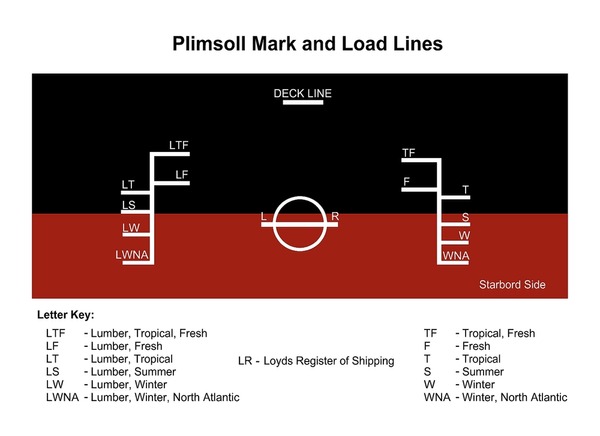
14.2 The Load Line Marks (Plimsoll Marks)
Every ship subject to the Load Line Convention must have the following marks painted/cut on both sides of the hull:
Mark / Symbol | Meaning |
Deck line | A separate horizontal line marked amidships indicating the position from which assigned freeboard is measured |
S — Summer | Maximum draught in summer zones in salt water |
W — Winter | Maximum draught in winter zones in salt water (higher freeboard than Summer) |
WNA — Winter North Atlantic | Special Winter North Atlantic load-line requirement applies to ships of 100 m in length and under, subject to the Convention's conditions |
T — Tropical | Maximum draught in tropical zones in salt water (less freeboard than Summer — deeper loading allowed) |
TF — Tropical Fresh Water | Maximum draught in tropical fresh water |
F — Fresh Water | Maximum draught in fresh water (summer) |
Load Line Mark / Plimsoll disc | A ring intersected by a horizontal line; the centre of the ring is at the same level as the Summer load line. Letters identifying the assigning authority are marked adjacent to the ring |
14.3 What the Load Line Surveyor Checks
Freeboard marks are correctly placed and clearly visible on both sides of the hull
Hatch covers: weathertight; dogs/cleats in good condition; gaskets intact
Air pipes: automatic closing devices working; pipe heights above deck are adequate
Ventilators: closures and coaming heights checked for the applicable deck position (Position 1 / Position 2) and approved arrangement; do not confuse deck position with geographic Load Line zones.
Doorways and sills: weathertight doors operational; sill heights meet convention
Side scuttles (portholes): deadlights (storm covers) available and working below freeboard deck
Freeing ports: open; hinged flaps working; dimensions adequate to drain deck water
Superstructure integrity: all openings in superstructure are weathertight
Stability information: ship must have approved stability booklet on board
📝 Note: The Load Line Certificate (ILLC) is valid for 5 years with annual surveys. If any Load Line item becomes deficient (e.g., hatch cover gasket deteriorated, air pipe closure not working), the ship may be required to reduce its loading until repaired.
SECTION 15 — ISSC SURVEY (SHIP SECURITY CERTIFICATE)
ISSC — International Ship Security Certificate Survey [ISPS Code / SOLAS Chapter XI-2]
The ISSC verification confirms implementation of the approved Ship Security Plan and compliance with SOLAS XI-2/ISPS requirements. It applies to passenger ships (including HSC), cargo ships (including HSC) of 500 GT and above, and mobile offshore drilling units engaged on international voyages, as applicable.
15.1 What Does the ISSC Surveyor Check?
Ship Security Plan (SSP): Approved by flag state; on board; crew trained in its procedures
Ship Security Officer (SSO): Designated; holds valid SSO certificate (STCW Reg VI/5)
Security equipment: Automatic Identification System (AIS), Ship Security Alert System (SSAS), CCTV if fitted
Access control: Procedures for controlling access to the ship and restricted areas
Security drills: Records of security drills and exercises
Port facility interfaces: Check Declaration of Security (DoS) records where a DoS was required or agreed; a DoS is not automatically required for every port call.
ISSC is valid for 5 years with an intermediate verification between the 2nd and 3rd year.
SECTION 16 — OTHER IMPORTANT SURVEYS
16.1 Boiler Survey
BOILER SURVEY — Boiler Inspection and Survey [Classification Society Rules]
Boilers are pressure vessels — a failure can cause catastrophic explosion. Class rules require regular boiler surveys, separate from CSM in some societies.
Internal/complete boiler survey: frequency and scope are governed by the applicable class/flag survey scheme. Open accessible spaces as required and inspect pressure parts, furnace/tubes, supports, mountings and safety devices for condition.
External survey/inspection: carried out at the intervals required by class/Administration; check general condition, fittings, water-level devices, combustion/safety controls and evidence of leakage/overheating.
Hydraulic (hydrostatic) pressure test: carried out when required by class/Administration, for example after major pressure-part repair or where condition warrants. Test pressure is per the approved rule/procedure; 1.5× working pressure every 5 years is not a universal rule.
Safety Valve Test: Each safety valve is tested to confirm it lifts at the correct pressure (set pressure)
16.2 Safety Equipment Survey (SEC)
SAFETY EQUIPMENT — Cargo Ship Safety Equipment Survey [SOLAS Chapters II-2 & III]
Verifies all life-saving appliances (LSA) and fire-fighting appliances (FFA) are in good condition and meet SOLAS requirements.
Lifeboats — structural condition, equipment, launching/release arrangements and maintenance/inspection/servicing records in accordance with SOLAS Chapter III (notably operational readiness/maintenance provisions) and the LSA Code
Liferafts — hydrostatic release, painter, service records (annual servicing at approved station)
Rescue boat — condition, launching equipment, search equipment
Immersion suits — verify the required number, sizes, condition and approved stowage for the ship/route; inspect for deterioration, damage and serviceability
Lifebuoys, lifejackets — numbers, condition, lights, whistles, SART
EPIRBs — hydrostatic release, battery expiry, registration; annual service records
Fixed firefighting systems — CO₂, foam, water mist and other approved fixed systems: condition, controls, alarms, quantity/pressure and servicing records as applicable
Portable fire extinguishers — inspected, charged; within service date
Fire detection and alarm systems — tested; all detectors functional
16.3 Compass Adjustment Survey
Statutory requirement under SOLAS Reg V/19 — ships must have a magnetic compass
Compass must be adjusted (deviation corrected) and a deviation card prepared
Required when deviation becomes excessive or after changes/repairs/addition of magnetic material likely to affect the compass; dry-docking alone is not automatically a statutory trigger unless magnetic characteristics may have changed
Carried out by an approved compass adjuster — not a class surveyor
16.4 SIRE / CDI Inspection (Vetting — Tankers)
SIRE 2.0 / CDI — Commercial Vetting Inspections [OCIMF / CDI]
These are commercial inspections, not statutory surveys. OCIMF SIRE 2.0 is the current tanker inspection regime; CDI provides inspection schemes for chemical/gas sectors. Reports support charterer/vetter decisions and focus on vessel condition, systems, procedures and crew performance.
SIRE 2.0 (Ship Inspection Report Programme): OCIMF's digitalized, risk-based tanker inspection programme
CDI (Chemical Distribution Institute): For chemical tankers
Inspection reports are made available within the relevant programme to authorized recipients; observations can materially affect commercial vetting decisions, but the outcome is not a statutory certificate
Vetting inspectors check: SMS, crew competency, equipment condition, operational standards, environmental compliance
16.5 Flag State Inspection (FSI)
Some flag states conduct their own inspections of ships registered under their flag
This is separate from PSC — it is the flag state checking its own ships
In India: DGS inspection of Indian-flagged vessels at Indian ports
Checks: statutory certificates, crew documents, STCW compliance, ISM implementation
16.6 Other Current Statutory Survey / Certification Topics (2026)
HSSC 2025: IMO resolution A.1207(34) is the current harmonized survey-guideline reference and includes updated guidance for SOLAS, MARPOL, BWM, Polar Code and Industrial Personnel Code surveys.
Ballast Water Management: applicable ships undergo initial, annual, intermediate and renewal surveys for the International Ballast Water Management Certificate under the BWM Convention.
Anti-Fouling Systems: applicable ships require AFS survey/certification and records under the AFS Convention, particularly when an anti-fouling system is changed or replaced.
MARPOL Annex VI: in addition to IAPP surveys, energy-efficiency requirements are verified through the International Energy Efficiency Certificate (IEEC) and related MARPOL Annex VI provisions.
Polar / Industrial Personnel: Polar Ship Certificate and IP Ship Safety Certificate survey/certification requirements apply where the relevant SOLAS/Code scope is met.
SECTION 17 — SURVEY CERTIFICATES — QUICK REFERENCE
Certificate | Abbreviation | Convention / Authority | Validity | Renewed By |
Certificate of Class | CoC | Classification Society | Typically a 5-year class cycle; exact validity/survey scheme is class-specific | Special Survey |
Cargo Ship Safety Construction Cert. | CSSCC | SOLAS Ch II-1, II-2 | Max 5 years + annual + intermediate survey | Flag State / RO |
Cargo Ship Safety Equipment Cert. | CSSEC | SOLAS Ch III / II-2 equipment requirements | Max 5 years + annual + periodical survey (2nd/3rd anniversary) | Flag State / RO |
Cargo Ship Safety Radio Cert. | CSSRC | SOLAS Ch IV | Max 5 years + periodical radio survey each anniversary | Flag State / RO |
Int. Oil Pollution Prevention Cert. | IOPP | MARPOL Annex I | Max 5 years + annual + intermediate survey | Flag State / RO |
Int. Sewage Pollution Prevention Cert. | ISPPC | MARPOL Annex IV | Max 5 years; initial/renewal survey scheme | Flag State / RO |
Int. Air Pollution Prevention Cert. | IAPP | MARPOL Annex VI | Max 5 years + annual + intermediate survey | Flag State / RO |
Int. Load Line Certificate | ILLC | Load Line Conv. 1966 | 5 years + annual endorsement | Flag State / RO |
Int. Tonnage Certificate | ITC-69 | Tonnage Conv. 1969 | No routine periodic expiry while particulars remain unchanged | Flag State / RO |
Int. Ship Security Certificate | ISSC | ISPS Code / SOLAS XI-2 | 5 years + intermediate | Flag State / RO |
Document of Compliance (ISM) | DOC | ISM Code / SOLAS IX | 5 years + annual audit | Flag State / RO |
Safety Management Certificate (ISM) | SMC | ISM Code / SOLAS IX | 5 years + intermediate audit | Flag State / RO |
Minimum Safe Manning Document | MSMD | SOLAS V Reg 14 | No expiry (unless conditions change) | Flag State |
CAS Statement of Compliance | CAS-SoC | MARPOL Annex I Reg 20/21 | Legacy CAS Statement of Compliance; see MARPOL phase-out context | Flag State |
Continue your preparation
Explore month-wise written questions and model answers in the study portal.
Return to the study desk ↗Use these notes alongside current official publications and applicable flag requirements. Find official references.