ISM CODE
International Safety Management Code
1. What is the ISM Code? (The Big Picture)
The ISM Code provides an international standard for managing ship safety and preventing pollution. It connects the Company’s responsibilities ashore with safe working practices on board.
Companies and ships within its scope must implement a documented Safety Management System (SMS). The SMS translates the Code and applicable requirements into responsibilities, procedures and practical controls for the particular operation.
Full name and applicability
International Management Code for the Safe Operation of Ships and for Pollution Prevention; commonly the International Safety Management (ISM) Code. Adopted by A.741(18) in 1993 and made mandatory through SOLAS IX.
SOLAS IX scope: passenger ships, including passenger high-speed craft, without a 500 GT threshold; oil tankers, chemical tankers, gas carriers, bulk carriers and cargo high-speed craft of 500 GT and above from 1 July 1998; other cargo ships and mobile offshore drilling units of 500 GT and above from 1 July 2002. Apply the Convention’s scope and exclusions; flag law can extend application.
The latest Code text amendment listed by IMO is MSC.353(92), effective 1 January 2015. Later guidance updates are distinguished in section 8. [1, 2]
Why was ISM created?
Major casualties, including the Herald of Free Enterprise disaster, highlighted failures in management and ship–shore communication. ISM addresses organisational as well as operational causes of accidents.
The ISM Code was created to establish a SAFETY CULTURE in shipping — where safety is a daily habit, not just a rule written in a manual that nobody reads.
Objectives — distinguish paragraphs 1.2.1, 1.2.2 and 1.2.3 [1]
Overall objectives (1.2.1): safety at sea, prevention of injury and loss of life, and avoidance of environmental and property damage.
Company safety-management objectives (1.2.2): safe operating practices and working conditions; assessment of all identified risks to ships, personnel and the environment, with appropriate safeguards.
Also under 1.2.2: continual improvement of shore and ship personnel’s safety-management skills, including preparation for safety and environmental emergencies. Under 1.2.3: comply with mandatory rules and regulations and take account of relevant recommended instruments and guidance.
Exam tip
State the overall objectives first, then the Company objectives and compliance requirement. The preceding wording is a study paraphrase, not a “word-for-word” quotation. Do not omit risk assessment from 1.2.2.2.
2. Key Definitions (Must Know — Examiners Test These)
Company
The Company is the owner, or another organisation or person (for example a manager or bareboat charterer) that assumes operation of the ship and accepts the Code’s associated duties and responsibilities. [1, 1.1.2]
An owner may remain the ISM Company, or an appointed manager may assume that role. Identify the actual Company from the ship’s ISM certification and documentation, rather than from a brand name.
Safety Management System (SMS)
An SMS is an organised, documented system through which Company personnel implement the safety and environmental protection policy. It includes responsibilities, operational controls, communication, emergency arrangements, reporting, audits and reviews. [1, 1.1.4 and 1.4]
Part A (sections 1–12) contains implementation requirements; Part B (13–16) deals with certification and verification. Ships carry documentation relevant to that ship. A manual alone does not demonstrate effective implementation.
SMS in practice
A good SMS connects the written procedure, competent personnel, working equipment, actual practice and verifiable feedback. A well-presented manual alone cannot show compliance.
Objective Evidence
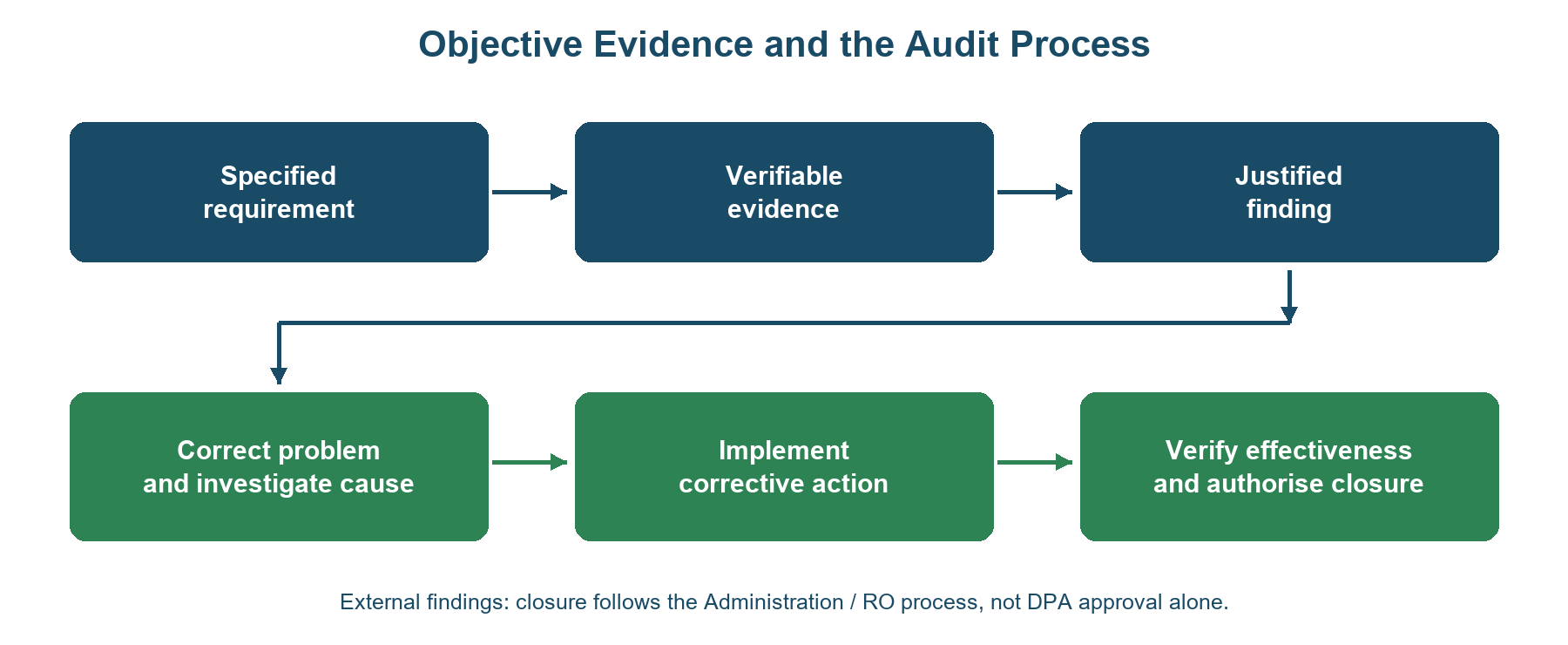
Objective evidence is verifiable quantitative or qualitative information, records or statements of fact concerning safety or the existence and implementation of an SMS element. It may be obtained by observation, measurement or test. [1, 1.1.7]
Examples of objective evidence:
A signed maintenance log showing the bilge pump was tested on a specific date.
A drill record showing the fire drill was conducted with crew names and signatures.
A photograph of a missing fire extinguisher bracket.
A logbook entry recording the near-miss incident.
A crew interview giving specific, verifiable facts, corroborated where appropriate by a demonstration or records.
Evidence must be assessed for reliability:
An uncertain recollection such as “I think it was tested” is weak evidence and needs verification.
A statement is not excluded merely because it is verbal; verifiable statements of fact can be objective evidence.
An unsigned or undated checklist may be insufficient where identification or authentication is required. Assess the specified requirement and other available evidence.
A missing required record can itself establish an NC. It does not automatically prove that the underlying work never occurred. Auditors relate the evidence to a specified requirement and assess implementation.
Non-Conformity (NC)
An NC is an observed situation where objective evidence demonstrates non-fulfilment of a specified requirement. This may be a Code, statutory or applicable SMS requirement. [1, 1.1.9]
Example: an approved SMS requires a monthly standby-pump test, but the required test is overdue. Establish whether the test was missed, its record is missing, or both; state the actual requirement and evidence.
Major Non-Conformity (MNC)
A major NC is an identifiable deviation meeting either of these tests (paraphrase of 1.1.10):
It seriously threatens personnel or ship safety, or presents serious environmental risk, and needs immediate corrective action; OR
It demonstrates absence of effective and systematic implementation of a requirement of the Code.
Potential major NC examples — classification depends on the evidence:
Required essential bilge or firefighting capability is unavailable, creating a serious safety threat.
A widespread failure to maintain and test emergency equipment demonstrates a systemic breakdown.
Emergency-response arrangements required by section 8 are absent or ineffective.
The Company has failed to provide an effective designated-person arrangement required by section 4.
An unresolved major NC can lead to withholding or withdrawal of certification and operating restrictions. An accident or overdue job is not automatically a major NC. See Scenario 16 for authorised downgrading and follow-up. [1, 13; 3]
Observation
The Code defines an observation as a factual statement made during a safety-management audit and supported by objective evidence. Some audit schemes use the label for improvement points, but “not a breach” is not the Code definition. [1, 1.1.8]
If required signatures are missing, this may be an NC; do not call it an observation simply to soften a finding. Follow the certifying body’s reporting system without obscuring a demonstrated breach.
Near Miss
A near miss is an event that DID NOT CAUSE HARM but HAD THE POTENTIAL to do so. It is sometimes called a “dangerous occurrence” or “hazardous occurrence.”
Example: A spanner falls from a height in the engine room and lands 50 cm from a motorman. Nobody is hurt. But if it had landed on the motorman, he could have been killed. That is a near miss.
SMS procedures must address reporting, investigation and analysis of hazardous situations. Report near misses under those procedures; depth of investigation should reflect potential consequences and circumstances, rather than mechanically treating every event identically. [1, 9; 8]
Overriding Authority (Master)
Under 5.2 the SMS must clearly state the Master’s overriding authority and responsibility for safety and pollution-prevention decisions, including the ability to request Company assistance. It is not authority to disregard applicable law.
The Company must provide necessary support (6.1.3). A clear written SMS statement is required; the Code does not demand a separate written Company endorsement of every decision.
As Chief Engineer, give the Master prompt, factual technical advice, state unsafe limitations clearly, and record significant defects and decisions. Urgent oral notification must not wait for a written report.
3. All 16 Elements — Plain Language Explanation
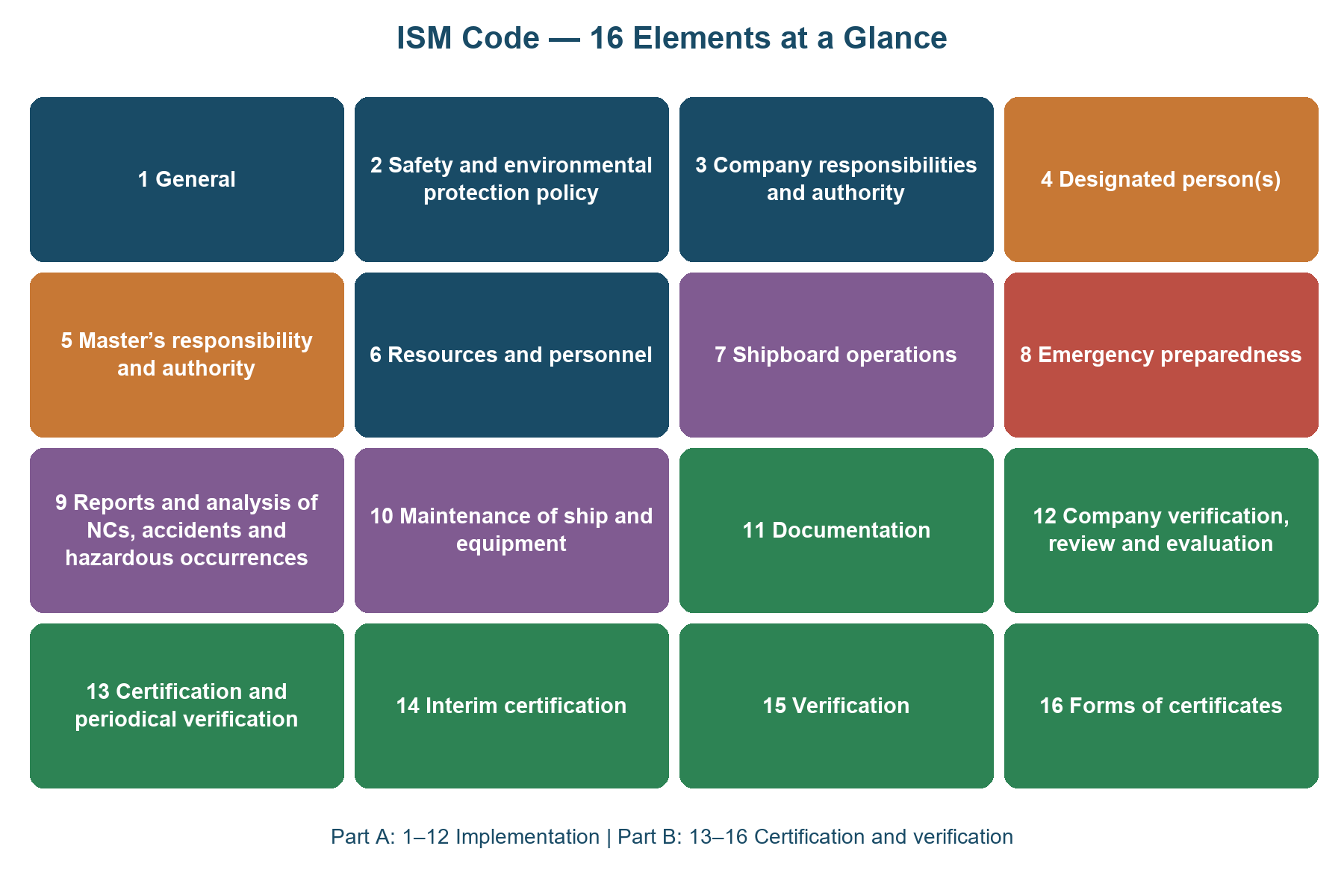
The ISM Code has 16 elements. Part A (1-12) is about DOING safety. Part B (13-16) is about PROVING you are doing it through certification.
Element 1: General
Section 1 covers definitions, objectives, application and SMS functional requirements. These include policy, operating instructions, defined authority and communication, reporting, emergency preparation, and audit/review arrangements. [1]
Element 2: Safety and Environmental Protection Policy
The Company must establish a safety and environmental protection policy and ensure implementation and maintenance at all levels, ashore and afloat. A CEO signature is common evidence of commitment, but section 2 does not prescribe that particular signature.
As Chief Engineer, understand the policy, communicate it in the department and demonstrate its practical application. Display arrangements and briefing records follow the Company’s controlled SMS.
Element 3: Company Responsibilities and Authority
The Company must define and document responsibilities, authority and relationships, and provide resources and shore support. In particular:
Have clear responsibilities defined for everyone — who does what, who reports to whom.
Provide all the resources the ship needs: spare parts, trained crew, information, money.
If the operator differs from the owner, the owner reports the Company’s full name and details to the Administration (3.1). Master’s competence and support are addressed in 6.1.
Have clear, open communication channels between ship and shore.
Element 4: Designated Person Ashore (DPA)
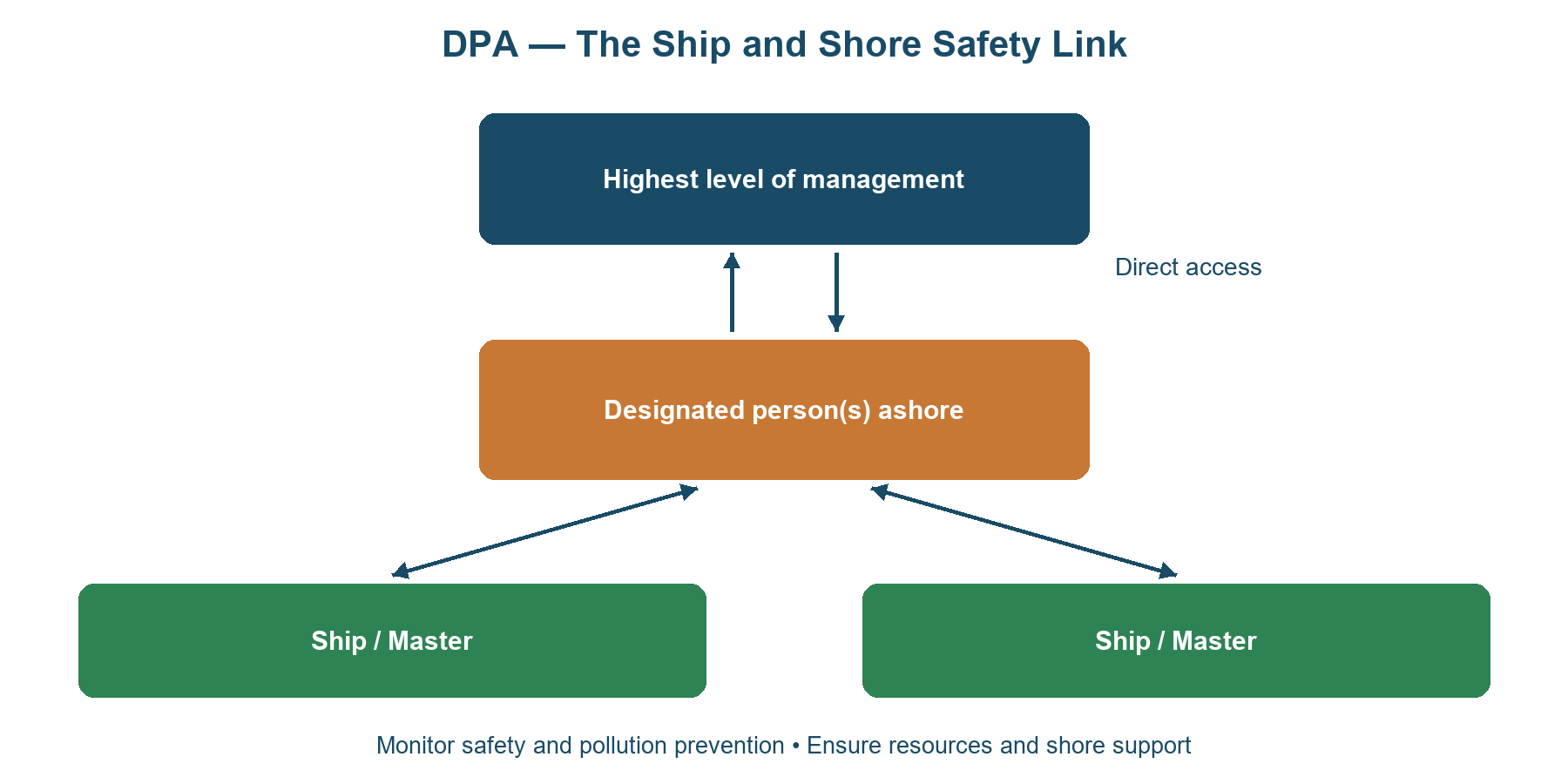
The Company must designate a person or persons ashore to link the Company and those on board each ship, with direct access to the highest management. [1, 4]
What makes the DPA special: The DPA must have DIRECT ACCESS to the HIGHEST LEVEL of management. That means if there is a safety problem on the ship, the DPA can go straight to the CEO — without being blocked by middle management.
DPA responsibilities:
Monitor safety and pollution-prevention aspects of each ship’s operation.
Ensure adequate resources and shore support are provided as required.
Maintain an effective ship–shore safety link; the DPA does not replace the Master or the Company’s line managers.
Follow-up responsibilities for reports and corrective actions are allocated in the SMS; the DPA is not automatically the sole person authorised to close every finding.
Escalate unresolved safety and resource issues to senior management. Qualifications, training and experience are addressed by MSC-MEPC.7/Circ.6. [7]
Can the DPA be the CEO?
Section 4 does not prohibit an appointment solely by job title or require a superior above the designated person. A combined CEO/DPA role must still satisfy the ashore function, competence, effective monitoring, access and resource requirements, and applicable flag expectations. Do not give an unconditional “No” based on an invented hierarchy rule. [1, 4; 7]
Element 5: Master’s Responsibility and Authority
The Company defines and documents the Master’s responsibilities under section 5:
Implement policy; motivate crew; issue clear instructions; verify compliance; periodically review the SMS and report deficiencies to shore management.
The SMS must expressly recognise overriding authority for safety and pollution prevention and the ability to request Company assistance (5.2).
What this means in practice: If a charterer says “sail now” and the Master says “it is not safe to sail,” the Master’s decision wins. No commercial pressure can override this. The company must back him up.
Element 6: Resources and Personnel
The company must ensure:
Ships are appropriately manned with qualified, certificated and medically fit seafarers, covering all aspects of safe operation, in accordance with national and international requirements.
New personnel and personnel transferred to new safety-related assignments receive proper familiarisation. Essential instructions needed before sailing are identified, documented and given before sailing.
All crew receive training in the SMS and know the procedures relevant to their job.
Language is not a barrier — crew can understand the instructions and procedures.
As Chief Engineer, arrange and verify engine-department familiarisation in accordance with assigned SMS responsibilities, including supervision until personnel are competent for their duties.
Element 7: Shipboard Operations
Provide procedures, plans and instructions, with checklists as appropriate, for key operations affecting personnel safety, ship safety and environmental protection. Define tasks and assign qualified personnel. Typical examples are:
Engine room watch-keeping
Bunkering (critical — pollution risk)
Working in enclosed spaces (enclosed space entry permit)
Hot work (hot work permit)
Working aloft or overside
Main engine start-up / stand-by / manoeuvring
Cargo heating / tank cleaning on tankers
Select permits, standing orders, checklists and risk assessments as required for the task. A PTW is not universally required for every maintenance job; failure to use one when required is an NC.
Element 8: Emergency Preparedness
Identify potential shipboard emergencies and establish response procedures, programmes of drills and exercises, and Company arrangements capable of responding at any time. [1, 8]
Written down in the SMS as an emergency procedure.
Practised regularly through drills and exercises.
Known to all crew before the emergency, not during it.
Foreseeable emergencies include: fire, flooding/sinking, collision, grounding, man overboard, machinery failure, pollution incident, piracy, medical emergency, structural failure.
As Chief Engineer, carry out the emergency duties assigned by the muster list and SMS, in coordination with the Master. Know emergency machinery, shutdowns, isolation arrangements and fixed firefighting controls, and train the team.
Element 9: Reports and Analysis of Non-Conformities, Accidents and Hazardous Occurrences
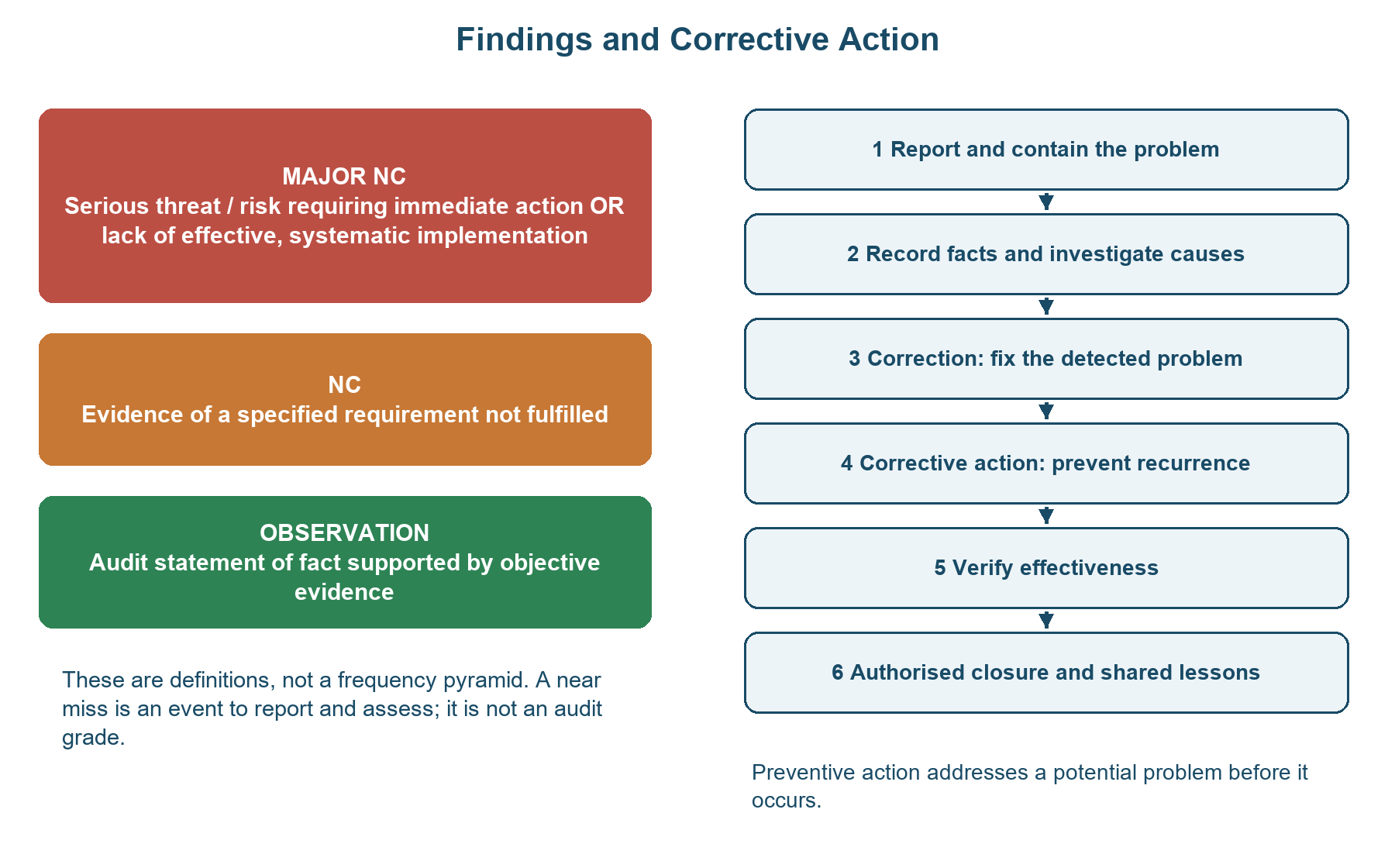
Reports of NCs, accidents and hazardous situations must reach the Company for investigation and analysis. Encourage honest reporting and learning; a just reporting culture does not remove accountability for deliberate or reckless misconduct. [1, 9; 8]
Why? Because if you only fix accidents after they happen, people get hurt. But if you report and fix near misses, you prevent the accident before it happens.
The CAPA Process (Corrective and Preventive Action):
Identify and report the NC, near miss or accident.
Record it formally in the SMS report form.
Investigate causes using a suitable method. “5 Whys” is one useful technique, not an ISM-mandated method.
Correction: remedy or contain the detected problem, for example replace a damaged hose coupling.
Corrective action: address the cause of an actual NC to prevent recurrence. Preventive action addresses causes of a potential NC before it occurs. Section 9.2 includes prevention of recurrence within corrective action.
Verify completion AND effectiveness, assign responsible persons and agreed due dates, and communicate lessons where relevant.
Close the finding through the applicable SMS/audit process. External findings require acceptance under the Administration/RO’s procedures.
Element 10: Maintenance of the Ship and Equipment
This is the element that directly governs your day-to-day work as Chief Engineer. It requires:
Maintenance procedures must achieve conformity with relevant rules and regulations and additional Company requirements, including appropriate inspections, reporting, corrective action and records. A PMS is a usual implementation method; the Code does not require a particular software product.
Identify equipment and technical systems whose sudden operational failure could create hazardous situations. Apply measures to improve reliability, including regular tests of standby arrangements and systems not continuously used (10.3). A risk assessment alone never authorises bypassing statutory protection.
For overdue or defective equipment, report and assess the defect, apply safe restrictions, obtain necessary Company/flag/class approvals, and arrange repair. Company approval cannot waive a statutory requirement.
Maintain authentic, traceable records of inspections, maintenance, defects and corrective action. Use the authentication method specified by the SMS and applicable requirements.
What if planned maintenance cannot be completed on time?
Report the actual defect or overdue requirement under the SMS, assess its safety and statutory implications, and agree safe restrictions and a repair plan. Raise an NC where a specified requirement has not been fulfilled. Escalate to flag/class where required. Neither a DPA email nor a risk assessment makes an unlawful condition acceptable.
Element 11: Documentation
All SMS documents must be CONTROLLED. This means:
Ensure valid documents are available where needed; revision identifiers and dates are common controls.
Ensure changes are reviewed and approved by authorised personnel; a master list is a useful control method, not a prescribed Code form.
When a document is updated, the old version is removed from circulation.
Ships always have the CURRENT version of every required document.
Records (drill logs, maintenance records, NC reports, safety meeting minutes, training records) must be retained for the required period and be available for audit at any time.
Element 12: Company Verification, Review and Evaluation (Internal Audits)
The company must check itself to see if the SMS is working. This is the INTERNAL AUDIT. Key rules:
Internal safety audits on board AND ashore: intervals must not exceed 12 months. [1, 12.1]
Exceptional circumstances may extend that interval by no more than 3 months. This is not permission for a routine 15-month audit cycle.
Auditors are independent of the area audited unless impracticable because of the Company’s size and nature (12.5).
Periodically evaluate SMS effectiveness; communicate audit/review results and take timely corrective action. Periodically verify delegated ISM tasks (12.2). The Code gives no universal annual interval for every management review.
Elements 13–16: Certification and Verification
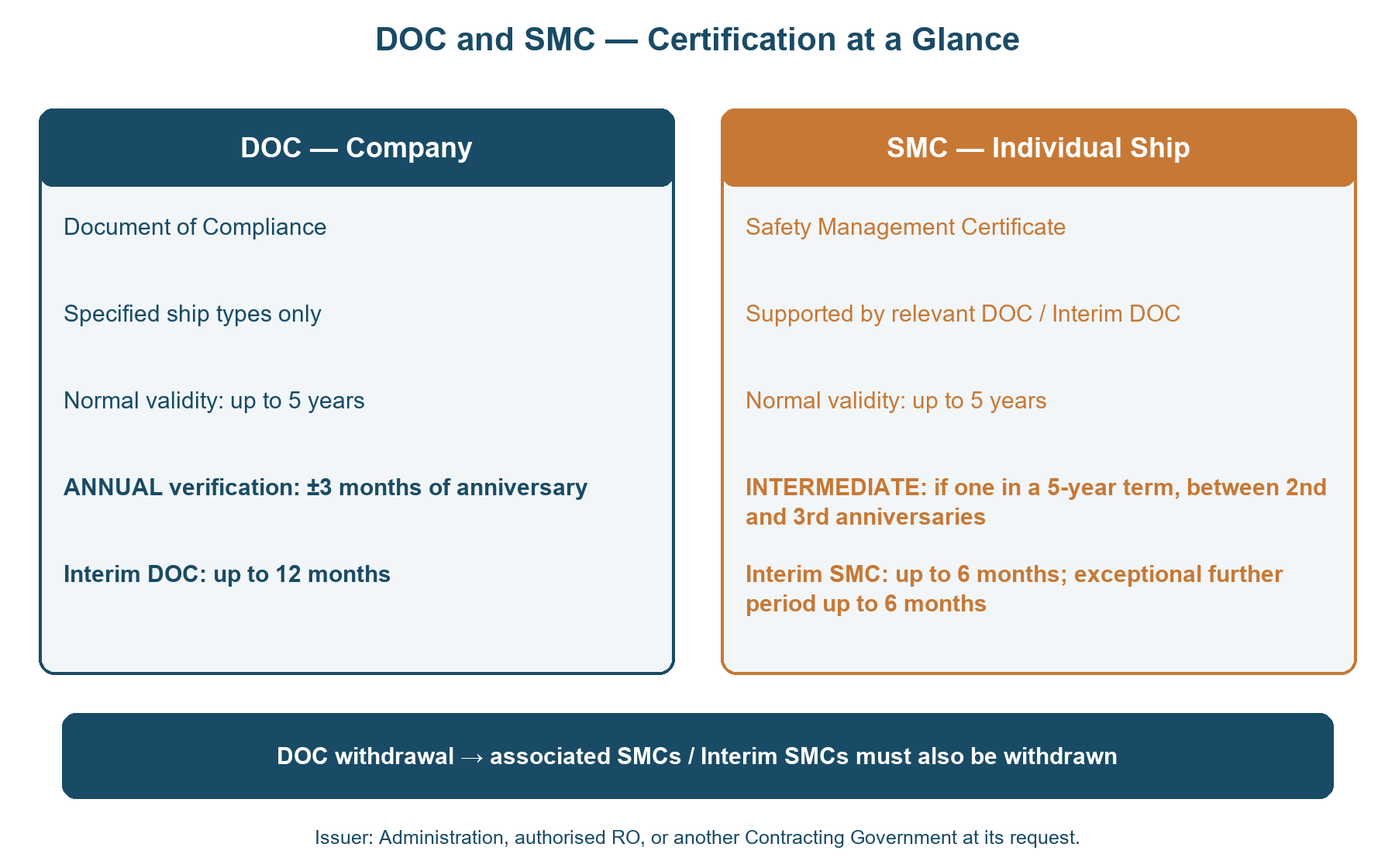
13: Certification and periodical verification. 14: Interim certification. 15: Verification. 16: Forms of certificates. Issuance is by the flag Administration, an authorised RO, or another Contracting Government at the Administration’s request. [1]
Certificate | Normal term / verification | Interim term |
DOC • Company; specified ship types | ≤5 years. Annual within 3 months before/after anniversary. | ≤12 months |
SMC • individual ship | ≤5 years. At least one intermediate; if only one during 5 years: between 2nd and 3rd anniversaries. | ≤6 months; exceptional further ≤6 months |
Certificate dependency
Withdrawal of the DOC requires withdrawal of all associated SMCs and/or Interim SMCs (13.5.1). A printed, unexpired SMC does not permit continued operation after the supporting DOC has been withdrawn. Restoration requires the prescribed verification; interim certification is not a shortcut after withdrawal for major NCs. [1; 3]
4. How Do You Know ISM Is Being Implemented on Board?
Use this practical structure when explaining how you verify implementation.
When you join a ship as Chief Engineer, you check the following to confirm ISM implementation:
Step 1: Check the Certificates
Is the SMC valid? Is the DOC copy on board?
Check DOC annual endorsements and SMC intermediate verification, as applicable, as well as expiry dates and correct ship-type coverage.
Step 2: Check the SMS Manual
Is relevant controlled SMS documentation available in a working language or languages understood by the personnel concerned (6.6)? English is not universally required for the SMS.
Is there a Master List of controlled documents?
Are procedures available for all key engine-room operations (enclosed space, hot work, bunkering, emergency)?
Step 3: Check the Records
Are maintenance records current, authentic and traceable, including defects and properly controlled deferrals?
Are drills completed and recorded in accordance with applicable regulations and the SMS?
Are safety meeting minutes recorded?
Are near-miss and NC reports filed?
Are rest-hour records maintained?
Is the applicable Oil Record Book complete and consistent with actual operations and tank quantities?
Step 4: Talk to the Crew
Do crew know the muster list and their emergency duties?
Do they know where the DPA contact number is?
Can they explain what to do in an enclosed-space emergency?
Have they received familiarisation?
Step 5: Physical Inspection
Is safety-critical equipment in working order (emergency fire pump, emergency generator, CO2 system)?
Are PTW forms in use for actual ongoing work?
Is the engine room clean and fire hazards controlled?
Continue your preparation
Explore month-wise written questions and model answers in the study portal.
Return to the study desk ↗Use these notes alongside current official publications and applicable flag requirements. Find official references.