MARPOL 73/78
Prevention of Pollution from Ships
All Six Annexes — Explained Simply, With Illustrations
─────────────────────────────────────
1. What Is MARPOL?
MARPOL stands for MARine POLlution. Its full name is the International Convention for the Prevention of Pollution from Ships. It is the main international law that stops ships from polluting the sea and the air.
Simple idea: A ship produces many waste streams — oily bilge water, sludge, cargo residues, sewage, garbage and exhaust gases. MARPOL tells you what you may discharge, how much, where, and what you must keep on board and land ashore.
1.1 How MARPOL Came Into Being
MARPOL was born out of disaster. The first oil treaty was OILPOL 1954, but it was weak. Then came the accidents that changed everything.
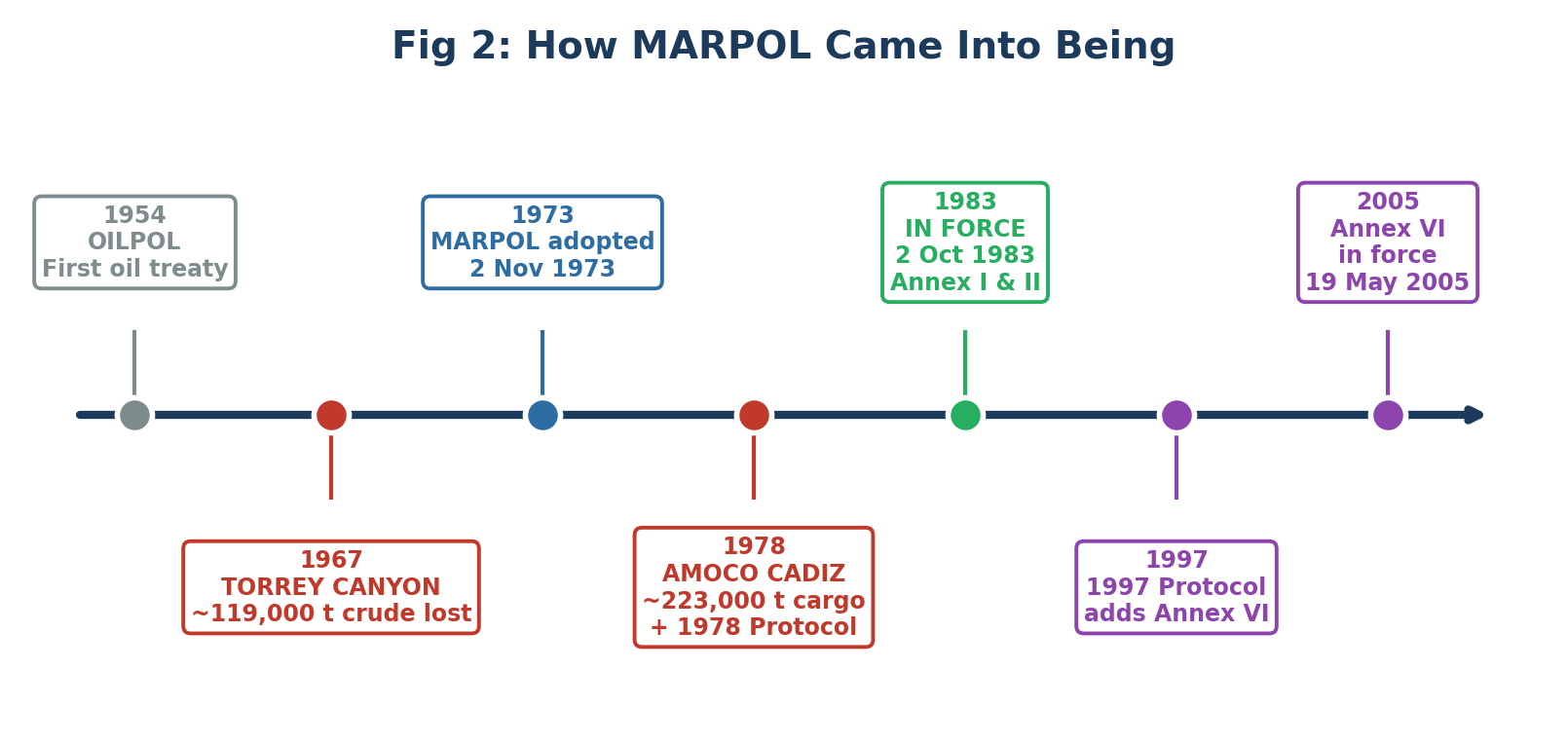
Torrey Canyon (1967): this supertanker ran aground on the Seven Stones reef off Cornwall. Over the next 12 days about 119,000 tonnes of Kuwait crude oil was lost. The world saw how unprotected the sea was.
MARPOL adopted (2 November 1973): IMO called a conference and adopted the Convention. But not enough countries ratified it, so it could not come into force.
Amoco Cadiz (1978): grounded on Portsall Rocks off Brittany, releasing its whole cargo of about 223,000 tonnes of crude plus 4,000 tonnes of bunkers — roughly 227,000 tonnes in total. Along with the Argo Merchant (1976), this created huge pressure.
1978 Protocol: because the 1973 Convention was still not in force, the 1978 Protocol absorbed the parent Convention. The combined instrument is called MARPOL 73/78.
Entered into force 2 October 1983 (Annexes I and II). Annex VI was added later by the 1997 Protocol and came into force on 19 May 2005.
💡 Exam Tip: A surveyor may ask 'Why is it called 73/78?' Answer: the Convention was adopted in 1973 but never came into force; the 1978 Protocol absorbed it, so the two are read together as one instrument — MARPOL 73/78.
1.2 Structure of MARPOL
MARPOL is made of three parts: the Articles (the legal framework), two Protocols, and six technical Annexes which contain the actual operating rules you follow on board.
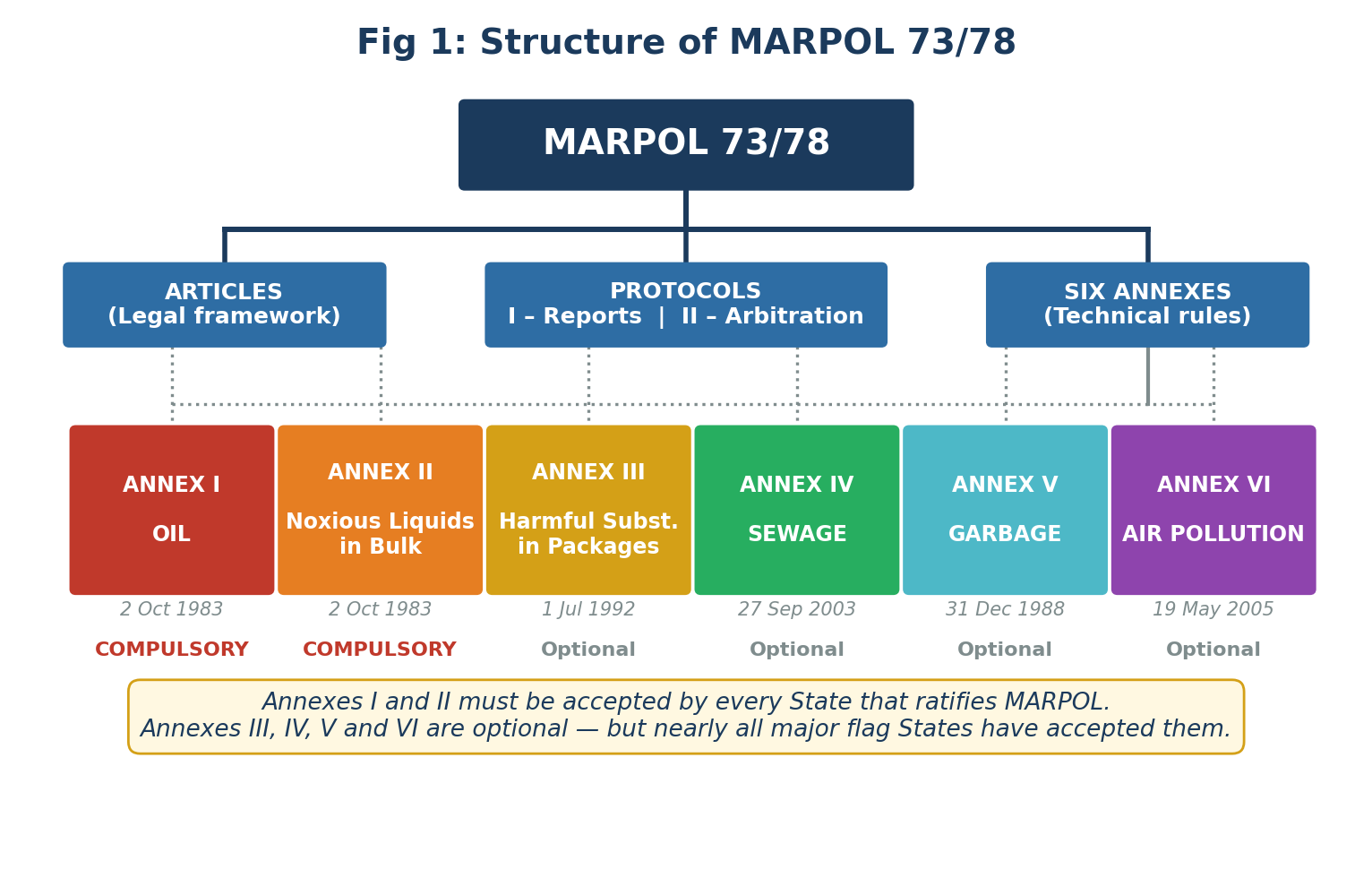
Articles — the legal duties of countries: obligations of Parties, definitions, and Article 4 on violations and penalties.
Protocol I — reports on incidents involving harmful substances.
Protocol II — arbitration procedure for disputes.
Six Annexes — the technical rules. Annexes I and II are compulsory for every country that ratifies MARPOL. Annexes III, IV, V and VI are optional, but almost every major flag State has accepted all of them.
Amendments are made by tacit acceptance — an amendment comes into force automatically on a set date unless a specified number of Parties formally object. This is why MARPOL can be updated quickly.
1.3 Definitions You Must Know
Term | Simple Meaning |
Ship | Any vessel operating in the marine environment — including hydrofoils, air-cushion vehicles, submersibles, and fixed or floating platforms. |
Discharge | Any release from a ship however caused — escape, disposal, spilling, leaking, pumping, emitting or emptying. It does NOT include dumping under the London Convention, sea-bed mineral release, or release for legitimate scientific research. |
Harmful substance | Any substance which, if put into the sea, is liable to harm human health, damage living resources and marine life, spoil amenities, or interfere with other lawful uses of the sea. |
Nearest land | Measured from the baseline of the territorial sea (normally the low-water line). Important exception: off the north-east coast of Australia the line runs around the outer edge of the Great Barrier Reef. |
Special Area | A sea area which, for recognised technical, oceanographic and ecological reasons, needs stricter mandatory rules. Annexes I, II, IV and V each have their own list. |
ECA | Emission Control Area — an Annex VI concept: an area with stricter limits on SOx/PM and/or NOx. |
PSSA | Particularly Sensitive Sea Area — needs special protection because of ecological, socio-economic or scientific value and vulnerability to shipping (e.g. Great Barrier Reef). Carries Associated Protective Measures such as routeing or reporting. |
💡 Exam Tip: The 'nearest land' definition with the Great Barrier Reef exception is a classic one-mark question. Remember it.
2. The Master Distance Chart
Before going annex by annex, learn this one chart. It puts every discharge distance in one picture. If you can draw this from memory, you have covered most of the numerical questions in the exam.
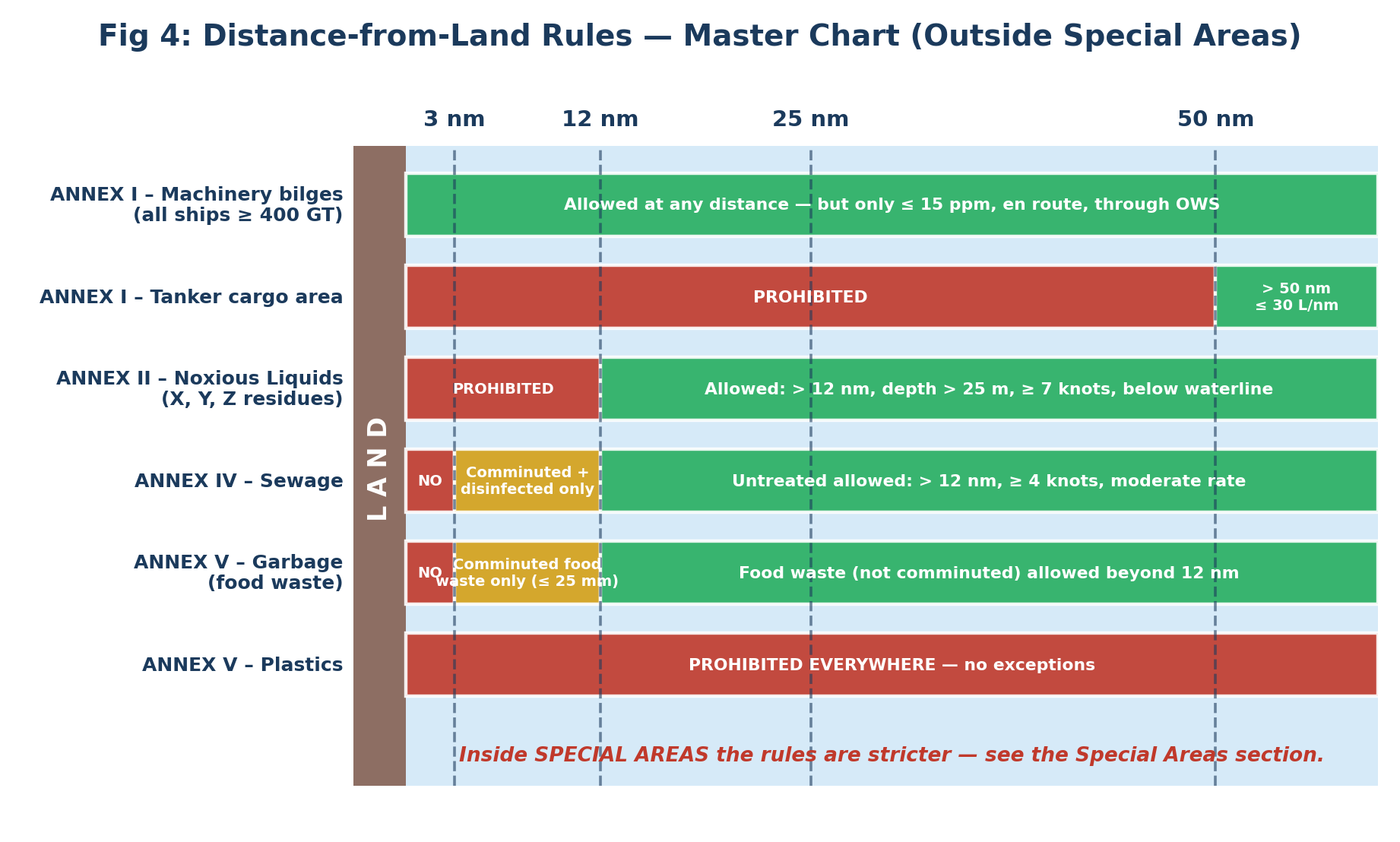
💡 Exam Tip: Practise drawing this chart on a rough sheet. In orals, if you can sketch the coastline with 3, 12, 25 and 50 nm marked and put each annex on it, you will answer half the discharge questions before they are asked.
3. ANNEX I — Oil
This is the annex an engineer deals with every single day — bilges, sludge, the oily water separator and the Oil Record Book.
3.1 Who It Applies To
Oil Record Book Part I — required for every oil tanker of 150 GT and above and every other ship of 400 GT and above. Oil filtering equipment (15 ppm OWS) — generally required for ships of 400 GT and above.
Extra cargo-area requirements — oil tankers of 150 GT and above.
3.2 Discharge from Machinery Space Bilges
This is the most-asked question in the whole of MARPOL. For a ship of 400 GT and above, outside a Special Area, ALL of the following must be satisfied at the same time:
The ship is proceeding en route.
The oily mixture is processed through oil filtering (15 ppm) equipment meeting Regulation 14.
The oil content of the effluent, without dilution, does not exceed 15 ppm.
The mixture does not originate from cargo pump-room bilges (on tankers).
The mixture is not mixed with oil cargo residues (on tankers).
The machinery-space bilge discharge criteria apply both outside and inside Special Areas. Under Regulation 14, ships of 10,000 GT and above must have 15 ppm oil filtering equipment fitted with a 15 ppm alarm and an arrangement to automatically stop/discontinue overboard discharge when the limit is exceeded.
How the 15 ppm system actually works:
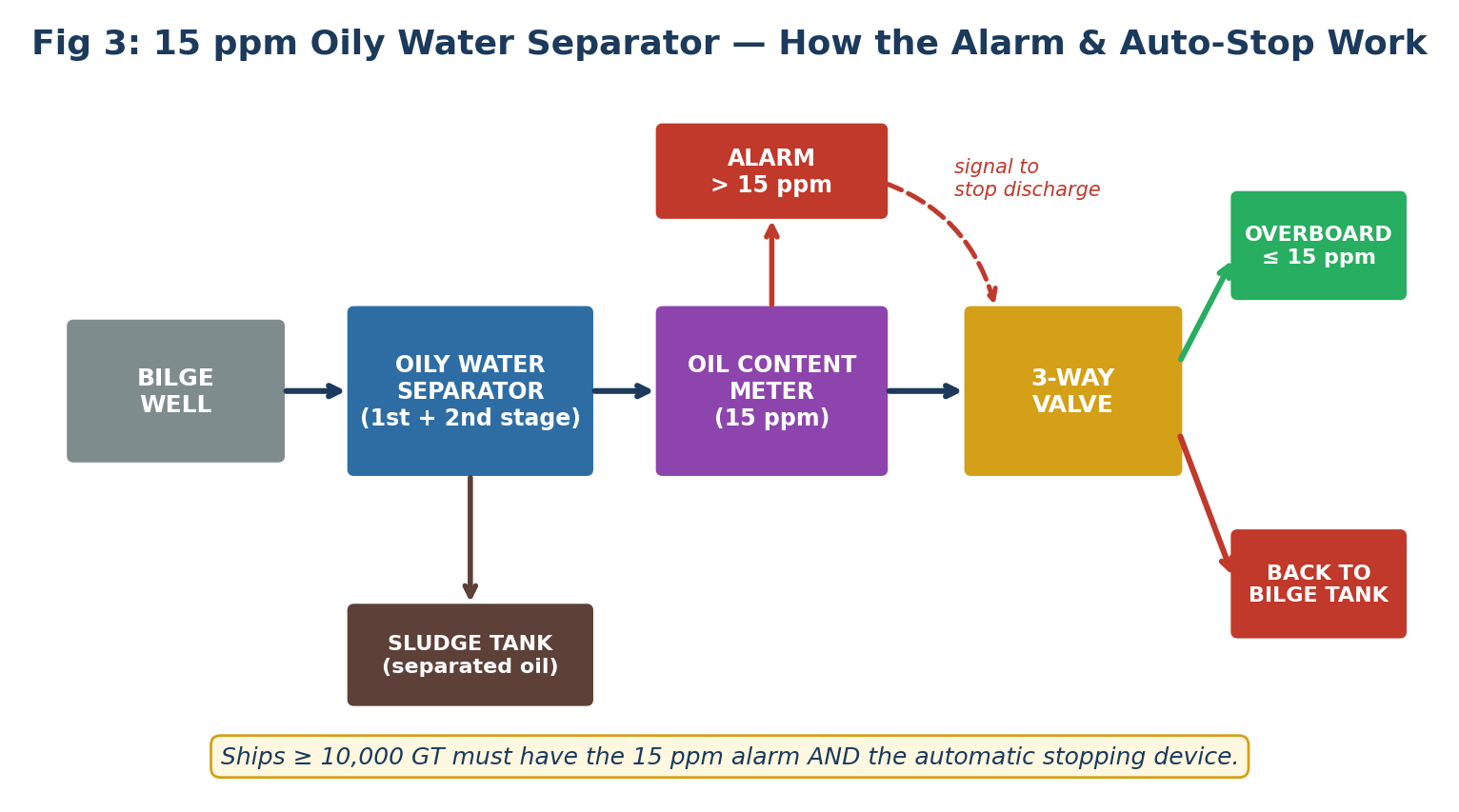
The oil content meter continuously samples the effluent. If the oil content goes above 15 ppm, the alarm sounds and the three-way valve automatically switches the flow back to the bilge holding tank instead of overboard. Separated oil goes to the sludge tank.
⚠ Note: Never bypass the OWS. A 'magic pipe' is one of the most serious offences at sea and leads to detention, heavy fines and imprisonment. PSC specifically looks for bypass arrangements and for ORB entries that do not match tank soundings.
3.3 Discharge from the Cargo Area of Oil Tankers
Outside a Special Area, all of the following must be met:
The tanker is not in a Special Area.
It is more than 50 nautical miles from the nearest land.
It is proceeding en route.
The instantaneous rate of discharge of oil content does not exceed 30 litres per nautical mile.
The total quantity discharged is not more than 1/30,000 of the total quantity of that particular cargo (for tankers delivered after 31 December 1979). For older tankers delivered on or before that date the figure is 1/15,000.
The tanker has an Oil Discharge Monitoring and Control System (ODMCS) and a slop tank arrangement in operation.
INSIDE a Special Area, operational discharge from the cargo area of an oil tanker is PROHIBITED.
💡 Exam Tip: Always state the delivery-date condition when you give the 1/30,000 figure. Saying 'one thirty-thousandth' without the date qualification is an incomplete answer.
3.4 Equipment Required Under Annex I
15 ppm oily water separator — for ships of 400 GT and above.
15 ppm alarm and automatic stopping device — for ships of 10,000 GT and above.
ODMCS — on oil tankers of 150 GT and above, for cargo-area discharges.
Slop tanks — to collect tank washings and oily residues.
Crude Oil Washing (COW) — required, subject to Annex I Regulation 33, on crude oil tankers of 20,000 DWT and above delivered after 1 June 1982.
Segregated Ballast Tanks (SBT) — for tankers delivered after 1 June 1982, required on crude oil tankers of 20,000 DWT and above and product carriers of 30,000 DWT and above. Existing/older tankers are subject to separate transitional provisions; COW could serve as an alternative in certain older crude oil tankers.
Double hull — MARPOL Annex I Regulation 19 applies to oil tankers of 600 DWT and above delivered on or after 6 July 1996 (subject to the regulation’s construction/delivery definitions). Regulation 20 provided the accelerated phase-out scheme for single-hull tankers; Regulation 21 restricts carriage of heavy grade oil in single-hull tankers.
Fuel oil tank protection — Regulation 12A applies to ships delivered on or after 1 August 2010 with fuel oil capacity of 600 m³ and above.
3.5 The Oil Record Book
Part I — Machinery Space | Part II — Cargo / Ballast | |
Applies to | All ships ≥ 400 GT | Oil tankers ≥ 150 GT |
Records | Ballasting/cleaning of fuel tanks; disposal of dirty ballast; disposal of oil residue (sludge); non-automatic and automatic discharge of bilge water; condition of the oil filtering equipment; bunkering of fuel and bulk lube oil; accidental or exceptional discharges | Loading and unloading of oil cargo; internal transfers; ballasting and cleaning of cargo tanks; crude oil washing; discharge of ballast and slops; ODMCS operation |
Signing | Officer in charge signs each completed operation; Master signs each completed page | Same |
Retention | 3 years from the last entry | 3 years from the last entry |
💡 Exam Tip: Know exactly who signs what. Officer in charge signs each operation; the Master signs each page. Kept three years. PSC checks this immediately.
3.6 SOPEP — Shipboard Oil Pollution Emergency Plan
Required for oil tankers of 150 GT and above and all other ships of 400 GT and above. The four contents to remember:
The reporting procedure — when and how to report an incident.
The list of authorities and contacts to be notified — coastal States, port contacts, the Company.
A detailed description of the immediate actions to be taken by shipboard personnel to reduce or control the discharge.
Procedures and the point of contact for coordinating with national and local authorities.
The approved SOPEP is normally supported onboard by relevant drawings, piping arrangements and pollution-response equipment. A dedicated “SOPEP locker” is common shipboard/company practice, but the locker itself is not one of the four statutory plan contents.
3.7 Special Areas Under Annex I
Mediterranean Sea, Baltic Sea, Black Sea, Red Sea, the Gulfs area, Gulf of Aden, Antarctic area, North West European waters, the Oman area of the Arabian Sea, and Southern South African waters.
The Red Sea and Gulf of Aden discharge requirements took effect from 1 January 2025 (Resolution MEPC.381(80)).
3.8 Certificate
The International Oil Pollution Prevention (IOPP) Certificate, valid up to five years. Its Supplement (Form A for non-tankers, Form B for tankers) lists the ship's construction and equipment. PSC checks the Supplement to confirm the listed equipment is actually fitted and working.
4. ANNEX II — Noxious Liquid Substances in Bulk
This applies to chemical tankers carrying noxious liquids in bulk. Substances are placed in categories according to how much harm they do.
4.1 The Categories
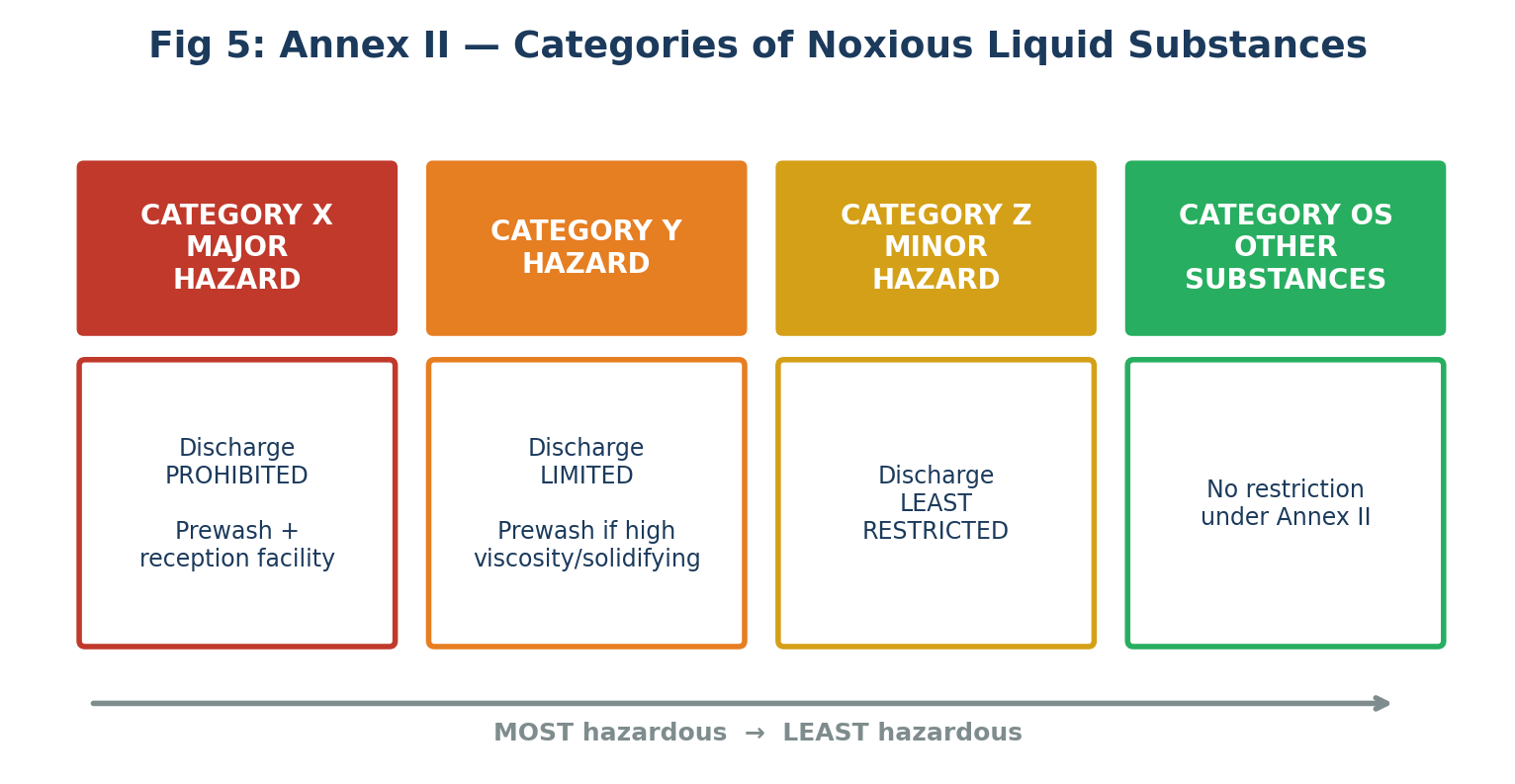
Category X — major hazard. Discharge is prohibited. The tank must be prewashed and the residues sent to a reception facility.
Category Y — hazard. Discharge is limited. Prewash may be required, particularly for high-viscosity or solidifying substances.
Category Z — minor hazard. Least restrictive discharge conditions.
OS (Other Substances) — evaluated and found to fall outside X, Y and Z. No restrictions under Annex II.
4.2 Discharge Conditions
Category X must be treated separately: mandatory prewash is required and the resulting residues/washings are discharged to a reception facility until the prescribed concentration is achieved. For permitted discharge of residues/washings of Categories Y and Z, and subsequent water introduced after a required Category X prewash, the following conditions apply:
The ship is en route at 7 knots or more if self-propelled, or 4 knots or more if not self-propelled.
The discharge is below the waterline through the underwater outlet, not exceeding its design rate.
The ship is at least 12 nautical miles from the nearest land.
The water depth is at least 25 metres.
Prewash is required for Category X, and for Category Y high-viscosity or solidifying substances. Prewash residues go to a reception facility.
For ships built on or after 1 January 2007, the residue left in a tank and its piping must not exceed 75 litres (the stripping standard).
Cleaning additives must not contain Category X components.
💡 Exam Tip: The four numbers for Annex II are 7 knots, 4 knots, 12 nm and 25 metres depth — plus 75 litres for ships built from 2007. Learn them as a set.
4.3 Special Area and Documents
The Antarctic area (south of 60°S) is the Special Area under Annex II — any discharge of NLS there is prohibited. North West European waters, the Baltic, Western European waters and the Norwegian Sea have extra prewash rules for persistent floating Category Y substances, but are not Special Areas.
P&A Manual — the approved Procedures and Arrangements Manual, identifying arrangements and procedures for cargo handling, tank cleaning, slops, ballasting and discharge.
Cargo Record Book — records all cargo, ballast, tank washing and discharge operations.
Certificate — the NLS Certificate; or, for chemical tankers, the International Certificate of Fitness under the IBC/BCH Code, which covers Annex II.
5. ANNEX III — Harmful Substances in Packaged Form
This applies to ships carrying harmful substances (marine pollutants) in packages — freight containers, portable tanks, road and rail tank wagons, and IBCs.
Harmful substances here are those identified as marine pollutants in the IMDG Code. In practice, Annex III is implemented through the IMDG Code, which is mandatory.
5.1 What It Requires
Packaging — adequate to minimise the hazard to the marine environment.
Marking and labelling — the durable MARINE POLLUTANT mark (a diamond/square set at 45°).
Documentation — dangerous goods declaration and manifest carrying the words MARINE POLLUTANT, plus a special list or stowage plan showing where each item is on board.
Stowage — properly secured and stowed to minimise hazard without impairing the safety of the ship.
Quantity limitations — for certain substances.
Jettisoning of harmful substances in packaged form is PROHIBITED — except where necessary for the safety of the ship or saving life at sea.
Empty uncleaned packagings are still treated as harmful substances.
6. ANNEX IV — Sewage
6.1 What Counts as Sewage
Drainage and other wastes from toilets and urinals.
Drainage from medical premises — dispensary, sick bay — via wash basins, wash tubs and scuppers in those spaces.
Drainage from spaces containing living animals.
Other waste waters when mixed with any of the above.
6.2 Who It Applies To
Ships of 400 GT and above, and ships of less than 400 GT certified to carry more than 15 persons, on international voyages.
6.3 Discharge Rules (Outside Special Areas)
Type of Sewage | Distance from Land | Other Conditions |
Untreated (raw) sewage | More than 12 nm | En route at ≥ 4 knots; at a moderate rate approved by the Administration (Res. MEPC.157(55)). Sewage held in a tank must not be discharged all at once. |
Comminuted and disinfected (approved system) | More than 3 nm | En route |
Treated by an approved sewage treatment plant | No distance limit | Effluent must not produce visible floating solids or discolour the water. Standard in Res. MEPC.227(64). |
6.4 The Baltic Sea Special Area
The Baltic Sea is the only Special Area under Annex IV, and the stricter rules apply to passenger ships only — not cargo ships.
Sewage discharge from a passenger ship is prohibited unless the ship uses an approved treatment plant that also meets the nitrogen and phosphorus removal standard in MEPC.227(64) section 4.2 — phosphorus not more than 1.0 mg/l or an 80% reduction, and nitrogen not more than 20 mg/l or a 70% reduction.
Implementation dates under MEPC.275(69): new passenger ships from 1 June 2019; existing passenger ships from 1 June 2021; with a two-year extension to 1 June 2023 for certain existing passenger ships on direct passages to or from ports east of longitude 28°10′E.
💡 Exam Tip: If asked about the Baltic under Annex IV, immediately say 'passenger ships only' — many candidates wrongly apply it to cargo ships.
6.5 Equipment and Certificate
The ship must have one of: an approved sewage treatment plant; an approved comminuting and disinfecting system with a holding tank; or a holding tank with a means of indicating its contents. A standard discharge connection is required for transfer to reception facilities. The certificate is the International Sewage Pollution Prevention (ISPP) Certificate.
7. ANNEX V — Garbage
7.1 The Big Change in 2013
The revised Annex V (Resolution MEPC.201(62)) came into force on 1 January 2013 and turned the old logic upside down.
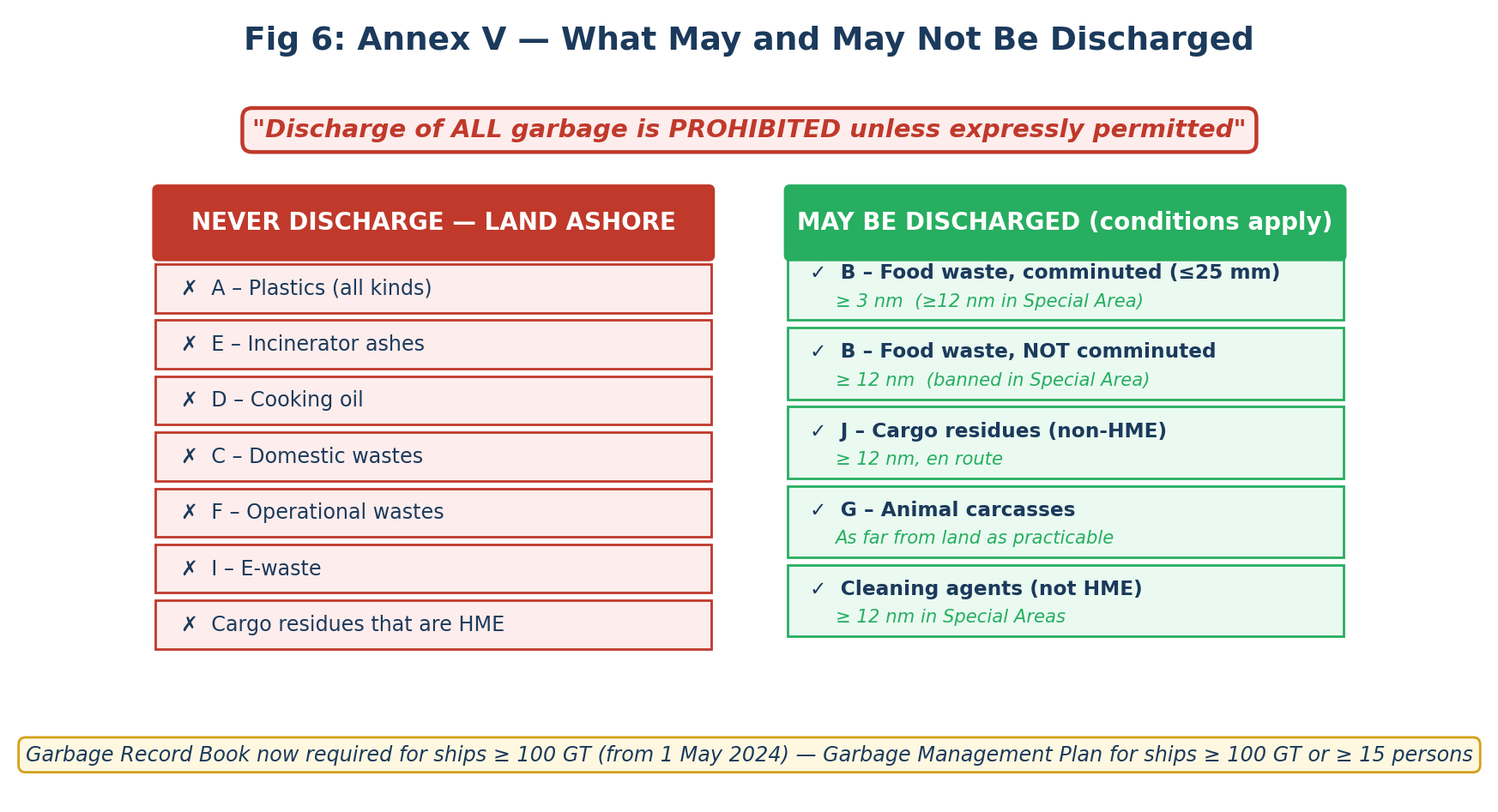
Discharge of ALL garbage into the sea is PROHIBITED unless expressly permitted.
Before 2013 the rule was 'you may discharge unless it is banned'. Now it is 'everything is banned unless it is specifically allowed'. This single sentence is worth memorising word for word.
7.2 The Discharge Table
Type of Garbage | Outside Special Areas | Inside Special Areas |
Plastics (including synthetic ropes and fishing gear) | PROHIBITED | PROHIBITED |
Food waste, comminuted or ground (passes a 25 mm screen) | ≥ 3 nm, en route | ≥ 12 nm, en route |
Food waste, not comminuted | ≥ 12 nm, en route | PROHIBITED |
Cargo residues NOT harmful to the marine environment | ≥ 12 nm, en route | ≥ 12 nm, only under strict conditions |
Cargo residues that ARE harmful (HME) | PROHIBITED | PROHIBITED |
Cleaning agents and additives in hold wash water | Permitted if not HME | ≥ 12 nm, if not HME |
Animal carcasses | As far from land as practicable | PROHIBITED |
Domestic wastes, cooking oil, incinerator ashes, operational wastes, e-waste | PROHIBITED | PROHIBITED |
Offshore platforms, and ships within 500 m of them: only comminuted or ground food waste may be discharged, and only when more than 12 nm from land. Some jurisdictions apply stricter distances — California uses 25 nm.
7.3 Garbage Record Book, Plan and Placards
Garbage Management Plan — required for every ship of 100 GT and above, every ship certified to carry 15 persons or more, and fixed or floating platforms as applicable. The 100 GT threshold for the Plan was already in place; the major 2024 change concerned the Garbage Record Book.
Placards — displayed to notify crew and passengers of the disposal requirements, on ships of 12 m or more in length overall.
Garbage Record Book — Resolution MEPC.360(79) extended the mandatory record book to ships of 100 GT and above (from the previous 400 GT threshold), effective 1 May 2024. It also applies to ships certified to carry 15 persons or more engaged in relevant voyages, and to fixed/floating platforms as applicable. Part I covers garbage operations; Part II covers cargo residues for ships carrying solid bulk cargo. Retained for 2 years.
Garbage categories are recorded by letter: A Plastics; B Food wastes; C Domestic wastes; D Cooking oil; E Incinerator ashes; F Operational wastes; G Animal carcasses; H Fishing gear; I E-waste; J Cargo residues. Loss of fishing gear that poses a threat must be reported to the flag State.
💡 Exam Tip: The 100 GT threshold from 1 May 2024 is recent and surveyors like recent changes. Older textbooks still say 400 GT — do not repeat that.
7.4 Special Areas Under Annex V
Mediterranean Sea (1 May 2009), Baltic Sea (1 Oct 1989), Black Sea, Red Sea (1 January 2025, MEPC.382(80)), the Gulfs area (1 Aug 2008), North Sea (18 Feb 1991), Antarctic area (17 Mar 1992), and the Wider Caribbean Region including the Gulf of Mexico (1 May 2011).
8. ANNEX VI — Air Pollution
This is the largest, fastest-changing and most heavily examined annex. Take it in five parts: SOx, NOx, ECAs, other controls, and energy efficiency.
8.1 SOx and Particulate Matter (Regulation 14)
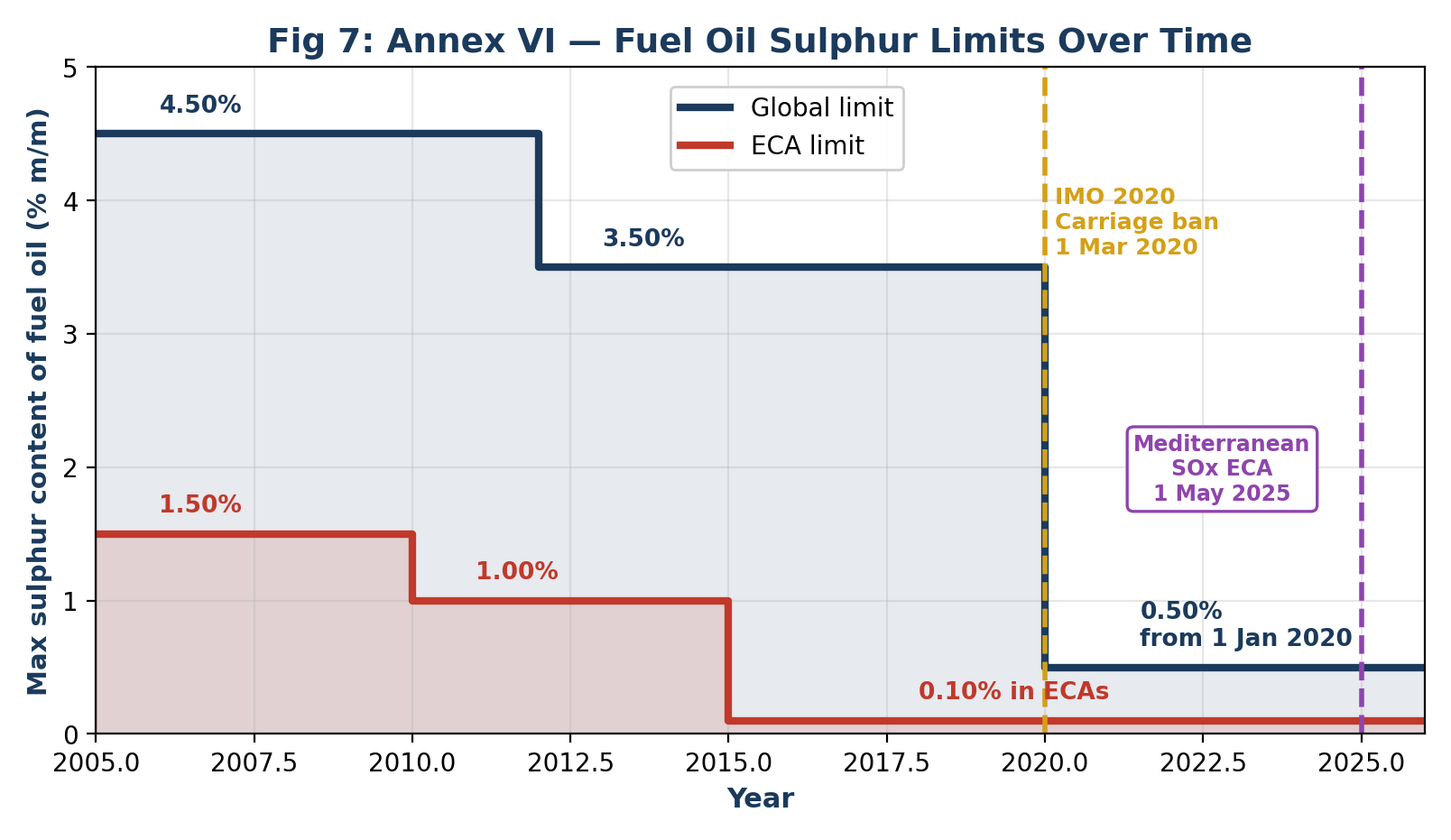
Global sulphur cap 0.50% m/m since 1 January 2020, down from 3.50%.
ECA sulphur limit 0.10% m/m. This is one-fifth of the global limit.
Carriage ban — from 1 March 2020 the carriage of fuel oil above 0.50% sulphur for combustion is prohibited unless the ship has a scrubber fitted, or the high-sulphur oil is carried as cargo.
FONAR — the Fuel Oil Non-Availability Report. If compliant fuel cannot be obtained despite best efforts, the ship submits a FONAR to its flag State and the port State under Regulation 18. It is evidence of best efforts, not an automatic exemption.
Scrubbers (EGCS) — accepted as an equivalent under Regulation 4. Open-loop discharges wash water overboard; closed-loop recirculates and stores residues for shore disposal; hybrid can switch between the two. A number of ports and States ban or restrict open-loop discharge in their waters, requiring closed-loop mode or compliant fuel.
Bunker Delivery Note — retained on board for at least 3 years. The representative MARPOL fuel oil sample is retained until the fuel oil is substantially consumed, but in any case for not less than 12 months from the date of delivery.
Recent change: Resolution MEPC.385(81), in force 1 August 2025, requires ships using low-flashpoint and gas fuels to be issued a Bunker Delivery Note; ships using high-flashpoint gas fuels such as ammonia are excluded from the in-use sampling-point requirement.
💡 Exam Tip: A very common oral question is 'What do you do if compliant fuel is not available?' The answer is: make documented best efforts to obtain it, notify the flag State and the next port State, and submit a FONAR — but never simply burn non-compliant fuel and stay silent.
8.2 NOx (Regulation 13)
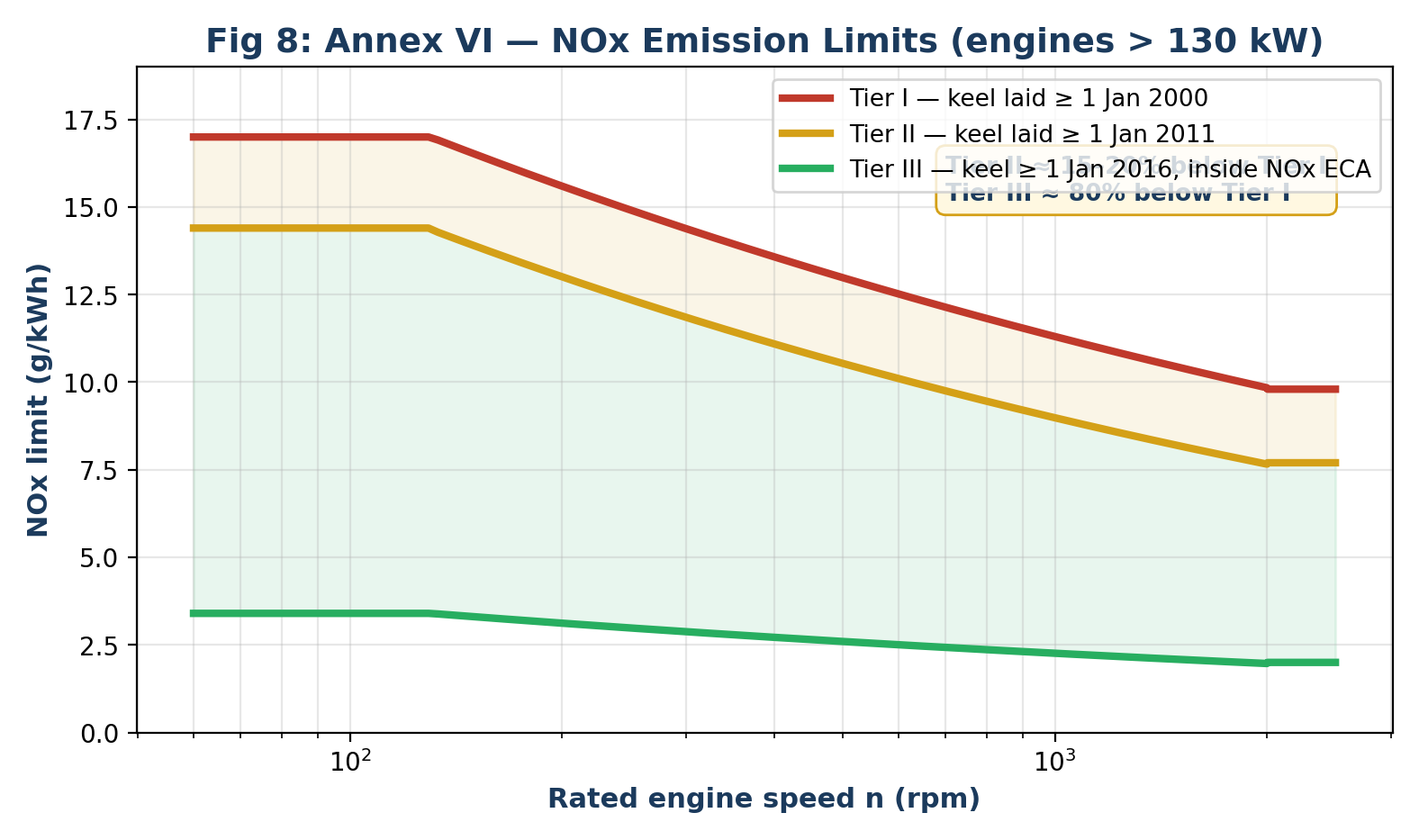
Applies to installed marine diesel engines of more than 130 kW output, except engines used solely for emergency purposes (including applicable emergency/lifeboat engines). The limit depends on the engine's rated speed and the applicable Tier/ship construction date.
Tier | Applies To | Roughly |
Tier I | Ships with keel laid on or after 1 January 2000 | Baseline |
Tier II | Ships with keel laid on or after 1 January 2011 | 15–20% below Tier I |
Tier III | Relevant ships operating inside a NOx ECA; construction-date applicability depends on the specific ECA (e.g. 2016 North American/US Caribbean, 2021 Baltic/North Sea, newer dates for Canadian Arctic/Norwegian Sea) | About 80% below Tier I |
Tier III compliance may be achieved by approved/certified arrangements such as SCR, EGR, combustion/engine optimisation, or a Tier III-certified gas/dual-fuel engine system. Gas fuel by itself does not automatically prove Tier III compliance.
NOx ECA applicability: North American and United States Caribbean Sea ECAs apply Tier III to relevant ships constructed on or after 1 January 2016; Baltic Sea and North Sea to relevant ships constructed on or after 1 January 2021. Under MEPC.392(82), the Canadian Arctic provisions apply to relevant ships constructed on or after 1 January 2025, while the Norwegian Sea provisions use 1 March 2026 as the construction reference date (with the detailed contract/keel/delivery criteria in Regulation 13).
Documents you must know:
NOx Technical Code 2008 — the rulebook for testing and certifying engines.
EIAPP Certificate — issued for each engine.
Technical File — approved, kept with the engine; defines NOx-critical components and settings.
Record Book of Engine Parameters — documents any change to NOx-critical components or settings.
Engine parameter check method and onboard monitoring — used for verification at surveys and PSC.
Pre-2000 engines may use an Approved Method where one exists.
💡 Exam Tip: Tier and on/off status must be logged when entering and leaving a NOx ECA. Surveyors ask 'How do you prove you were Tier III compliant in the ECA?' — the answer is the log entries plus the SCR/EGR operating records.
8.3 Emission Control Areas — Status in 2026
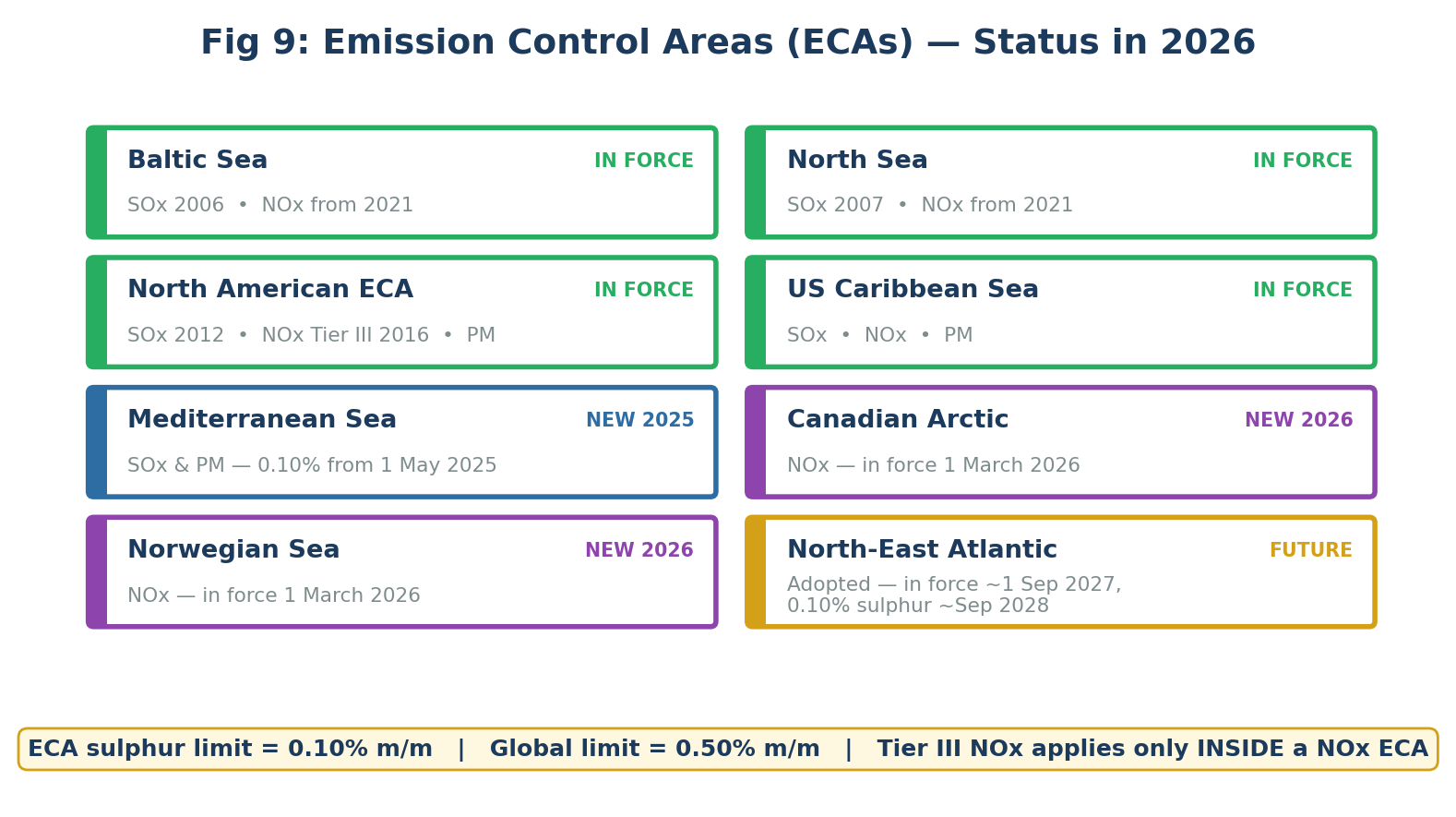
⚠ UPDATED AUGUST 2026: The North-East Atlantic ECA has now been adopted at MEPC 84. The MARPOL Annex VI amendment enters into force on 1 September 2027 and the ECA requirements take effect 12 months later, in September 2028. The Canadian Arctic and Norwegian Sea ECA amendments entered into force on 1 March 2026. Use this updated text if any older label in Fig. 9 differs.
8.4 Other Annex VI Controls
(a) Ozone Depleting Substances — Regulation 12
Deliberate emission of ODS is prohibited.
New installations containing CFCs or halons — prohibited on ships built on or after 19 May 2005.
New installations containing HCFCs — prohibited on ships built on or after 1 January 2020.
Existing HCFC systems may continue in use and be recharged.
An ODS Record Book is kept for recharge, repair and disposal. ODS removed from the ship must go to reception facilities.
(b) VOC Management — Regulation 15
Since 1 July 2010, every tanker carrying crude oil must have and implement an approved, ship-specific VOC Management Plan. Ports and terminals designated for VOC control require an approved vapour-collection system.
(c) Shipboard Incinerators — Regulation 16
Incinerators installed on or after 1 January 2000 must be type-approved to Resolution MEPC.76(40). The following must NOT be incinerated on board:
Annex I, II and III cargo residues.
Polychlorinated biphenyls (PCBs).
Garbage containing more than traces of heavy metals.
Refined petroleum products containing halogen compounds.
PVC — except in a type-approved incinerator.
8.5 Energy Efficiency — Chapter 4
This chapter is about greenhouse gases and fuel efficiency. Split it into technical (design) measures and operational measures.
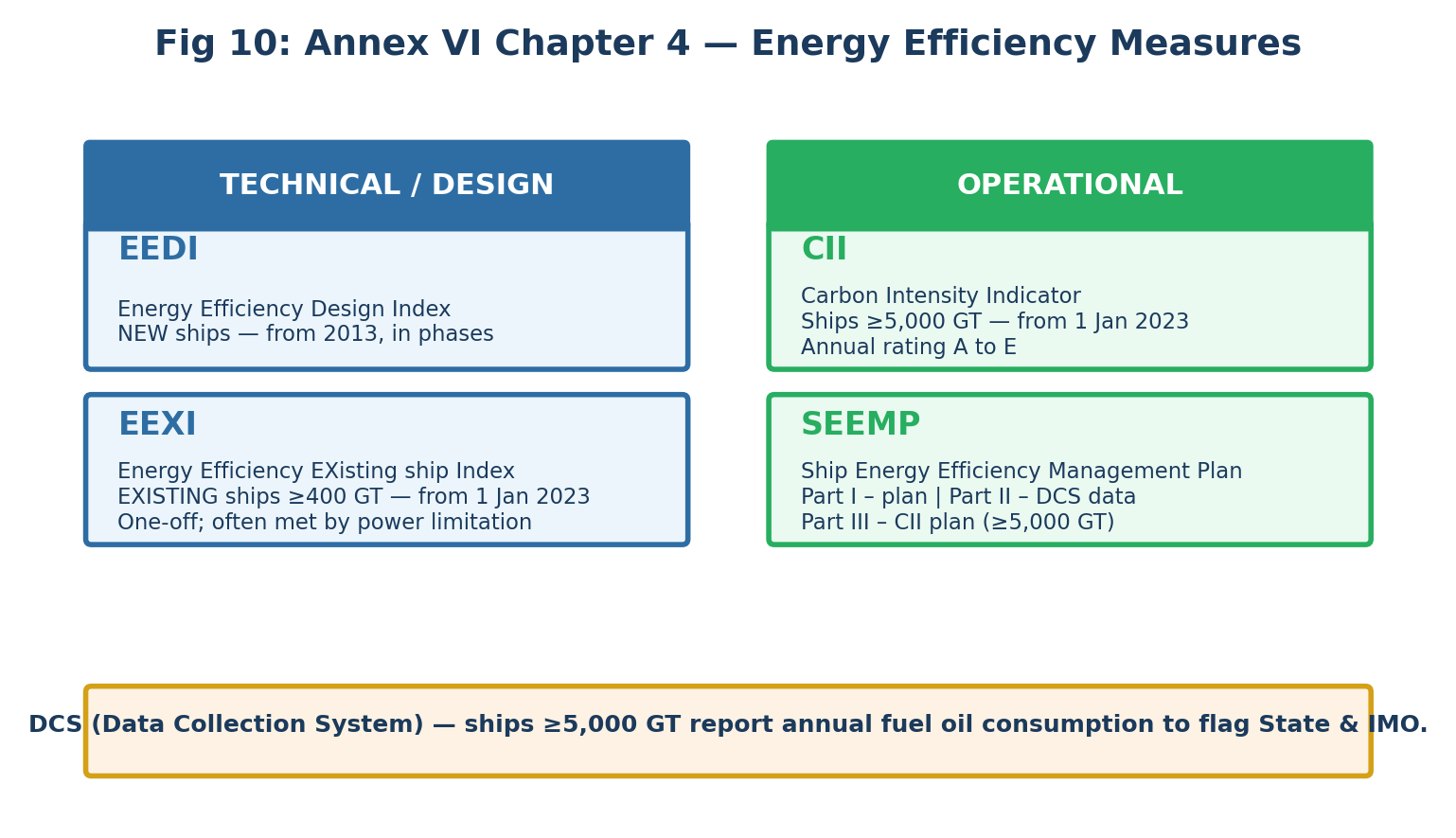
EEDI — Energy Efficiency Design Index. A mandatory design standard for new ships since 2013, tightened in phases (Phase 0, 1, 2, 3), with reduction factors rising by ship type and size.
EEXI — Energy Efficiency Existing Ship Index. A one-off technical/design index for existing ships of 400 GT and above, in force from 1 January 2023 and verified at the first IAPP survey after that date. Attained EEXI must be less than or equal to required EEXI. Compliance is often achieved by engine or shaft power limitation, or waste heat recovery.
SEEMP — Ship Energy Efficiency Management Plan. Part I is the ship-specific efficiency management plan; Part II is the fuel oil consumption data collection plan for DCS; Part III is the plan to achieve the required annual CII for ships of 5,000 GT and above, verified and kept on board from 1 January 2023.
CII — Carbon Intensity Indicator. An operational measure for ships of 5,000 GT and above, in force from 1 January 2023. The attained annual operational CII is rated A to E, where A is best. A ship rated D for three consecutive years, or E for one year, must submit a corrective action plan in SEEMP Part III. The rating is recorded on the annual Statement of Compliance.
DCS — Data Collection System. Ships of 5,000 GT and above report annual fuel oil consumption to the flag State and IMO. Resolution MEPC.385(81), in force 1 August 2025, requires enhanced granularity — fuel consumption by consumer type, transport work and onshore power. Existing ships' SEEMP Part II had to be updated and approved by 31 December 2025, with enhanced data collected from 1 January 2026.
How hard the CII gets, year by year:
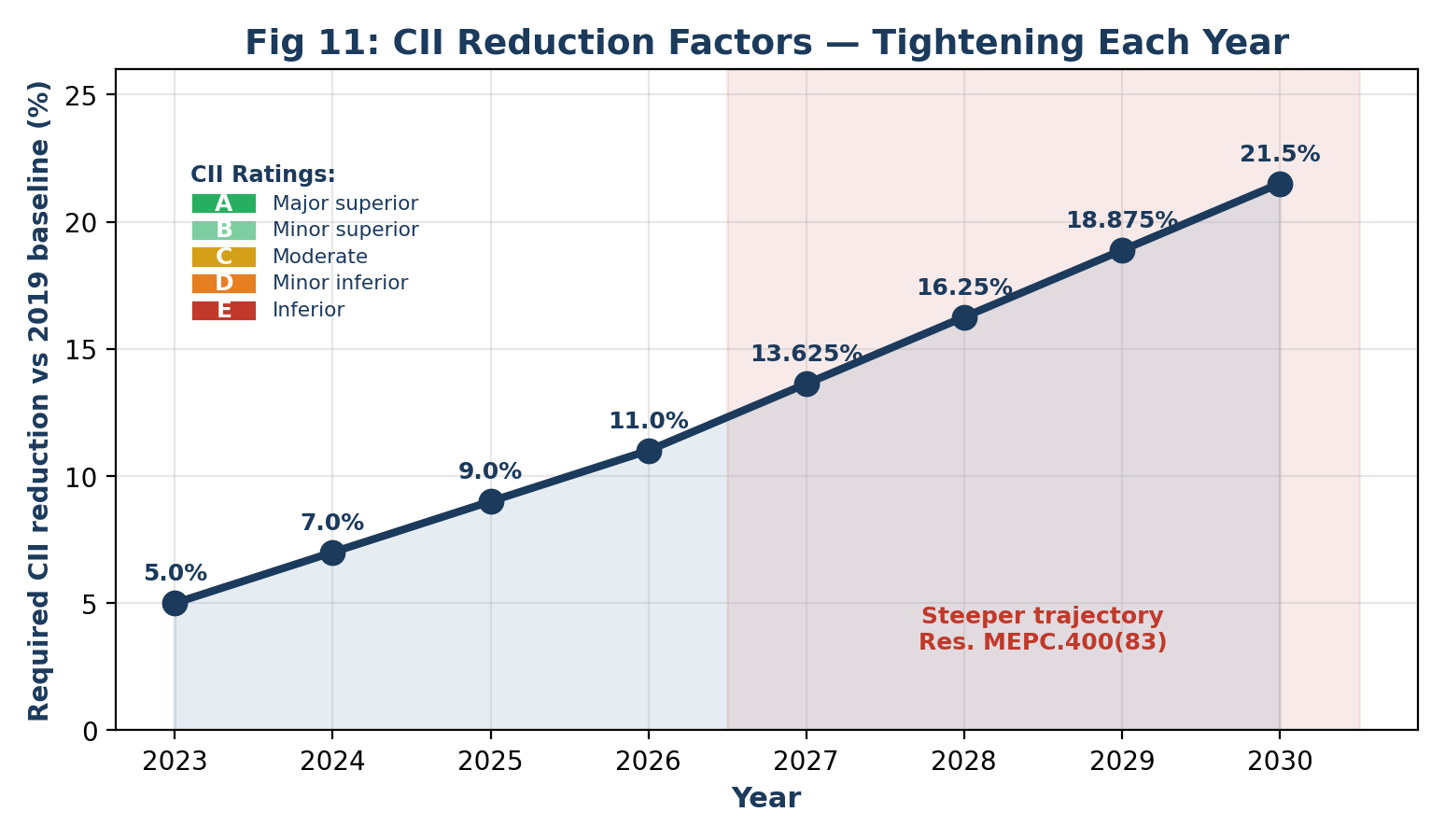
The reduction is measured against a 2019 baseline: 5% in 2023, rising to 11% in 2026, and then — under Resolution MEPC.400(83), adopted 11 April 2025 — 13.625% in 2027, 16.25% in 2028, 18.875% in 2029 and 21.5% in 2030.
💡 Exam Tip: The cleanest way to explain the difference in an oral: EEDI is for new ships at the design stage; EEXI is the same idea applied once to existing ships; CII is how efficiently you actually operate the ship each year. Design versus operation is the distinction they are testing.
8.6 The IMO Net-Zero Framework — Know the Status
The revised 2023 IMO GHG Strategy, adopted in July 2023, sets net-zero greenhouse gas emissions by or around 2050, with indicative checkpoints of at least 20% reduction (striving for 30%) by 2030 and at least 70% (striving for 80%) by 2040 against 2008, plus uptake of zero or near-zero fuels of at least 5% (striving for 10%) by 2030.
The IMO Net-Zero Framework would add a new Chapter 5 to Annex VI, combining a technical element — a goal-based GHG Fuel Intensity (GFI) standard measured well-to-wake in gCO₂eq/MJ — with an economic element, a GHG pricing mechanism. It would apply to ships above 5,000 GT, which produce roughly 85% of international shipping CO₂.
⚠ UPDATED AUGUST 2026: The IMO Net-Zero Framework was approved at MEPC 83 in April 2025 but has NOT been adopted into MARPOL Annex VI and is NOT in force. The extraordinary session in October 2025 was adjourned; MEPC 84 in April 2026 continued the work without adopting the framework. Therefore, do not quote a firm entry-into-force date in the oral exam. State that further negotiations/adoption work is continuing.
If asked for detail: each ship's attained GFI would be compared against two annual targets set from a 2008 baseline of 93.3 gCO₂eq/MJ — a Base Target and a stricter Direct Compliance Target. Ships below the stricter target earn Surplus Units; ships above the targets buy Remedial Units. Draft prices were set at 380 US dollars per tonne CO₂eq for Tier 2 and 100 US dollars per tonne for Tier 1, for the period 2028 to 2030 only. Proceeds would go to an IMO Net-Zero Fund. All of these figures are draft and subject to change.
8.7 Annex VI Certificates
IAPP Certificate — International Air Pollution Prevention Certificate, for the ship.
EIAPP Certificate — International Air Pollution Prevention Certificate for each engine.
IEE Certificate — International Energy Efficiency Certificate, covering EEDI, EEXI and SEEMP compliance.
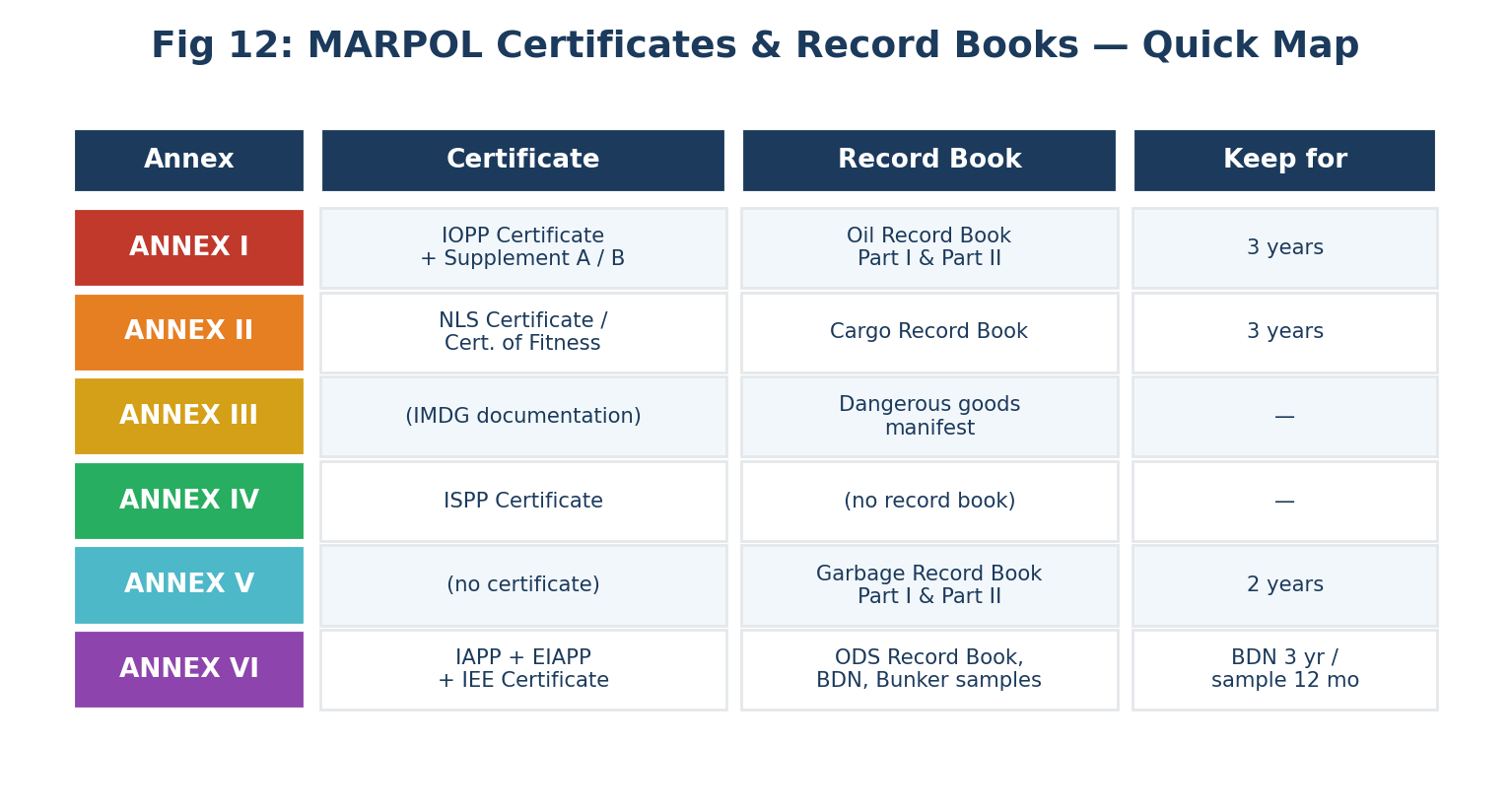
9. Certificates and Record Books — Quick Map
If you remember one summary page for the oral, make it this one.
10. Enforcement, PSC and Surveys
10.1 Article 4 — Violations and Penalties
A violation is prohibited and sanctioned under the law of the flag Administration wherever in the world it occurs. If it occurs within the jurisdiction of a Party, it is also prohibited and sanctioned under that Party's law. Penalties must be adequate in severity to discourage violations, and equally severe wherever the violation happens.
Flag States survey, certify and enforce. Port and coastal States inspect, and may detain and prosecute.
10.2 Port State Control
Foreign ships may be inspected in port. With clear grounds, a detailed inspection follows. PSC is harmonised through regional MoUs — Paris, Tokyo, Indian Ocean MoU and others.
Detainable deficiencies commonly found under MARPOL:
Oily water separator or 15 ppm equipment inoperative, or bypassed.
Oil Record Book or Garbage Record Book not maintained, or falsified.
Missing or invalid certificates — IOPP, IAPP, IEE, ISPP.
Sewage treatment plant or incinerator inoperative.
Non-compliant fuel on board with no FONAR.
Surveys overdue.
10.3 Port Reception Facilities
Each Party undertakes to ensure adequate reception facilities are provided at ports and terminals for oily residues, NLS residues, sewage and garbage, without causing undue delay to ships. Inadequate facilities may be reported to IMO through GISIS.
10.4 Survey and Certification
Most MARPOL statutory certificates such as IOPP, IAPP and ISPP are subject to the HSSC survey cycle (initial, annual/intermediate as applicable, and renewal) with a maximum validity normally of five years. However, do NOT apply this statement to every MARPOL certificate: the International Energy Efficiency (IEE) Certificate is normally valid throughout the life of the ship, unless it ceases to be valid under Annex VI (for example after certain major conversions, transfer of flag, or withdrawal from service). Recognised Organisations may act on behalf of the flag Administration when authorised.
11. Recent Amendments — 2024 to 2026
Date | What Changed |
1 July 2024 | Arctic HFO ban — heavy fuel oil may not be used or carried for use as fuel in Arctic waters (exemptions and waivers run to 1 July 2029 for certain ships). |
1 May 2024 | Garbage Record Book threshold lowered from 400 GT to 100 GT (Res. MEPC.360(79)). |
1 January 2025 | Red Sea and Gulf of Aden — Annex I Special Area discharge requirements and Annex V Red Sea Special Area take effect. |
1 May 2025 | Mediterranean Sea becomes a SOx and PM ECA — 0.10% sulphur limit (Res. MEPC.361(79)). |
1 August 2025 | Enhanced IMO DCS reporting and Bunker Delivery Notes for low-flashpoint and gas fuels (Res. MEPC.385(81)). SEEMP Part II to be updated by 31 December 2025. |
1 January 2026 | Enhanced granular DCS data collection begins for the 2026 reporting year. |
1 March 2026 | Canadian Arctic and Norwegian Sea designated as Annex VI ECAs; the amendments enter into force on 1 March 2026 (Res. MEPC.392(82)). Tier III applicability depends on the ship-construction criteria specified for each area. |
1 September 2026 | NOx Technical Code 2008 amendment MEPC.398(83) enters into force — certification of an engine subject to substantial modification or being certified to a Tier to which it was not certified at installation. |
1 March 2027 / 1 September 2027 | MEPC.397(83) NOx Technical Code amendments on multiple engine operational profiles enter into force 1 March 2027; corresponding MARPOL Annex VI amendments MEPC.408(84) enter into force 1 September 2027. |
North-East Atlantic / Net-Zero | North-East Atlantic ECA adopted at MEPC 84: MARPOL Annex VI amendment MEPC.407(84) enters into force 1 September 2027; ECA requirements take effect 12 months later in September 2028. IMO Net-Zero Framework: approved in principle but not yet adopted/in force as of August 2026. |
Continue your preparation
Explore month-wise written questions and model answers in the study portal.
Return to the study desk ↗Use these notes alongside current official publications and applicable flag requirements. Find official references.