Answer
Retrofitting a Propeller is typica ally done to improve the efficiency of a ship’s propulsion system. Here are some key reasons for retrofitting a Propeller:
1. Improved Efficiency: Operational profiles with varying speeds often lead to no on-optimal Propeller designs
on existing vessels. These Propellers have ve typically been designed for maximum speed and low cavitation. An upgrade
to a high-efficiency Propeller can reduce e the overall fuel consumption.
2. Fuel Saving: Exchanging the existing ship’s Propeller with a retrofit Propeller tailored to the new operating profile significantly increases efficiency and simultaneously reduces fuel consumption on. In combination with an innovative Propeller cap, ship owners can n achieve fuel savings of up to 14 percent.
3. Adaptation to New Operating Profiles: Propeller retrofitting is suitable for all vess sel types and ages with slow steaming, especially container and large vessel series. The exchange of the Propeller er with an upgraded design assures operation at peak efficiency.
4. Compliance with Regulations: The EEXI regulations require additional efficiency improvements in order to
meet the CO2 reduction goals
We should provide the following things--
1.Drawings, manuals, sea trial data, performance data to give
2.100% Propeller immersion should take place
3.Minimum tip clearance should be present
4.Propeller curve as given by the manufacturer should cut the engine curve line at point M
Propeller tip broken-
1.Edge cracks-
Edge cracks can quickly become more serious especially at the leading edge if the cracks are less than 10 mm in length.
They can be ground out and the edge faired.
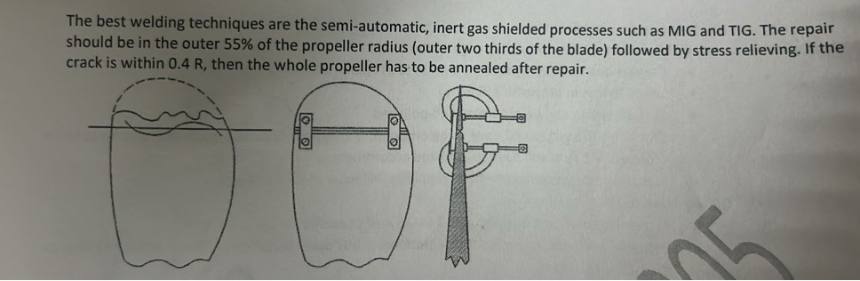
Larger cracks may need to be repaired by drilling a small hole at the root of the crack, gouging out, welding, grinding and polishing.
2.Serious edge damage-
repaired by welding on a new cast piece of the Blade
The Blade is cropped and the new portion clamped in position, welded on one side, ground flash, clamps reversed, other side gauged welded and ground.
final polish gives the required finish to the blade surface