Answer
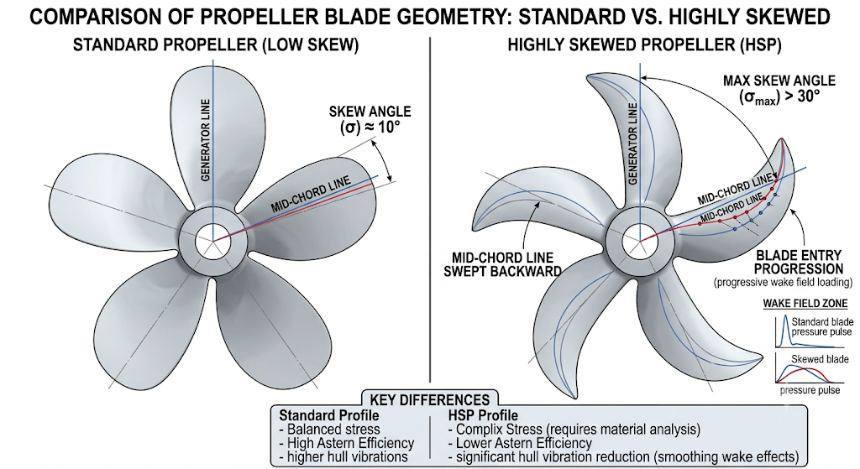
A highly skewed propeller is a propeller in which the blades are strongly swept backward in the circumferential direction, so that the blade tip is significantly displaced from the radial line through the blade root.
propeller blades having a skew angle greater than about 25° as highly skewed blades.
Why are propeller blades highly skewed?The main purpose is to reduce vibration, pressure pulses and cavitation, especially on ships where the propeller operates in a non-uniform wake field behind the hull.
In a normal blade, a comparatively large portion of the blade may enter the high-wake region near the top of the propeller disc almost simultaneously. This produces a sudden change in blade loading.
With a highly skewed blade: Different radial portions of the blade enter the high-wake region progressively rather than simultaneously.Therefore, the change in thrust is spread over a longer period.
Main advantages-
Reduced hull pressure pulses
- Particularly important near the stern plating above the propeller.
-
Reduced propeller-induced vibration
- Less vibration transmitted to stern structure, shafting and accommodation.
-
Reduced cavitation
- Loading is distributed more gradually as the blade passes through the wake field.
-
Reduced propeller noise
- Useful for passenger ships, naval vessels and ships where underwater-radiated noise is important.
-
Smoother thrust
- Reduces the magnitude of fluctuating or alternating thrust.
Highly skewed blades have important structural disadvantages.
Because the blade is swept backward, the hydrodynamic force produces a larger bending and twisting moment at the blade root. Therefore:
- blade-root stresses are higher,
- manufacturing/design is more complicated,
- structural analysis is more critical,
- repair requires greater care,
- excessive skew may reduce structural robustness.