Answer
Pre-swirl and post-swirl devices are Energy Saving Devices (ESDs) fitted around the ship's propeller to optimize hydrodynamic efficiency, reduce fuel consumption, and lower greenhouse gas (GHG) emissions. They work by recovering kinetic losses from the water flow around the hull and propeller race.
Hydrodynamic Working PrinciplePre-Swirl Devices (Ahead of Propeller): Modify the inflow of water coming off the hull before it reaches the propeller disc. By introducing a rotational flow opposite to the propeller’s direction of rotation (counter-swirl), the effective angle of attack on the propeller blades is increased. This generates higher thrust for the same shaft power input.
Post-Swirl Devices (Behind Propeller): Target the rotational energy (swirl losses) present in the propeller slipstream. The propeller naturally imparts rotational kinetic energy to the water, which is normally lost. Post-swirl devices straighten this turbulent, rotating outflow into axial flow, converting lost rotational energy into useful forward thrust.
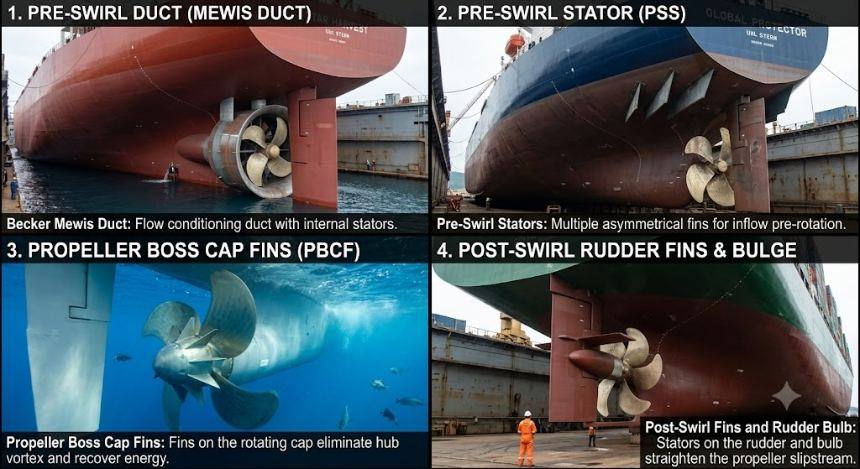
| ESD Category | Device Type | Location | Working Mechanism & Primary Benefit |
| Pre-Swirl | Pre-Swirl Stators (PSS) | Welded to the stern frame/bossing, directly forward of the propeller. | Set of asymmetrical fins that pre-rotate the flow counter to propeller rotation. Improves propeller efficiency by 2%–6%. |
| Pre-Swirl | Equalizing Ducts / Kort-type Ducts (e.g., Becker Mewis Duct) | Fitted upstream of the propeller on the upper part of the stern tube bossing. | Combines a flow-directing duct with internal stator fins. Equalizes wake wash, reduces flow separation, and introduces pre-swirl (saving 3%–8% fuel). |
| Post-Swirl | Propeller Boss Cap Fins (PBCF) | Replaces the standard propeller boss cap (rotates with the shaft). | Features small fins aligned with the propeller blades. Eliminates the hub vortex, reduces hub drag, and recovers rotational energy (saving 1.5%–3% fuel). |
| Post-Swirl | Post-Swirl Stators (Asymmetric Rudder Fins / Rudder Bulge) | Fixed to the rudder horn or rudder blade downstream of the propeller. | Uses stationary fins or an asymmetric bulb (e.g., Costa Bulb) integrated into the rudder to convert slipstream swirl into axial thrust (saving 2%–4% fuel). |