Answer
A – Ref URS6
Types of steel used for Ship construction include:
1.Mild steel
2.High Tensile Steel
3.Aluminium alloys (A major disa advantage of the use of aluminium alloys is thei ir high initial cost (They are
estimated to cost 8 to 10 times the price of steel per tonnage)) URW25
Grades of steel: | |||||
Grade A: A mild steel used in majority | of the ship structure of less than 20mm thicken ness such as B/heads, T/top, | ||||
Non-strength Deck & structures | |||||
Grade E: An extranotch tough steel bec | ause this is a heat treated Grade D steel used fo | r very thick plating in excess | |||
of 50mm thick. Arctic D: A special grade of steel used w where the part of the structure is subject to extr reme low temp.. UTS is 435- 510 Nm/m2 ; yield stress – 310 Nm/m2 If mentioned as AH,BH n so on it means s HighTensileSteel of that grade.EH can be used fo or ice classed vessel. Benefits: | |||||
| Increased Strength | ||||
| Increased Durability | ||||
| Reduced Weight | ||||
| Increased Flexibility | ||||
Drawbacksof HTS: | |||||
| High-tensile steel is more expen nsive than other types of steel. | ||||
| High-tensile steel is more difficu ult to work with than other types of steel. | ||||
| High-tensile steel is less ductile | than other types of steel. This means that it is m more likely to break or | |||
shatter under impact. | |||||
| High-tensile steel can be more s susceptible to corrosion than other types of steel. | ||||
| High-tensile steel may not be as s strong as other types of steel in certain applicat tions. | ||||
| Hts is susceptible to fatigue crac cooking | ||||
| Higher cost | ||||
| Will have to renewal of steel qu uicker- considering the Substantial Corrosion. | ||||
Q5- Propeller inspection, defects and | repairs. Polishing grades and any special instar ruction to yard before they | ||||
polish the Propeller? A – Ref URW24
Zone A: | |||||
5.Welding generally not permitte | d | ||||
6.If welding permitted(special con nsideration by class) than Heat relieving essential 7.High residual stress could lead t to fatigue cracking. Zone B 1.Opr. Stress high 2.Welding preferably avoided but t generally allowed(approval by class) 3.All repair procedure to be subm imitated to class for approval. | |||||
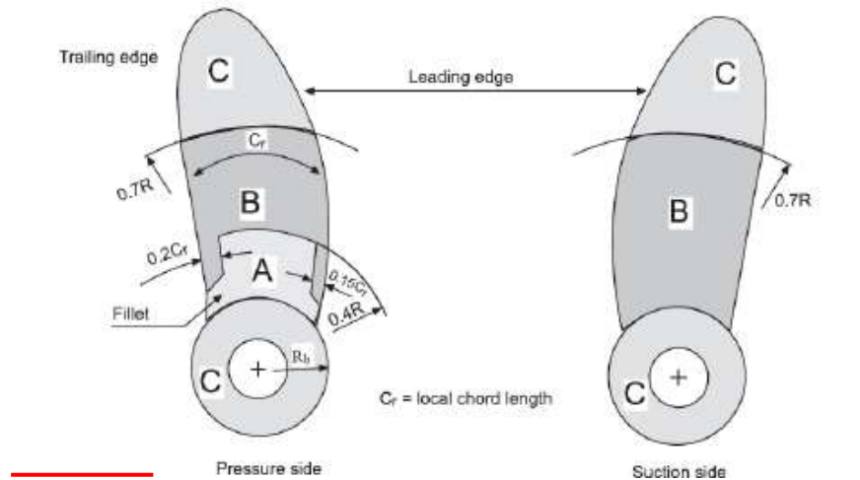
Zone C
1.Low opr stress
2.Min blade thickness
3.Welding allowed after approval from class.
Types of Inspection:
1.Visual testing
2.Dye penetrant test in accordance with specs from C/society.
3.Ultrasonic test
Repair:
1.Repair by mech. Means i.e Grinding, milling, chipping,etc,.
2.After milling & chipping to be followed by grinding.
3.Welding of area <5cm2 to be avoided
Repair for Zone A:
1.Welding generally not permitted, If welding permitted(special consideration by class) 2.In all case of repair the thickness of the blade to be maintained.
Repair in zone B
1.Defects that are not deeper than dB = (t/40) mm (t = min. local thickness in mm according to the Rules) or 2 mm (whichever is greatest) below min. local thickness according to the Rules of the C/Society should be removed by grinding.
2.Those defects that are deeper than allowable for removal by grinding may be repaired by welding.
Repair in zone C
1.In zone C, repair welds are generally permitted.
Propeller Polishing
Problem: Without regular maintenance, Propellers are prone to build-ups of calcareous deposits, as well as corrosion and other damage. This reduces their efciency and may require restorative processes that further impact
Benefits: 1.Lower fuel use (Propeller fouling creates drag) 2.Identifying blade damage (driver identify at early stage)
the environment.
3.Regular polishing intervals (optimal perf. At all times, wartsila recommends one or twice/year)
Grades of Propeller polishing:
• The industry standard is to use a Rupert scale
• Rupert "A" roughness which equates to a surface roughness of 0.65 microns. Its, highest quality finish that
can be achieved by polishing of blades
• New Propellers are typically delivered with a surface roughness in accordance with ISO standard 484.
Propellers are delivered to either a Class "S" or Class "I" standard which equates to surface roughness between1.5 and 6 microns.
• Since there is no available technology to measure the surface roughness underwater the only way to
evaluate the roughness is to visually compare the polished surface to a reference gauge. Propeller polishing in 3 different Processes: (added just for Xquestion)
• STAGE 1 ⇒ ORANGE DISC - Remove marine growth and thick Calcium layers
• STAGE 2⇒BLUE DISC - Polish the Propeller to Grade 'A/B.'
• STAGE 3 ⇒ BLACK DISC - Polish the Propeller to Grade 'A.'