Answer
The SAR Convention is the International Convention on Maritime Search and Rescue, 1979. Its objective is to establish an internationally coordinated system so that persons in distress at sea receive assistance irrespective of nationality or circumstances. Contracting Governments are required to establish SAR regions, Rescue Coordination Centres, communication facilities and rescue units, and to cooperate with neighbouring States. The Convention lays down procedures for distress alerts, SAR coordination, appointment of the SAR Mission Coordinator and On-Scene Coordinator, and recognizes uncertainty, alert and distress phases. The 2004 amendments further strengthened arrangements for disembarkation of rescued persons at a place of safety.
The SAR Convention is the International Convention on Maritime Search and Rescue, 1979, adopted by IMO in Hamburg on 27 April 1979 and entered into force on 22 June 1985.
Its purpose is to ensure that, wherever a casualty occurs at sea, there is an organized international system for search and rescue, with coordination between coastal States so that persons in distress can be rescued quickly and effectively.
Main provisions of the SAR ConventionThe Convention requires Contracting Governments to establish and maintain an effective maritime Search and Rescue (SAR) service. Important provisions are:
- Establishment of Search and Rescue Regions (SRRs) by agreement between neighbouring States.
- Establishment of Rescue Coordination Centres (RCCs) and, where necessary, Rescue Sub-Centres (RSCs).
- States must maintain adequate communication facilities, rescue units and arrangements for receiving distress alerts.
- Cooperation between neighbouring States for SAR operations, including entry of rescue units into each other's territorial waters where agreed.
- Coordination between maritime and aeronautical SAR services.
- Procedures for receiving and evaluating distress information and initiating SAR operations.
- Appointment of an On-Scene Coordinator (OSC) when several rescue units are operating at the casualty site.
- Use of internationally agreed SAR procedures, communication methods and terminology.
- States should arrange training and exercises for SAR personnel.
- Assistance must be provided to any person in distress at sea, regardless of nationality, status, or circumstances in which that person is found.
Key Operational Responsibilities
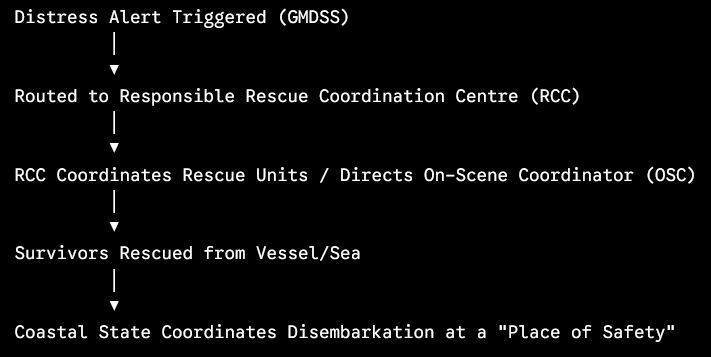
In India, maritime SAR coordination is primarily carried out by the Indian Coast Guard, which operates Maritime Rescue Coordination Centres and coordinates maritime search-and-rescue operations in the Indian Search and Rescue Region.