Answer
The economic RPM is the RPM at which the ship achieves the required voyage speed with the lowest fuel consumption per unit of transport work, while keeping the main engine within its safe operating/load limits.
For an oral exam, do not say that there is one fixed economic RPM for every ship. It depends on draft, weather, hull/propeller condition, engine condition and voyage requirement.
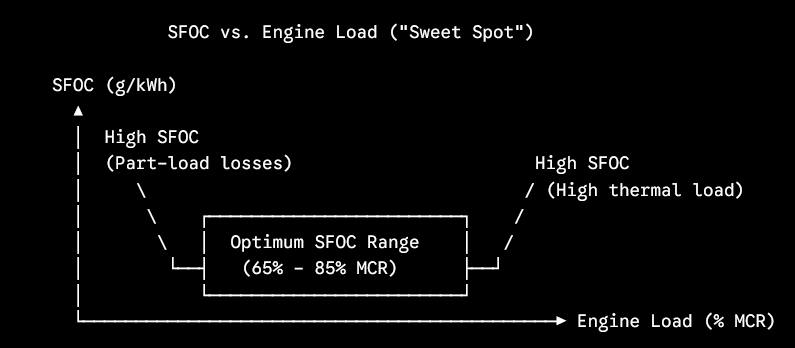
Practical method onboard
Run the vessel at a few steady RPM points, for example:
60% → 65% → 70% → 75% MCR, allowing parameters to stabilize at each point.
At every RPM record:
- engine RPM;
- shaft power / indicated power;
- fuel consumption in kg/h;
- SFOC in g/kWh;
- ship speed through water;
- exhaust temperatures;
- scavenge pressure;
- turbocharger RPM;
- weather, draft and trim.
Then compare fuel consumption against ship speed.
For voyage economy, a very useful parameter is:
Fuel per nautical mile= Fuel consumption kg/h / Ship speed knots
Example:
RPM | Fuel kg/h | Speed kn | Fuel kg/nm |
|---|---|---|---|
65 | 1,100 | 11 | 100 |
70 | 1,250 | 13 | 96.2 |
75 | 1,500 | 14 | 107.1 |
Here, 70 RPM is more economical because fuel consumed per nautical mile is lowest.