Answer
Classification Societies (such as IRS, DNV, Lloyd’s Register, ABS, and ClassNK) publish comprehensive Rule Books to govern the design, construction, machinery installation, and periodic inspection of ships throughout their operational life. The Rule Book ensures structural integrity and reliability of essential shipboard systems.
The Rule Book is divided into systematic sections:
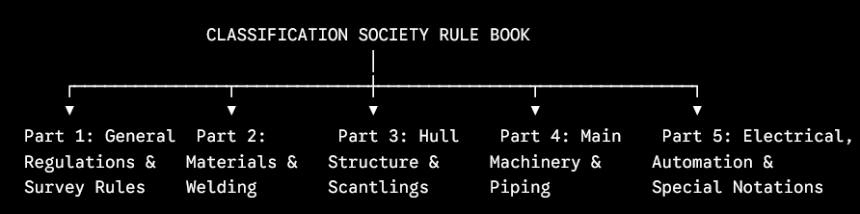
Key Sections Breakdown
- Part 1: General Regulations, Classification & Survey Rules
- Conditions of Classification, assignment, suspension, and withdrawal of class notation.
- Survey cycles: Annual, Intermediate, Renewal/Special Survey (5-year cycle), Docking Survey, Tailshaft Survey, and Enhanced Survey Programme (ESP) for bulk carriers and oil tankers.
- Part 2: Materials & Welding
- Specifications for hull structural steel, castings, forgings, non-ferrous metals, and composite materials.
- Non-Destructive Testing (NDT) standards, welding procedure approvals (WPS), welder qualifications, and filler metals.
- Part 3: Hull Structure & Construction
- Longitudinal, transverse, and torsional strength criteria based on direct analysis or prescriptive equations (aligned with IMO Goal-Based Standards - GBS).
- Minimum scantlings for bottom plating, side shell, deck plating, transverse bulkheads, and framing systems.
- Corrosion wastage allowances, fatigue strength limits, and structural buckling control.
- Part 4: Main Machinery, Boilers & Pressure Vessels
- Design and construction standards for main propulsion engines (2-stroke/4-stroke), gas turbines, gears, shafting, and propellers.
- Auxiliary engines, fire/bilge pumps, steering gear mechanics, pressure vessels, thermal fluid systems, and essential service piping systems.
- Part 5: Electrical Installations, Control & Automation Systems
- Main switchboard, emergency generator sizing, power distribution, circuit protection, and cable installations in hazardous areas.
- Instrumentation, control systems, alarm management, and requirements for Unattended Machinery Spaces (UMS / AUT-UMS).
- Part 6: Ship Types & Class Notations
- Specialized requirements for Oil Tankers (IBC Code), Gas Carriers (IGC Code), Bulk Carriers, Container Ships, and Passenger Ships.
- Special notation additions: Ice Class, Dynamic Positioning (DP), Green Passport, Cyber Security, Dual Fuel / Alternative Fuel (Ammonia/Methanol) Ready notations.