Answer
A Close-Up Survey is a statutory structural inspection where critical structural members are examined within close visual range of the surveyor (typically within arm’s reach, ≤ 1.5 meters).
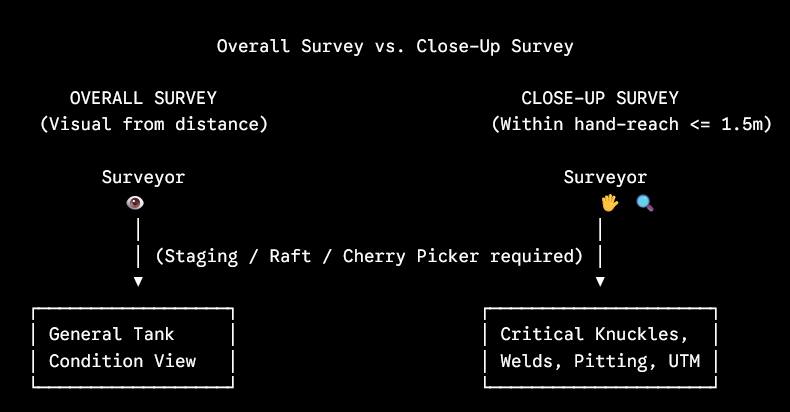
This is particularly important under the Enhanced Survey Programme (ESP) for applicable:
- bulk carriers;
- oil tankers.
The ESP regime is made mandatory through SOLAS XI-1/2 and the 2011 ESP Code, as amended. IMO continues to update the associated survey framework.
Key Differences: Overall Survey vs. Close-Up Survey
Feature | Overall Survey | Close-Up Survey |
|---|---|---|
Inspection Distance | Distance visual check (e.g., standing on tank top looking at deckhead). | Within hand reach (≤ 1.5 m ). |
Access Required | Walkthrough, tank ladder access. | Staging, cherry pickers, ladders, or raft access in ballast tanks. |
Scope | General structural condition, large scale deformation, major coating breakdown. | Pitting, micro-fractures, localized corrosion, weld seam cracking, bracket attachment failure. |
UTM Requirement | General random gauging if needed. | Mandatory Ultrasonic Thickness Measurement (UTM) at close-up locations. |
Critical Locations Inspected During Close-Up Surveys
A. Bulk Carriers
- Transverse Watertight Bulkheads: Lower stool, shelf plates, and corrugated bulkhead plating welds.
- Side Shell Frames: Lower brackets connecting side frames to the hopper tank top (highest stress zone).
- Hatch Coamings & Deck Plating: Hatch coaming stay brackets, top-side tank web frames, and corners of hatch openings.
B. Oil Tankers
- Deck Transverses & Bottom Web Frames: High-stress web ring frames in cargo/ballast tanks.
- Corrugated Bulkheads: Upper and lower knuckle connections to deck/bottom plating.
- Inner Hull & Wing Ballast Tanks: Structural ties, stringers, and longitudinal bracket connections.
Chief Engineer / Vessel Preparation Requirements
- Tank Cleaning & Gas Freeing: Tank surfaces must be pressure-washed clean of sludge, scale, and oil coating. Atmosphere certified Gas Free (Oxygen 20.9 %, HC < 1% LEL, H2S < 5 ppm).
- Safe Means of Access: Erect certified scaffolding/staging, ensure hydraulic platforms (cherry pickers) are operational, or set up approved raft arrangements (water level manipulation in ballast tanks).
- Illumination & Safety: Surface illumination must meet minimum levels Enclosed space entry permits, continuous ventilation, and standby personnel deployed per SMS procedures.