Answer
Assembly Highest governing body. All members states of IMO are members of assembly.
- It meets once every 2 years.
- It can have extra ordinary sessions after 1/3rd of the members give notice of 60 days to the secretary general for the session to be arranged.
- President – H.R.H. Prince Khalid of Saudi Arabia
- Function of the assembly
1. To elect President & two Vice Presidents who shall hold office until next regular session.
2. To determine own Rules of Procedures.
3. To Elect members of council.
4. To Receive & consider reports of council.
5. To approve the work of organization.
6. To Vote the Budget & determine the financial arrangements.
7. To review the expenditures and approve the accounts of the organization.
8. To recommend to members for adoption of regulations & guidelines concerning maritime safety and prevention & control of marine pollution etc.
9. To take such actions as necessary to promote technical co-operation.
10. Decisions regarding convening any international conference.
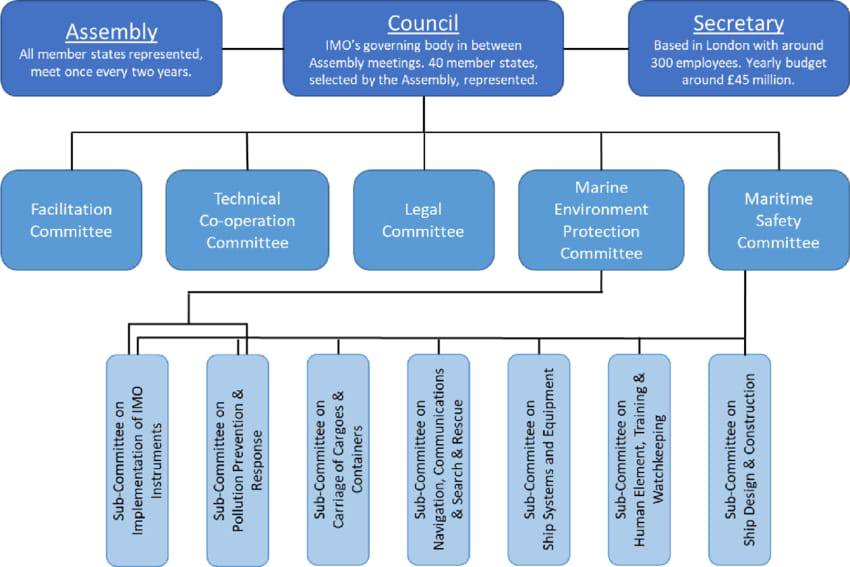
Council It is the Executive organ of IMO and is responsible, under the assembly, for supervising the work of the organization. Between the sessions of the assembly, it performs all the functions of the assembly, except the function of making recommendations to governments on maritime safety & pollution prevention which is reserved for assembly.
- 40 members
Category A – 10 States with the largest interest in providing International shipping services. China, Greece, Italy, Japan, Liberia, Norway, Panama, the Republic of Korea, the United Kingdom of Great Britain and Northern Ireland and the United States of America.
Category B – 10 States with the largest interest in international seaborne trade: Australia, Brazil, Canada, France, Germany, India, the Kingdom of the Netherlands, Spain, Sweden and the United Arab Emirates.
Category C – 20 States not elected under A or (B above, which have special interests in maritime transport or navigation and whose election to the Council will ensure the representation of all major geographic areas of the world: The Bahamas, Bangladesh, Chile, Cyprus, Denmark, Egypt, Finland, Indonesia, Jamaica, Kenya, Malaysia, Malta, Mexico, Morocco, Peru, the Philippines, Qatar, Saudi Arabia, Singapore and Turkiye.
- Function of the council
1. Shall consider the draft work program and the Budget estimates prepared by secretary general. 2. Shall receive reports, proposals, and recommendations of the committees.
3. Council with the approval of the assembly appoints the secretary general.
4. Shall make a report at each regular session of assembly.
5. Shall submit to the assembly financial statements of the organization.
6. Council performs all the functions of assembly except for making recommendations (Article 15J) Secretariat
- It consists of Secretary general (Arsenio Antonio from the Republic of Panama) and 300 International
personnel
- Head quarter in London
- Functions
Maintains all such records and data as may be necessary for the efficient discharge of the functions of the organization and shall prepare, collect & circulate the papers, Documents, agenda, minutes and information that may be required.
Secretary General has to prepare & submit the final statement for each year & the Budget estimates on 2 yearly basis (estimate for each year is shown separate) to the council.
MSC
- Shall meet atleast once a year. It shall elect its officers once a year & adopt its own rules of procedures.
- Safety, Security related codes fall under MSC. E.g. SOLAS, COL REG, SART etc.
- It is highest technical body of IMO.
- It reports to the council.
1.Proposal for safety regulations or for amendments to safety regulations. 2.Recommendations & guidelines the committee has developed
3.Report of the work carried in the previous session
MEPC
- It reports to the council
1. Proposals for regulations for the prevention and control of marine pollution from ships & its amendments.
2. Recommendations and guidelines developed.
3. The report of the work carried out in the previous session.
- Shall meet atleast once a year.
Legal Committee
- Established in1967 as a subsidiary body to deal with legal questions which arose in the aftermath of the
Torrey Canyon disaster.
- Shall consider any legal matter within the scope of IMO or if requested by any other international org
anization. It includes liability & compensation issues related to operation of ships including damage, pollution, passenger claims, wreck removal etc. Also addresses seafarer’s matters including fare treatment of seafarers, unlawful activities at sea.
- It reports to the council
1.Drafts of international conventions and of amendments to International conventions which it has developed.
2.Report of the work carried out in the previous session.
- Shall meet altleast once a year
Technical Co-operation Committee
- It was established in 1969 as a subsidiary body of the council and was institutionalized by amendment to
IMO convention which entered into force in 1984
- Oversees capacity building program, implementation of Technical Co-operation Projects, ensuring that
IMO supports the UN SDGs & 2030 Agenda for Sustainable Development. Facilitation Committee
- It was established as a subsidiary body of council in may 72 & became fully institutionalized in Dec 2008.
- It was established to eliminate unnecessary formalities & “red tape”.
- It deals with FAL convention 1965.
HTW (Human Element, Training & Watch Keeping) Sub- Committee
-Deals with human side of shipping, including training & certification, review , updating & revision of IMO Model courses
-Guidelines of fatigue
III (Implementation of IMO instruments) Sub-committee
-
Brings together flag, Port & Coastal state to consider implementation issues with reg ards to IMO instruments
-Analysis of consolidated Audit summary reports from IMSAS (IMO Member State Audit Scheme) Key role in casualty analysis & learning from Incidents.
- Guidelines under HSSC.
NCSR (Navigation, Communication and Search & Rescue) Sub committee
- LRIT, GMDSS
-ICAO/IMO Joint working group on Harmonization of aeronautical & marine search & rescue.
PPR (Pollution Prevention & Response) Sub committee
-MARPOL annexes, BWM, AFS, OPRC (International Convention on Oil Pollution Preparedness, Response and Co-operation), HNS is under PPR
Ship Design and construction Sub-Committee
-Technical & operational matters related to ship design & construction including sub-division & stability. i.e. Load-line, tonnage, IP.
Ship System & Equipment Sub-Committee.
- LSA, Fire Detection & fire Extinguishing Systems.
CCC (Carriage of Cargoes & Containers) Sub-Committee
-Updating the IMDG & IMSBC code once every two years alternatively every year.
- It also keeps under review of other codes including IGF & IGC code.
India in IMO has been actively participating in the International Maritime Organization (IMO). Recently, India was re-elected to the IMO Council under Category B, which includes states with the "largest interest in international seaborne trade"- during Assembly Session-33 from 27 Nov 2023 to 6 Dec 2023.
India's Vision 2030 aims to enhance representation at IMO by appointing permanent representatives at IMO London.
Major Conventions that India still has to accede are
International convention for control and management of Ships ballast water and sediments Bunker convention
London convention