Answer
Propeller Repair:
Refer IACS UR W24
Any repairs to be carried out must be to the satisfaction of class.
Repairs must be done by approved workshop with class surveyor attendance.
Propeller is at a height so we need to have proper staging to reach to that level. Cleaning of the Propeller has to be carried out first and look for cracks.
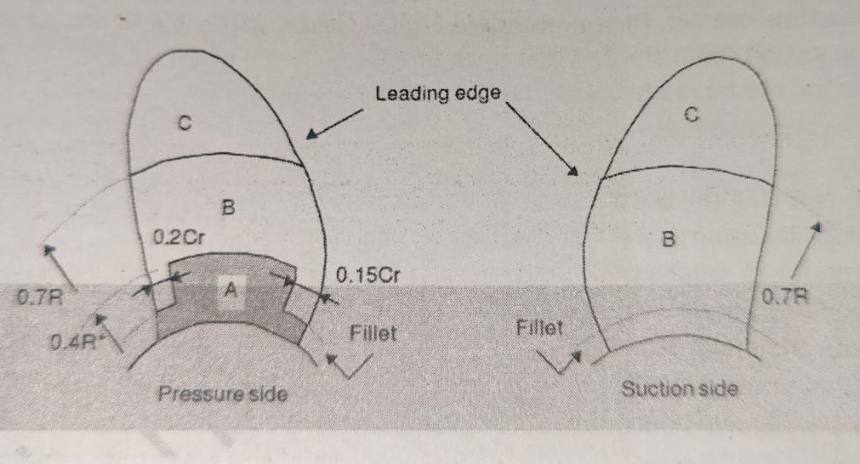
The Propeller is divided into 3 zones A, B, C
Left side figure is AFT side of the Propeller blade
Right side figure is FWD side of the blade.
Pressure side 3 zones A,B,C
A-0.4R where R is radius of the Propeller.
B-Is from there upto 0.7R
C-Is the rest area.
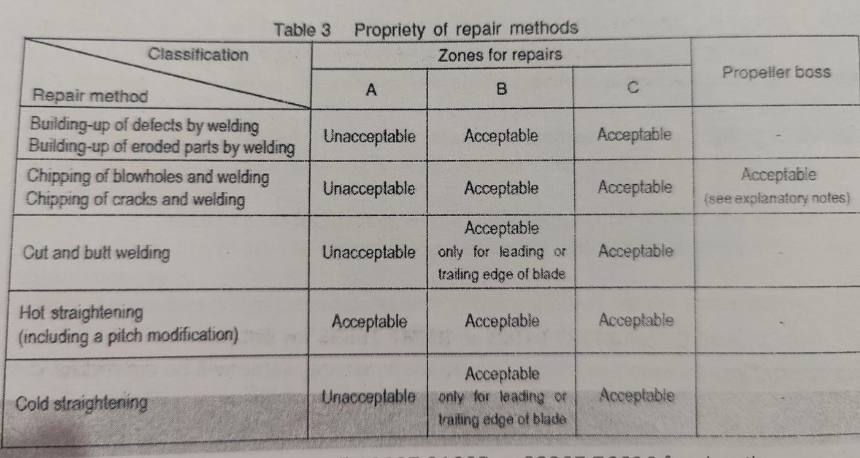
In zone A only hot straightening s allowed, but if welding is to be done then special consideration from class to be taken
Suction side there are only B and C Zones.
In B & C region you can directly look for cracks, should be visible in case they are.
So we don’t use DPT for the whole of the blade.
But for A region we have to go for the DPT test.
Reason because A region the cracks are due to casting faults.
So those casting faults when pressure is there are visible, but will not be visible with the naked eye. So DPT required.
SO A region is most Critical region as it is near to the root of the Propeller boss.
C least Critical areas.
Any floating debris and all will damage this C area cavitation marks will come in C area Mostly cracks will appear in C region and repairs are possible
B less no. of repairs possible and A least.
Propeller blades are marked A,B,C,D,E and it is engraved on the blades.
Each blade has its own identity and its own history.
SO, you can check what repairs are carried out previously also and if any repair is done ag ain and ag ain in the same
Material for Propeller : High strength brass casting Welding Material : MIG welding, TIG welding Filler material : Aluminum bronze Pre heat temp : 150 deg C (to reduce stresses caused by welding)
area than you can look for the root cause analysis and carry out stress analysis.
Stress relief temperature : 350-500 deg C (after job is done) Inter pass temperature : 300 deg C max.
Surface preparation:
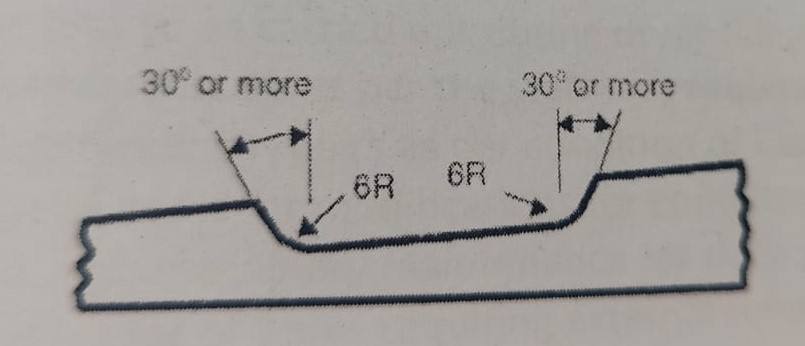
EDGE CRACKS:
So minor cracks can become more serious, so if the crack is less than 10mm in length just grind them out, fair them out i.e make edges smooth, no sharp change in section.
But for larger cracks-
Find the ends of the crack and drill the ends so that the crack does not propag ate and then make a groove as shown in the figure.
R is the radius of the blade, 6R this is made to avoid any stress rais.ers.
Then gouging, welding, grinding and polishing to be done.
SERIOUS EDGE DAMAGE:
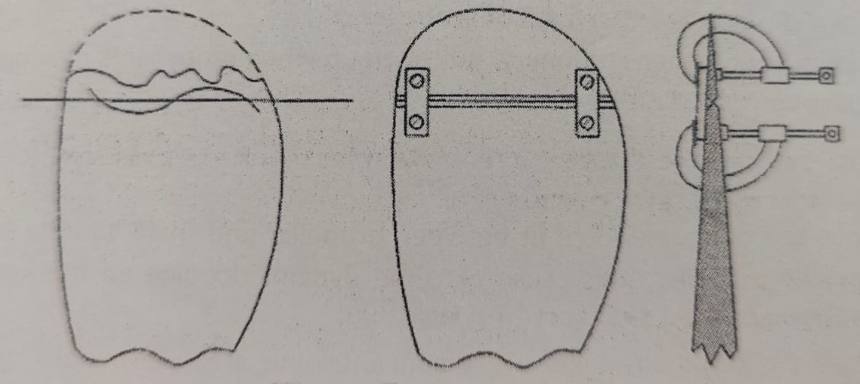
Some times we loose portion of the blade tip, may be there was a crack at the tip and it got propagated.
Now you have to reweld the casting here
TIG/MIG welding to be used
Ensure casting has the required profile what Propeller requires.
Once the profiling done clamp the piece as shown in the figure
Weld on one side than remove the clamp fix the clamp on the other way and weld the other side. If the crack is in region B than the whole Propeller have to be annealed after repairs.