Answer
KN Cross Curves of Stability are hydrostatic curves provided in a vessel's Stability Booklet that allow ship officers to calculate the righting lever (GZ) for any given displacement (Δ) and angle of heel (θ).
KN is the righting lever measured from the keel reference K to the vertical through the shifted centre of buoyancy at a particular angle of heel.
The cross curves of stability are curves of KN versus displacement for a number of fixed heel angles, such as 10°, 20°, 30°, 40°, etc.
For a given ship condition, you first take the ship’s displacement, then from the cross curves read the corresponding KN at the required heel angle.
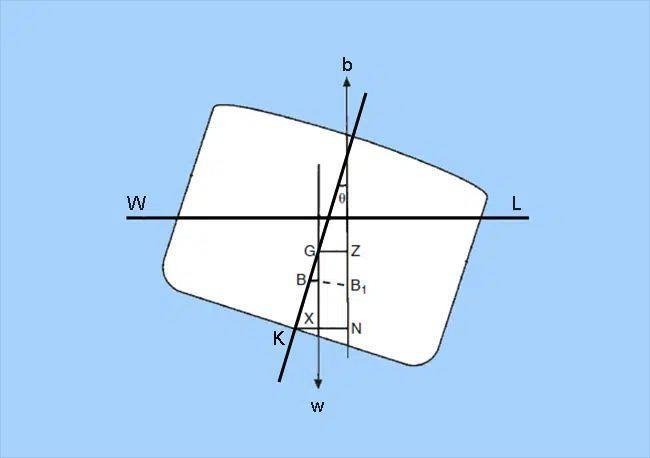
Then actual righting lever is:
GZ=KN−KGsinθwhere:
- GZ = actual righting lever
- KN = value obtained from cross curves
- KG = actual vertical centre of gravity above keel
- θ = angle of heel
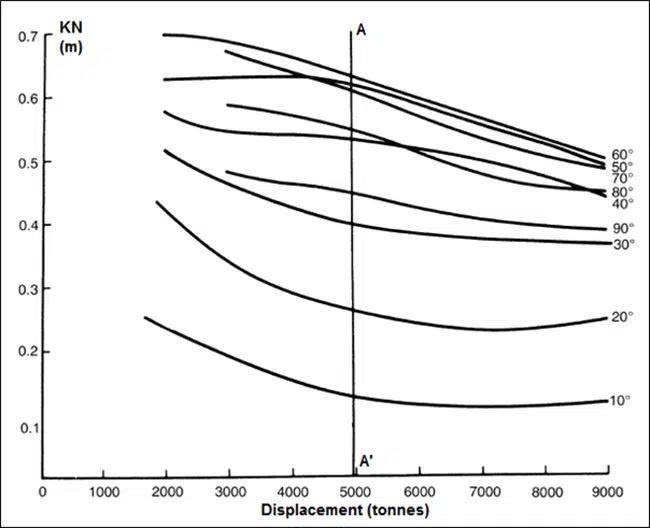
Cross curves are prepared from the ship’s hull geometry and therefore mainly depend on displacement and heel angle, not on the actual KG of the loading condition. Once KG is known, the actual GZ curve can be obtained.