Answer
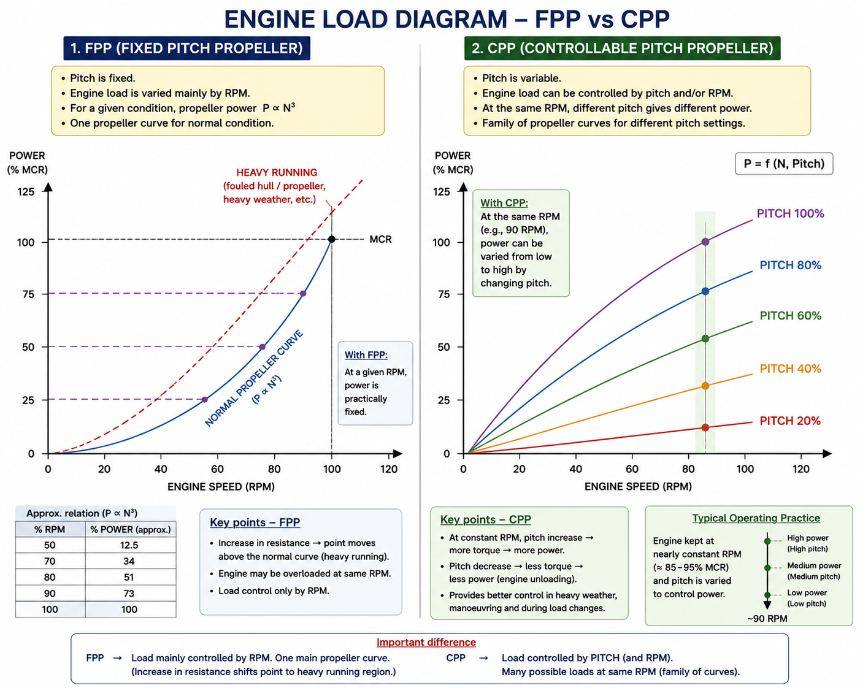
An FPP setup forces the engine along a strict, fixed theoretical path, whereas a CPP setup grants an operational area across a family of pitch curves, allowing power to be varied independently of engine speed.
Key Differences at a Glance| Feature / Diagram Element | Fixed Pitch Propeller (FPP) | Controllable Pitch Propeller (CPP) |
|---|---|---|
| Operating Path | Single fixed Propeller Curve following the cubic law (P∝N3). | A family of pitch curves across a wide operating field. |
| Control Parameters | Engine speed (RPM) only. | Engine speed (RPM) AND Propeller Pitch angle (θ). |
| Heavy / Light Running Shift | The single propeller curve shifts left (heavy running, e.g., foul hull, heavy weather) or right (light running). | Pitch can be reduced (coarsened or flattened) to keep the engine operating on its optimal design line despite hull fouling or heavy seas. |
| Operation at Low Ship Speed | Engine speed (RPM) must be reduced down toward minimum scavenge/idle limits. | Can operate at Constant Speed (Combinator Mode or Shaft Generator Mode) while reducing pitch down to zero. |
| Torque Load Variation | Strictly follows the N2 torque law along the single curve. | High torque can be developed at low engine speeds by increasing pitch, or low torque at high speeds by decreasing pitch. |