Answer
The Internet of Things (IoT) refers to a network of physical objects—"things"—embedded with sensors, microcontrollers, software, and connectivity that enable them to collect, transmit, and act on real-time operational data over the internet or private networks without human intervention.
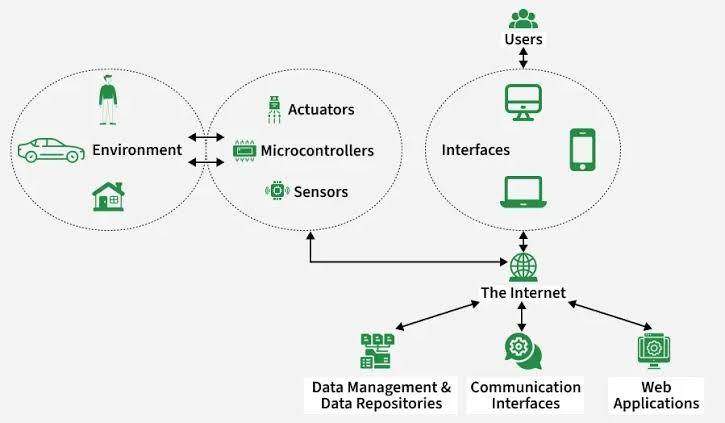
An IoT system operates across four primary layers:
Sensors & Actuators: Physical hardware that detects environmental variables (e.g., temperature, pressure, vibration, flow rates) or executes physical commands (e.g., closing valves, starting motors).
Connectivity & Edge Nodes: Transmission gateways and protocols (e.g., MQTT, Modbus, Cellular/5G, LoRaWAN) that route physical telemetry from microcontrollers to processing networks.
Data Processing & Storage: Cloud databases and analytics platforms that filter, store, and analyze streaming telemetry.
User Interface & Automation: Dashboards and control systems where operators visualize operational parameters or set automated feedback triggers.
| Domain | Key Function | Typical Use Case |
| Industrial IoT (IIoT) | Machine monitoring & condition-based maintenance | Continuous telemetry monitoring on heavy machinery, boilers, and pumps to prevent catastrophic failure. |
| Logistics & Maritime | Asset tracking & condition monitoring | Cargo container temperature logging, fuel oil consumption tracking, and voyage telemetry transmission. |
| Smart Infrastructure | Utility management & environmental control | Automated grid switching, intelligent HVAC balancing, and remote pressure regulation in pipelines. |
Cybersecurity: Expanding the surface area for cyberattacks due to legacy hardware integration, unencrypted edge communications, or unpatched firmware vulnerabilities.
Bandwidth & Latency: High telemetry volume requires local edge computing to process critical data locally before transmitting back to cloud servers.
Interoperability: Standardizing communication protocols between proprietary industrial equipment, legacy sensors, and modern software networks.