Answer
Axes of the GZ Curve (Curve of Statical Stability)
The GZ Curve (Statical Stability Curve) displays a vessel's righting lever across various angles of heel at a specific displacement and center of gravity position (KG).
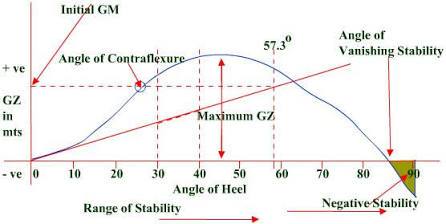
GZ Statical Stability Curve, AI generated
1. Horizontal Axis (X-Axis)
- Parameter: Angle of Heel
- Units: Degrees or Radians
- Key Landmarks on X-Axis:
- 0⁰: Upright equilibrium position.
- Angle of Deck Edge Immersion: Point where the slope of the curve changes (inflection point / angle of contraflexure).
- Angle of Maximum GZ: Angle at which the vessel offers its maximum righting lever.
- Angle of Vanishing Stability: Angle where GZ = 0; beyond this angle, the righting lever becomes negative and the ship capsizes.
2. Vertical Axis (Y-Axis)
- Parameter: Righting Lever (GZ)
- Units: Meters (m) or Feet (ft)
- Physical Significance: Represents the perpendicular distance between the vertical line of action of gravity through G and the vertical line of action of buoyancy through B_1.
Area Under the GZ Curve
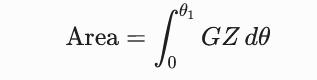
The area under the GZ curve up to a given angle of heel is obtained by integrating the righting lever with respect to the heeling angle:
Physical Significance
- Mathematical Area: Represents the integral of GZ over the angle of heel, expressed in Meter-Radians (m.rad).
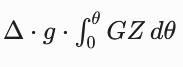
- Dynamical Stability Relationship: Represents the Dynamical Stability per unit displacement of the vessel up to that angle of heel
- Energy Capacity: Indicates the total external energy (from wind gusts, wave impacts, or cargo shift) the ship can absorb before heeling to that specific angle.
Units of Measurement
Depending on whether you are expressing the raw geometric area under the curve or the total physical work done on the ship, the units are defined as follows:
Parameter | Formula | Standard SI Unit | Alternative Metric Unit |
|---|---|---|---|
Area Under GZ Curve |
| Meter-Radians (m.rad) | Meter-Degrees |
Dynamical Stability (Energy / Work Done) |
| KiloJoules (kJ) or kiloNewton-Meters {kN.m) | Tonne-Meter-Radians (t.m.rad) |