Answer
Yes — but under controlled conditions.
Propane and butane are compatible LPG cargoes and can be co-mingled/blended, provided the vessel is certified/suitable for the resulting mixture and the operation complies with the approved cargo procedures, terminal/charterer requirements and applicable regulations.
SOLAS VI/5-2 prohibits physical blending processes during a sea voyage where the intent is to create a product with a different product designation. Therefore, commercial blending should not simply be undertaken at sea as a production process.
How Blending Operations Are Executed
- In-Line Blending at Manifold (Preferred):
- The terminal supplies liquid Propane and Butane simultaneously through separate shore arms.
- The streams join at a manifold T-piece equipped with calibrated flow meters and non-return valves, entering the cargo tank as a homogenous mixture.
- Sequential Loading & Tank Recirculation:
- Layering: The heavier component (Butane, density approx 600 kg/m3) is loaded first, followed by the lighter component (Propane, density approx 580 kg/m3).
- Homogenization: Cargo deepwell pumps draw liquid from the bottom of the tank and discharge it back through top cargo spray headers to thoroughly mix the contents.
- In line blending at manifold during discharging
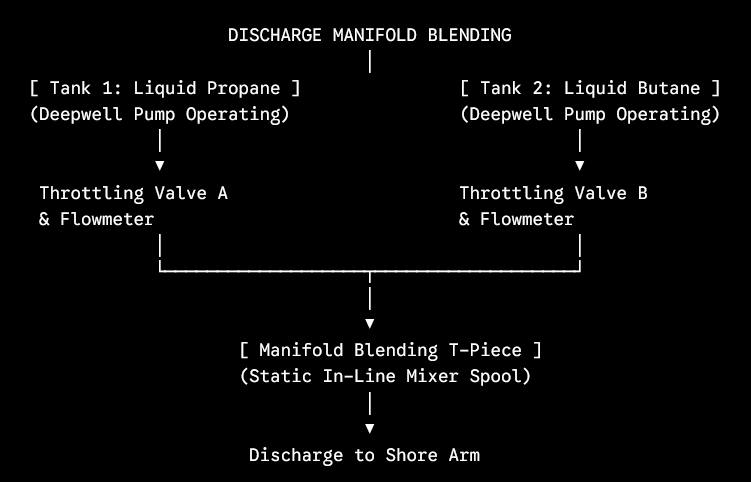
Propane and butane can be co-mingled on an LPG carrier provided the vessel and cargo system are suitable and the operation is properly planned. For refrigerated cargo, butane is generally taken first and propane is introduced slowly into the butane. Because propane is lighter it tends to rise and assists mixing, but because it is much colder and more volatile, considerable flash gas and pressure rise can occur. Therefore tank pressure, temperature, MARVS, reliquefaction capacity, vapour return and loading rate must be continuously monitored. Adding butane to propane is possible but the heavier butane tends to settle and may require recirculation.