Answer
The transport of dangerous goods (DG) in packaged form or solid bulk is governed by SOLAS Chapter VII, MARPOL Annex III, the IMDG Code, and the IMSBC Code.
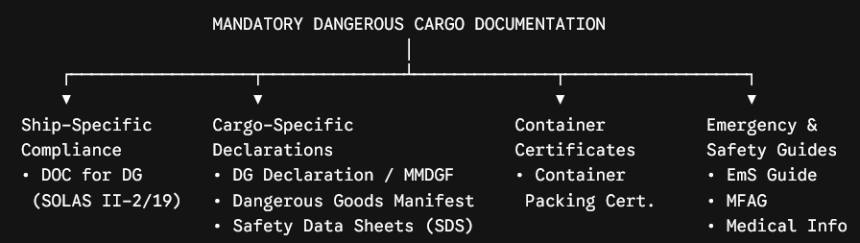
Statutory Documents Required On Board
- Document of Compliance for Ships Carrying Dangerous Goods (DOC for DG):
- Issued by Flag Administration or Recognized Organization (Class) under SOLAS Regulation II-2/19.
- Confirms the ship’s structure, cargo hold ventilation, bilge pumping isolation, electrical spark-proofing, and fire-fighting systems meet statutory requirements for specific classes of dangerous goods.
- Dangerous Goods Manifest or Detailed Stowage Plan:
- Mandated by SOLAS Regulation VII/4.5 and MARPOL Annex III.
- Must list every dangerous item on board, including:
- UN Number, Proper Shipping Name (PSN), IMO Hazard Class/Division.
- Packing Group (I, II, or III), number/type of packages, net/gross mass.
- Flashpoint (for flammable liquids), marine pollutant status.
- Exact onboard stowage location (hold/bay number).
- Dangerous Goods Declaration / Multimodal Dangerous Goods Form (MMDGF):
- Provided by the shipper/consignor.
- Certifies that the cargo is properly classified, packaged, marked, labelled, and placard-identified in accordance with the IMDG Code.
- Container / Vehicle Packing Certificate:
- Required when dangerous goods are packed into a Freight Container or Cargo Transport Unit (CTU).
- Signed by the party responsible for loading, confirming that the container is clean, dry, structural, and that packages are segregated and secured per IMDG rules.
- Safety Data Sheets (SDS):
- Mandated under IMO Resolution MSC.286(86) for all hazardous chemical cargoes and fuel oil cargoes.
- Provides emergency, toxicological, reactivity, and fire-fighting details.
- Emergency Response & First Aid Guides:
- EmS Guide (Emergency Response Procedures for Ships Carrying Dangerous Goods): Detailed operational fire and spillage response steps for specific UN numbers.
- MFAG (Medical First Aid Guide for Use in Accidents Involving Dangerous Goods): First-aid and antidote treatment guidelines for toxic exposures.
- Special Certificates (for Bulk Solid / Liquid DG Cargoes):
- IMSBC Cargo Information & Test Certificates: Certificate of Moisture Content and Transportable Moisture Limit (TML) for Group A cargoes prone to liquefaction.
- International Certificate of Fitness: For chemical tankers (IBC Code) or gas carriers (IGC Code).