Answer
“Cargo holds are normally protected by a fixed fire-detection arrangement such as a sample-extraction smoke detection system complying with FSS Code Chapter 10, and by a fixed gas fire-extinguishing system, commonly CO₂, complying with FSS Code Chapter 5 and SOLAS II-2 Regulation 10. The smoke-sampling system continuously draws air from sampling points in the hold to a smoke detector and gives an audible and visual alarm identifying the affected hold. On confirmation of fire, I will inform the Master, muster the fire party, identify the cargo and check IMSBC or IMDG requirements, stop ventilation, close all openings, account for personnel and prepare the fixed CO₂ system. For ordinary cargo spaces the CO₂ quantity is generally sufficient to provide free gas equal to 30% of the gross volume of the largest protected cargo space. For container/general cargo spaces at least two-thirds must be capable of discharge within 10 minutes, while for solid bulk cargo spaces it is within 20 minutes. After flooding, I will keep the hold sealed, carry out boundary cooling and monitor continuously because opening the hold too early can cause re-ignition.”
Cargo hold fire safety on merchant vessels relies on a unified Sample Extraction Smoke Detection System integrated with a Fixed High-Pressure CO2 Extinguishing System. This arrangement uses shared piping to continuously monitor the holds for fire and discharge smothering gas when required.
Sample Extraction Smoke Detection System
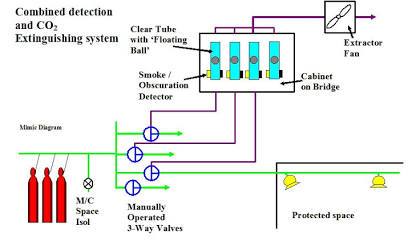
Regulated under SOLAS Chapter II-2 and the FSS Code (Chapter 10), the extraction system continuously draws air samples from each cargo hold to detect combustion before open flames develop.
- Continuous Extraction: Extraction fans located in the detection cabinet draw air samples continuously through sampling accumulators positioned at the top of each hold.
- Three-Way Valves: Each sampling line passes through a three-way changeover valve located in the detection panel. During normal sampling, the valve routes hold air to the detectors. During a fire, it switches to connect the hold directly to the CO2 manifold.
- Detection Cabinet & Bridge Indication:
- Optical/Photoelectric Detectors: Air passes through an optical chamber where light obscuration or scattering triggers an audible and visual alarm on the bridge.
- Visual Flow Indicators: Glass sight tubes containing light-weight indicator balls allow watchkeeping personnel to visually confirm active suction from each individual hold line.
- Smell Freeing / Exhaust: Air samples are discharged either to the atmosphere or into the wheelhouse through a dedicated diverter valve (allowing watchkeepers to physically smell smoke or chemical odors).
High-Pressure CO2 Extinguishing System
Regulated under the FSS Code (Chapter 5), total flooding fixed gas systems extinguish fires by reducing oxygen levels in the affected compartment to below 15% (typically targeting a CO2 concentration of 30% to 45% of the gross hold volume).
- Capacity Requirements: SOLAS requires available CO2 quantity to be sufficient to give a minimum volume of free gas equal to 30% of the gross volume of the largest cargo compartment so protected.
- System Components & Operation:
- CO2 Cylinder Room: High-pressure cylinders 50 L capacity charged at 67 bar working pressure) are stored in a dedicated, well-ventilated space outside cargo holds and machinery spaces.
- Control Cabinet / Quick Release: Opening the release cabinet door triggers microswitches that sound pre-discharge alarms and trip cargo hold mechanical ventilation fans.
- Pilot Cylinder Activation: Opening the release valves allows pilot gas (CO2 or N2) to actuate the main distribution directional valve (section valve) for the targeted cargo hold and trigger the pneumatic gang-release mechanism for the required number of cylinder head valves.
- Discharge Line Isolation: The three-way valve for the specific hold is manually repositioned to isolate the delicate smoke detection panel and align the high-pressure CO2 line directly to the hold's discharge nozzles.
Operational & Statutory Requirements
- Indian Merchant Shipping Framework: The Merchant Shipping (MS) Act, 2025 and corresponding MS (Fire Appliances) Rules enforce compliance with the IMO FSS Code and SOLAS Chapter II-2 for Indian-flagged vessels.
- Line Blowing with Compressed Air: Sampling lines are prone to blockage from dust (especially when carrying bulk cargoes like coal, grain, or iron ore). Periodic line blowing using compressed air (via dedicated blow-back valves) is mandatory to keep pipes clear.
- Cargo-Specific Exceptions: Under SOLAS II-2/10.7.1.4, ships constructed exclusively for the carriage of ore, coal, or unseasoned timber may be exempted from fixed gas fire-extinguishing systems by the Administration, provided fitted hatch covers are steel and effective closing arrangements are maintained.
- Special Cargo Provisions (IMSBC Code & DG Cargoes): When carrying Dangerous Goods (SOLAS II-2/19), additional requirements may mandate higher gas capacities, specialized water spraying, or continuous temperature monitoring.