Answer
1. Definitions & Blending Ratios
- B60: A biofuel blend containing 60% volume biofuel (typically Fatty Acid Methyl Ester [FAME] or Hydrotreated Vegetable Oil [HVO]) and 40% volume conventional marine distillate or residual fuel (e.g., MGO, VLSFO).
- B100: 100% pure neat biofuel derived entirely from renewable biological feedstocks without petroleum blendstocks.
2. Primary Biofuel Categories
A. FAME (Fatty Acid Methyl Ester — First Generation)
- Production: Transesterification of vegetable oils (e.g., palm, rapeseed, soy) or used cooking oil (UCO) and animal fats.
- Chemical Profile: Oxygenated hydrocarbon structure (~11% oxygen content).
- Key Characteristics:
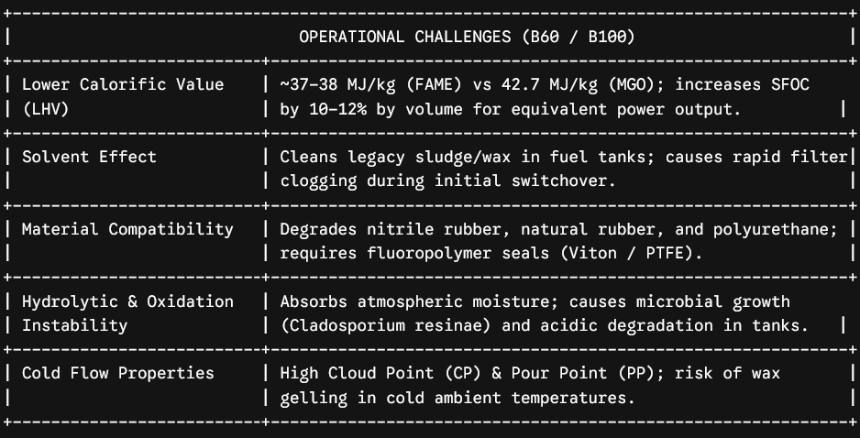
- Higher solvent effect (cleans legacy tank deposits).
- Hygroscopic (attracts moisture, increasing corrosion and microbial risk).
- Lower thermal and oxidation stability compared to fossil fuels.
B. HVO / HDRD (Hydrotreated Vegetable Oil — Second Generation)
- Production: Hydro-processing of lipids using hydrogen under high pressure and temperature.
- Chemical Profile: Paraffinic hydrocarbon, chemically identical to fossil diesel distillate (drop-in fuel).
- Key Characteristics:
- Oxygen-free and virtually sulfur-free.
- High Cetane Number (approx 70+).
- Excellent cold flow properties and oxidation stability without water retention issues.
3. Statutory & Standardization Framework
ISO 8217:2024 Marine Fuel Standard Updates
- Table 1 (Distillates & Bio-Distillates): Covers DF grades (Distillate FAME) permitting up to 100% FAME (B100).
- Table 3 (Bio-Residual Fuel Blends): Introduces standard specifications for residual blends with biofuel components (e.g., RFB grades).
- Mandatory Testing Parameters: Mandates testing for oxidation stability, net heat of combustion, cetane index, and cold flow properties (Cloud Point / Cold Filter Plugging Point).
MARPOL Annex VI Requirements
- Regulation 18.3.2: Biofuels must not cause the engine to exceed applicable NOx emission limits specified in Regulation 13.
- IMO MEPC.1/Circ.795/Rev.8 Guidelines:
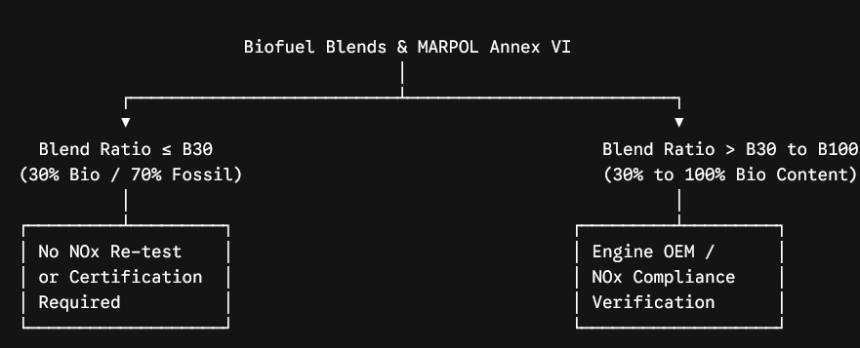
- Blends ≤ B30: Deemed to comply with NOx limits without requiring additional engine testing or re-certification under the NOx Technical Code 2008.
- Blends > B30 up to B100: Requires proof that combustion does not alter NOx parent engine family parameters. If parameters change, onboard NOx simplified measurement or direct monitoring is required unless cleared by the engine manufacturer (OEM).
- Bunker Delivery Note (BDN) & Statutory Sampling: Must state exact biofuel percentage and density; representative MARPOL sample retained per Reg. 18.6.
- Indian MS Act 2025 & DG Shipping Directives: Mandates full compliance with MARPOL Annex VI fuel quality standards, proper bunker management, and verification of classification society approvals prior to bunkering high-ratio blends like B60/B100.
4. Operational & Engineering Challenges (B60 / B100 FAME)