Answer
1. Concept & Working Principle
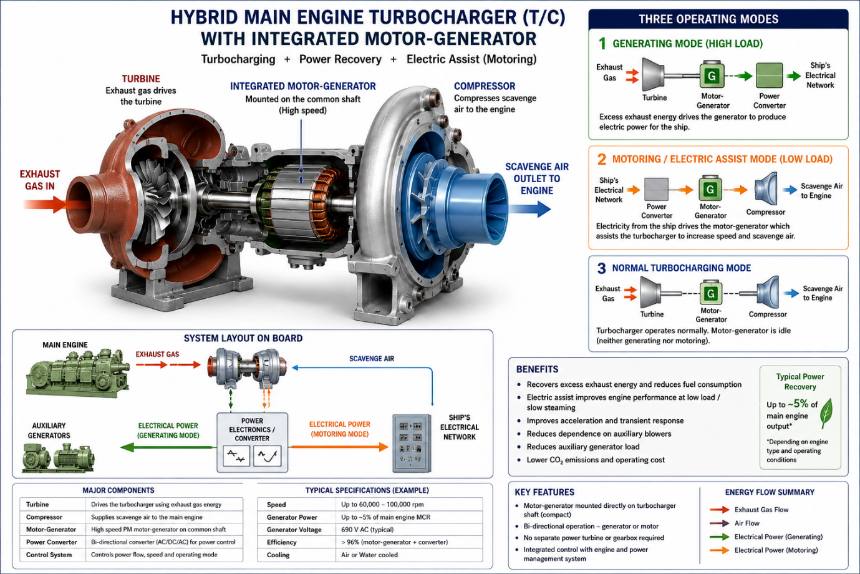
A Hybrid Turbocharger integrates a high-speed Permanent Magnet Motor/Generator (PMM) directly on the turbocharger rotor shaft (or linked via a high-speed gearbox). The system connects to the vessel's main switchboard via a bidirectional power electronics package (Inverter / Rectifier / Static Frequency Converter).
2. Operating Modes
A. Power Take-In (PTI) / Motor Assistance Mode (Low Engine Load)
- Operational Trigger: Engine operating at low loads (e.g., during manoeuvring, port entry, or slow steaming < 40-50% MCR), where exhaust gas energy is insufficient to drive the compressor at required speed.
- Mechanism: The permanent magnet machine acts as an Electric Motor, drawing electrical power from the ship's auxiliary generators to drive the turbocharger shaft.
- Operational Benefits:
- Eliminates or replaces conventional motor-driven auxiliary blowers.
- Prevents compressor surge and maintains optimal air-to-fuel ratio.
- Reduces smoke emissions and improves transient load acceptance response.
B. Power Take-Off (PTO) / Generator Mode (High Engine Load)
- Operational Trigger: Engine operating at medium to high loads (> 50-60 % MCR), where exhaust gas energy exceeds what the compressor requires for scavenge air delivery.
- Mechanism: The permanent magnet machine acts as an Electrical Generator, converting excess exhaust energy into electricity fed back to the vessel's main switchboard.
- Operational Benefits:
- Recovers up to 3–5% of main engine power as electrical energy (Waste Heat Recovery).
- Reduces load on auxiliary diesel generators, lowering overall Specific Fuel Oil Consumption (SFOC).
- Reduces total vessel greenhouse gas emissions (CO2, NOx).
C. Neutral / Standard Turbocharger Mode
- The system operates passively when turbine power exactly balances compressor power requirement without electric power export or import.
3. Key Constructional Features
- Permanent Magnet Synchronous Machine (PMSM): Compact high-speed rotor mounted inside the turbocharger casing between bearing pedestals.
- Frequency Converter & Control Unit: High-frequency active front-end (AFE) converter regulating voltage, frequency, and phase alignment with the vessel's 60Hz/50Hz grid.
- Advanced Bearing & Cooling Systems:
- High-duty oil-lubricated or active magnetic bearings to manage high rotational speeds (up to 15,000–25,000 RPM).
- Dedicated water-cooling jacket for generator stator windings.
4. Regulatory Impact (EEXI & CII)
- EEXI (Energy Efficiency Existing Ship Index): Improves the attained EEXI value by lowering calculated carbon output per transport work due to waste heat recovery.
- CII (Carbon Intensity Indicator): Reduces operational fuel consumption, directly supporting operational CII rating maintenance (A or B rating).