Answer
GHG Fuel Intensity (GFI)—or GHG Intensity of Energy Used Onboard—is a core regulatory metric in maritime decarbonization. It measures the total greenhouse gas emissions generated per unit of energy consumed onboard a vessel, expressed in grams of CO2 equivalent per Megajoule (gCO2 eq /MJ).
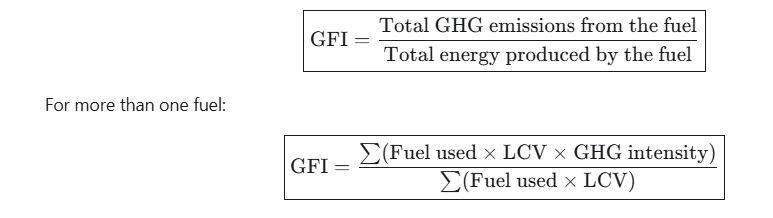
GFI is the central compliance parameter under FuelEU Maritime (EU Regulation 2023/1805) and forms the technical baseline for the IMO Net-Zero Framework / Global Fuel Standard (GFS) under MARPOL Annex VI mid-term measures.
Unlike the IMO CII (Carbon Intensity Indicator) or EEXI, which focus strictly on Tank-to-Wake (TtW) operational emissions from burning fuel on board, GFI evaluates emissions on a Well-to-Wake (WtW) lifecycle basis:
WtW = WtT + TtW
where:
WtT = Well-to-Tank
Emissions arising from:
- extraction;
- production;
- processing;
- transportation and distribution of fuel.
TtW = Tank-to-Wake
Emissions resulting from using the fuel onboard the ship.
- Combustion
- Methane Slip
- N2O Slip
Why GFI is important
Under the IMO Net-Zero Framework concept, ships are required to progressively reduce their annual GHG fuel intensity.
There are compliance thresholds, and a vessel performing above the permitted GFI level develops a compliance deficit. A vessel performing better can potentially generate surplus units under the framework