Answer
James Reason's Swiss Cheese Model explains that accidents normally do not occur because of one single failure. An organization has several layers of defence, but every layer has weaknesses represented as holes in Swiss cheese. When weaknesses in several layers align, the hazard passes through all barriers and results in an accident. Therefore, after an incident we should identify not only the operator's active error but also latent organizational and management failures.
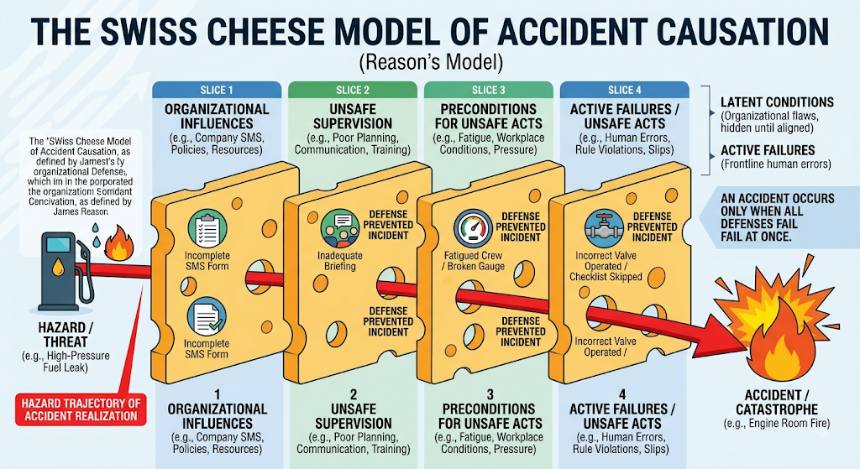
Developed by Professor James Reason, the Swiss Cheese Model explains how complex maritime incidents (such as blackouts, engine room fires, or groundings) occur through the alignment of multiple organizational and human failures across successive defensive barriers.
- System Barriers (The Slices of Cheese): Represent protective defences built into maritime operations, including SMS procedures, supervision, equipment design interlocks, alarms, emergency drills, and PPE.
- Weaknesses (The Holes in the Cheese):
- Latent Conditions: Hidden design flaws, inadequate training, poor maintenance schedules, flawed company policies, or ambiguous SMS checklists created long before an incident.
- Active Failures: Errors, slips, or deliberate rule violations committed by shipboard personnel on the front line (e.g., bypassing a high-temperature alarm or skipping a pre-warning step during fuel changeover).
- The Trajectory of Accident Realization: An accident occurs only when the holes in every slice line up momentarily, allowing a hazard (e.g., fuel oil leakage under high pressure) to pass unhindered through all defensive layers:
- Slice 1 (Organizational): Lack of spare high-pressure fuel pipe shielding in store (Latent).
- Slice 2 (Supervisory): Tool Box Talk omitted before fuel pump maintenance (Active/Latent).
- Slice 3 (Workplace): Poor engine room lighting and high ambient noise causing fatigue (Latent).
- Slice 4 (Unsafe Act): Pipe joint bolts under-torqued by engineer (Active).
- Result: High-pressure fuel spray hits an unlagged exhaust manifold, causing a major engine room fire.