Answer
Augmented Reality (AR) works by superimposing computer-generated 3D graphics, text, or audio over a real-time view of the physical environment. Unlike Virtual Reality (VR), which replaces the real world entirely, AR enhances reality by anchoring digital elements to physical space.
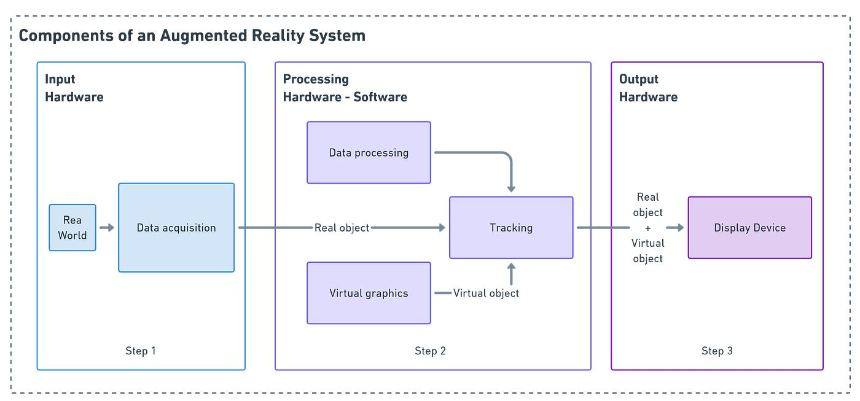
AR works mainly on the principle of:
Sense → Track → Process → Register → Render → Display
-
Sensing the real environment
A camera and sensors capture the surroundings. Sensors may include GPS, gyroscope, accelerometer, depth sensor and compass. -
Tracking and localization
The system determines the position and orientation of the user/device relative to the actual object. Modern AR commonly uses computer vision and SLAM (Simultaneous Localization and Mapping). -
Recognition
Software identifies the required object, marker or equipment—for example, a fuel pump, valve or engine component. -
Registration
This is a very important AR principle. The virtual information must be accurately aligned with the corresponding real-world object. -
Rendering
The computer generates the required digital content, such as text, arrows, dimensions, alarms, 3-D models or maintenance instructions. -
Real-time display
The virtual information is superimposed on the real scene through a smartphone/tablet, AR glasses or head-mounted display.
Suppose an engineer points an AR tablet at a main-engine fuel pump.
The system recognizes the pump and can overlay:
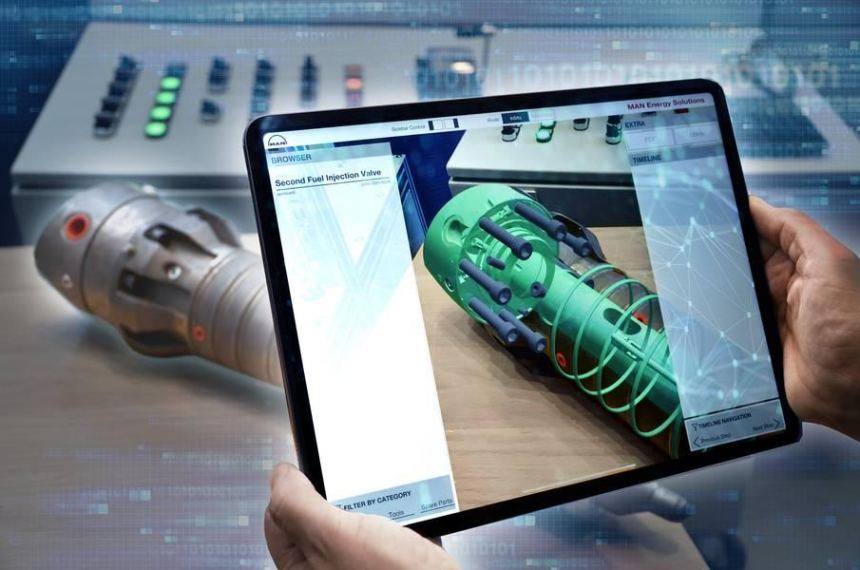
Fuel pump → component identification → operating parameters → dismantling sequence → clearances → maintenance instructions
The engineer can therefore see the actual machinery and digital maintenance guidance simultaneously.
AR vs VRAR = Real world + virtual information.
VR = Completely computer-generated virtual environment.