Answer
The Code was adopted in 2012 and became effective for applicable ships from 1 July 2014, alongside amendments making noise protection mandatory through SOLAS Chp-2-1.Reg 3-12
Compulsory for ships of 1600gt and above.
The objective is to:
Protect seafarers from hazardous noise exposure and provide acceptable acoustic conditions in working, control and accommodation spaces.
Measurement method are:
1. In machinery spaces:1.2 m sitting and 1.6 m standing above the Deck platform 1m from running machinery n not greater than 3m . Horizontal distance between two measuring pts not to be greater than 2m. 0.5m from side margin.
2. In accommodation spaces: 40% of the total accommodation spaces.
1 measurement in the middle of the room moving the sensor vertically and horizontally 1m.
Measurement at unoccupied spaces far from machinery atleast 3 microphone readings.
3. On Deck it should be taken on leeward side.
Internal Conditions-
At sea:
Measurements should be taken with ME running at 80% MCR , all emergency and navigation equipment running
all doors and windows of compartments shut,
ventilation and heaters running,
if ship is fitted with bow thrusters then thruster run with 40% power.
At port:
With all cargo equipment running as well as machinery running required for cargo handling must be running.
External condition:
Wind force:4
Wave height -1 MTR
Depth not less than 5 times the draft.
Noise levels of ship
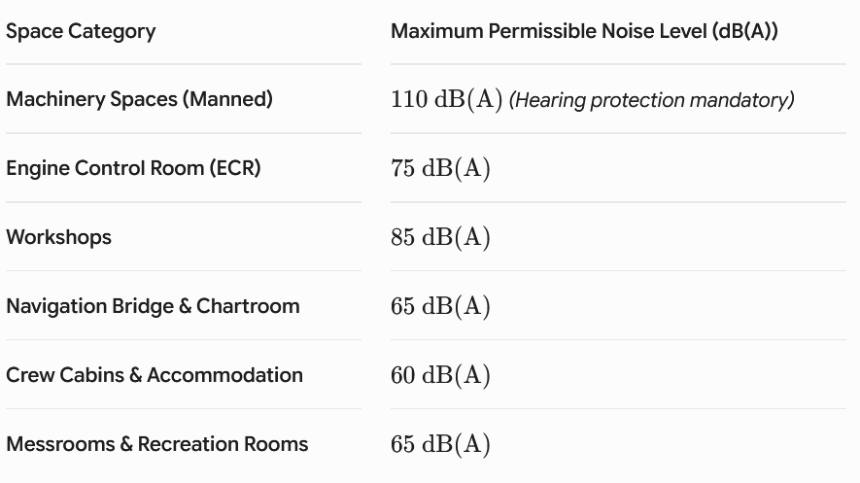
24-Hour Exposure Limit: The equivalent continuous noise exposure (L ex, 24h) for any seafarer must not exceed 80 dB(A).
Mandatory Hearing Protection Zones:
> 85 dB(A): Warning signs posted at entrances; hearing protection (ear defenders/plugs) must be provided and worn.
> 110 dB(A): Unprotected exposure is strictly forbidden. Double hearing protection (earplugs + muffs) is required for limited entry.
Absolute Ceiling (120 dB(A)): No entry permitted regardless of PPE worn.
Noise Survey Report: A comprehensive survey must be conducted by qualified personnel using calibrated sound level meters during sea trials under normal operating conditions. The report must be kept permanently on board.
Acoustic Insulation: Requires structural insulation around accommodation trunks, ECR bulkheads, and engine casing spaces to minimize sound transmission.