Answer
Carbon Intensity (CI) is a lifecycle metric that measures the mass of greenhouse gases—expressed in grams of carbon dioxide equivalent (g CO2eq)—emitted per unit of energy produced (MJ) or per unit of transport work executed (dwt⋅nautical mile).
Under MARPOL Annex VI and the IMO Lifecycle Assessment (LCA) Guidelines (Res. MEPC.391(81)), Carbon Intensity is evaluated across two distinct boundaries:
Well-to-Tank (WtT): Emissions generated from feedstock extraction, processing, refining, and transport to the ship.
Tank-to-Wake (TtW): Emissions generated directly on board during fuel combustion/utilization.
Well-to-Wake (WtW): Total lifecycle carbon intensity (WtW=WtT+TtW).
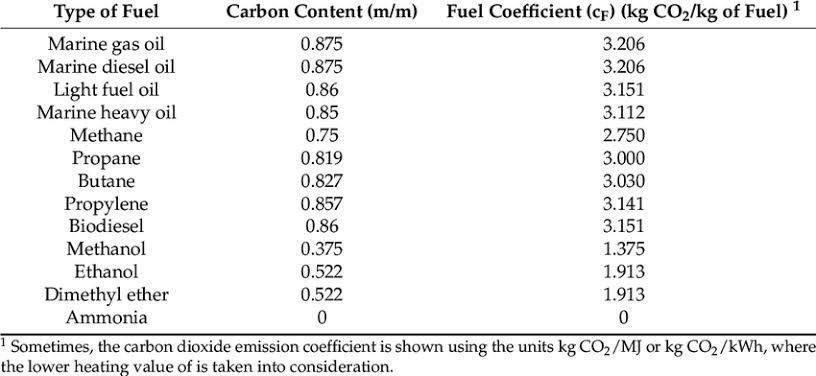
It is crucial to separate Carbon Content (the physical mass percentage of carbon atoms within the fuel molecule) from Carbon Intensity (the actual environmental impact on a lifecycle basis):
Carbon Content (%C by weight): Determines the immediate CO2 conversion factor (CF) when burned.
Carbon Intensity (g CO2eq/MJ): Determines the overall emissions impact per unit of usable energy, taking into account heat content (Lower Heating Value - LHV) and upstream production emissions.