Answer
SEEMP Part I is the Ship Energy Efficiency Management Plan (Operational Measure) required under MARPOL Annex VI, Regulation 26.1.
It is a ship-specific, operational mechanism designed to monitor, track, and continuously improve a vessel's energy efficiency and greenhouse gas (GHG) performance over time.
Application: Applies to all ships of 400 GT and above engaged in international voyages.
Mandatory Entry into Force: Came into effect on January 1, 2013 (amended by Resolution MEPC.346(78) for updated guidelines).
SEEMP Part I is built on a four-stage continuous management methodology:
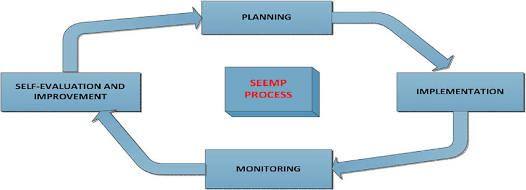
1. Planning Stage
Identify ship-specific measures to reduce fuel consumption and emissions. Common operational practices include:
Voyage Optimization: Weather routing, just-in-time port arrivals, and speed optimization (eco-speed / slow steaming).
Propulsion Management: Hull cleaning schedules, propeller polishing, and anti-fouling coatings.
Engine Room Operational Measures: Boiler optimization, auxiliary generator load management, variable frequency drives (VFDs), and waste heat recovery.
2. Implementation Stage
Establishes clear operational procedures and assigns specific responsibilities to both shore-based management and shipboard personnel (Master, Chief Engineer, Chief Officer) to ensure planned measures are executed effectively.
3. Monitoring Stage
Quantitative tracking of ship energy usage.
Uses tools like the Energy Efficiency Operational Indicator (EEOI) to measure CO2 emitted per unit of transport work:
EEOI= (Fuel Consumed×CF)/ (Cargo Carried×Distance Travelled)
Records quantitative performance metrics during voyages.
4. Self-Evaluation and Improvement Stage
Periodic review (typically annually) comparing actual energy efficiency against set targets to evaluate measure effectiveness, correct deficiencies, and feed updated goals into the next Planning phase.
How SEEMP Part I is Verified1. Initial Verification (Verification of Presence & Plan Adequacy)When: During the initial survey prior to issuing the International Energy Efficiency Certificate (IEEC) (or during a major conversion survey).
Who: Recognized Organization (RO) / Flag State Surveyor.
Unlike SEEMP Part II and Part III (which require annual statements of compliance), Part I does not receive a standalone annual certificate update. Instead, verification is maintained through:
Flag State / RO Audits: Checked during periodical/intermediate/renewal surveys for the IAPP Certificate to ensure the SEEMP Part I remains updated and active on board.
Port State Control (PSC): Inspecting officers verify that SEEMP Part I is on board, customized for the vessel, and accessible to crew members.
Internal & External ISM Audits: Verifies that operational measures listed in the SEEMP (such as hull cleaning, weather routing, and speed management) are actively executed and documented in engine/deck logbooks.
_____________________________________________________________________________________________________
Weather routing is planning the Voyage according to the weather to reduce the fuel consumption
- In this the fuel consumption speed, cargo carrying capacity, and route of the ship are inputs.
- Then the weather routing software will collect real time data of the wind, currents etc from satellites and weather stations.
- Then depending upon this it will plan the route of the ship so as to reduce the fuel consumption as much as possible.
Under SOLAS Chapter V, Regulation 34 (Voyage Planning) and overarching Master’s discretion, the Master evaluates the recommended route against local conditions, passage plan, and safety parameters. The accepted route is programmed into ECDIS as the primary voyage track.
- It will also send weather updates to the ship and then depending upon the weather optimize the route further to reduce the fuel consumption.
WNI is a service provider for Weather routing. Inputs from C/E during reporting- noon/ departure etc. C/P speed, Fuels ROB, Engines consumption and power.