Answer
Warranty – A promise by the assured that a specified set of affairs will continue to exist for the duration of an Insurance policy. Warranty is the statement by which insured promises to do or not do specific things during an Insurance policy. The policy becomes void if warranty is broken.
Warranty Types
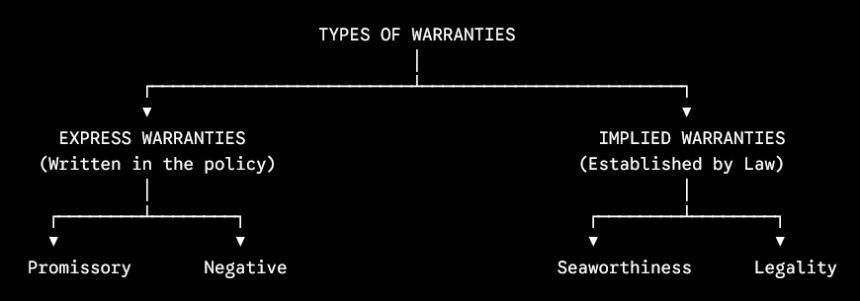
Express Warranty
Undertaking that is clearly mentioned in written form in the policy or associated policy papers. These are deliberately drafted & agreed upon by both the insured & the insurer. These provide clarity & specificity, ensuring both parties understand the obligations & limitations associated with insurance contract.
Promissory Warranties: Assured promises to do something (e.g., "Warranted vessel shall maintain Class with Lloyd’s Register throughout the policy period").
Negative Warranties: Assured promises NOT to do something (e.g., "Warranted no passage north of 70°N latitude between 1st November and 1st April").
These are unwritten obligations that form integral part of insurance contract, even though they are not explicitly mentioned. For the insurance policy to remain valid, the insured is expected to comply with all conditions & act in utmost good faith.
This is not given in the policy papers but is self-understood by the law.
Below are its types-
- Warranty of seaworthiness – A Vessel to be seaworthy at the commencement of a Voyage.
- Warranty of legality – There is an implied warranty that the adventure insured is lawful one and that so far as the assured can control the matter, the adventure shall be carried out in a lawful manner. Smuggling, drug and human trafficking are illegal and the policy becomes void if such activities exist.
Disbursement Warranty
A Disbursement Warranty is a standard restrictive provision in a Hull & Machinery (H&M) policy that limits the maximum amount of "additional" or secondary insurance the shipowner can purchase on the vessel.
Why does insurer impose Disbursement Warranty?
Three major reasons:
1. Prevent over-insurance
The owner should not receive an excessive amount following total loss. Permitted up to 25% of the insured value of the vessel.
2. Preserve insurable interest / indemnity principle
Insurance should compensate a genuine financial loss, not create a profit from casualty.
3. Reduce moral hazard
If the vessel is insured for substantially more than its economic value, deliberate destruction or abandonment could become financially attractive.